Facts
The applicant, Chandan Ghosh, filed an Original Application (O.A. 350/01361/2021) challenging a departmental charge sheet dated January 12, 2021, and a decision regarding a bias petition against the Enquiry Officer.
Source reference: p. 2The Tribunal dismissed the O.A. on November 14, 2025, finding no infirmity in the proceedings or the disposal of the bias petition by the Director of Postal Services.
Source reference: p. 2, para. 10-12The applicant subsequently filed the instant Review Application (R.A.) seeking a review of the dismissal, primarily arguing that the bias petition should have been decided by the Disciplinary Authority (Superintendent of Post Offices) rather than the Reviewing/Appellate Authority (Director of Postal Services).
Source reference: p. 2-3, para. 3Issues
1. Whether there exists any error apparent on the face of the record or discovery of new evidence sufficient to warrant a review of the Tribunal's order dated 14.11.2025 under Section 22(3)(f) of the Administrative Tribunals Act, 1985.
Source reference: p. 3, para. 42. Whether the Director of Postal Services, acting as the appellate authority, committed a legal error by disposing of the bias petition, thereby bypassing the Disciplinary Authority.
Source reference: p. 2, para. 3Law Applied
Section 22(3)(f) of the Administrative Tribunals Act, 1985, which grants the Tribunal power to review its decisions, a power analogous to Order 47 Rule 1 of the Code of Civil Procedure (CPC).
Source reference: p. 3-5, para. 5Review is permissible only upon: (i) discovery of new/important matter, (ii) mistake or error apparent on the face of the record, or (iii) any other sufficient reason.
Source reference: p. 4, para. 5Doctrine from Gopal Singh v. State Cadre Forest Officers' Assn. [(2007) 9 SCC 369] regarding the scope of review; Aribam Tuleshwar Sharma v. Aribam Pishak Sharma [AIR 1979 SC 1047], which distinguishes review from appeal; Parsion Devi v. Sumitri Devi [(1997) 8 SCC 715], holding that an erroneous decision cannot be "reheard/corrected" under review; and State of West Bengal v. Kamal Sengupta [(2008) 8 SCC 612], defining the strict limits of "error apparent" and "sufficient reason".
Source reference: p. 4-5Reasoning
The Tribunal observed that the grounds raised in the review application—specifically the procedural challenge to the Director of Postal Services' authority to decide the bias petition—had already been considered during the original adjudication of the O.A.
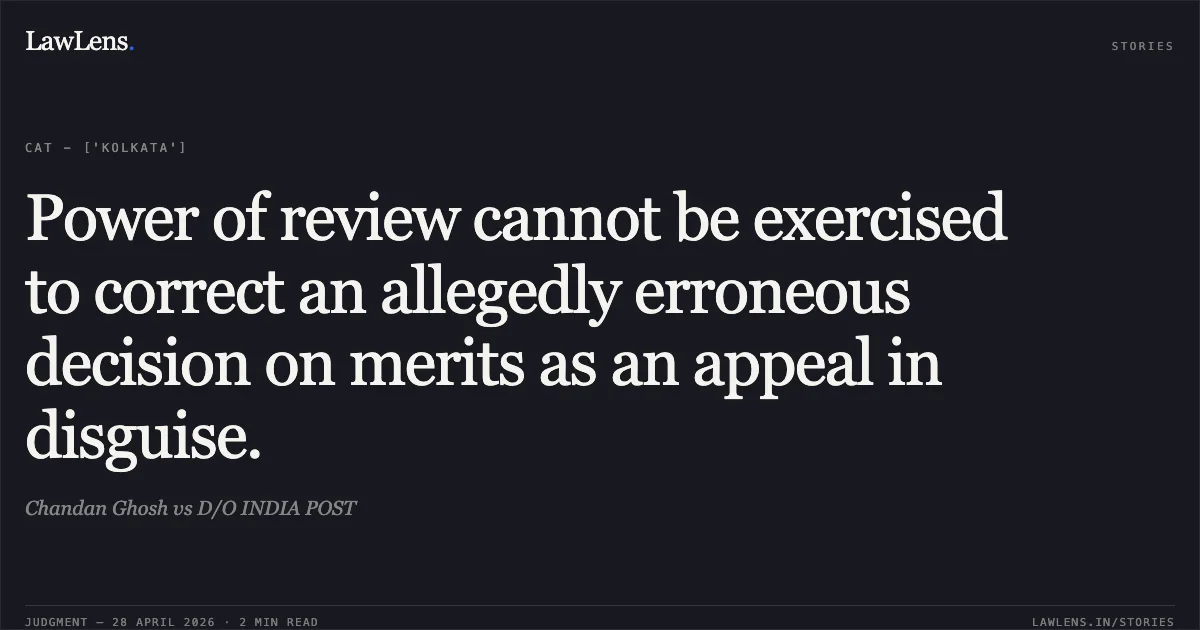
Source reference: p. 3, para. 4The Bench reasoned that a review is not an "appeal in disguise" and cannot be used to re-argue the merits of a case or correct an allegedly erroneous decision.
Source reference: p. 4-5The applicant failed to produce any new or important evidence that was previously unavailable despite due diligence, nor could the applicant demonstrate a self-evident error on the face of the record that did not require a "long process of reasoning" to discover.
Source reference: p. 3, 5The Tribunal maintained that the disposal of the bias petition by the Director of Postal Services did not constitute a patent illegality warranting the exercise of limited review jurisdiction.
Source reference: p. 2, 6Holding
The Tribunal found no merit in the review application as it failed to satisfy the statutory criteria under Order 47 Rule 1 of the CPC. The Tribunal held that the applicant was seeking a rehearing of the case under the guise of a review.
The Review Petition was dismissed. In a preliminary matter, the Miscellaneous Application for condonation of delay (M.A. 350/00341/2026) was allowed.
Source reference: p. 1, 6Acts & Sections Cited
3 provisions across 2 statutes referred to in this judgment. Each provision opens on LawLens.
Code of Civil Procedure, 19082
Administrative Tribunals Act, 19851
Original Court PDF
Chandan GhoshvsD/O INDIA POST
Click to open original judgment
Original judgment, available to read, download and summarize on LawLens.in