Facts
The Appellant, a solar power developer, entered into a Power Purchase Agreement (PPA) with Respondent No. 2 (PSPCL) on March 31, 2015, to establish 10 MW of rooftop solar projects
Source reference: p.6The PPA required commissioning within 10 months of execution
Source reference: p.6However, the PPA was only approved by the Regulatory Commission on May 11, 2015
Source reference: p.7Subsequent delays occurred due to site identification disputes, technical concurrences, and grid feasibility clearances, which were finalized between October and December 2015
Source reference: p.7-10The Appellant sought an extension of the Scheduled Commercial Operation Date (SCOD) and the original tariff of Rs. 7.59/kWh, citing Force Majeure events
Source reference: p.11The State Commission condoned only 29 days of delay, leading to a tariff reduction to Rs. 5.09/kWh
Source reference: p.12Issues
1. Whether the 41-day period between the signing of the PPA and its approval by the Commission constitutes a valid ground for extending the SCOD
Source reference: p.12 / para. 262. Whether the lack of a formal Force Majeure notice precludes the Appellant from claiming relief for delays caused by the PPA approval process
Source reference: p.41 / para. 493. Whether the delays in grid connectivity and supplementary PPA execution were properly assessed by the lower Commission
Source reference: p.45 / para. 544. Whether the "Jat agitation" qualifies as a Force Majeure event in the absence of a contractual notice
Source reference: p.49 / para. 61Law Applied
The court applied Section 86(1)(b) of the Electricity Act, 2003, which empowers State Commissions to regulate electricity procurement and price, and Regulation 46 of the PSERC (Conduct of Business) Regulations, 2005, which mandates Commission approval for long-term power purchase commitments
Source reference: p.28-30The tribunal relied on Tata Power Co. Ltd. v. Reliance Energy Ltd. (2009) regarding the necessity of Commission approval for PPAs to be enforceable
Source reference: p.31Regarding Force Majeure notices, the court considered the strict compliance rule established in Chamundeshwari Electricity Supply Co. Ltd. v. Sai Sudhir Pvt. Ltd. (2025), which dictates that notice is a condition precedent unless the counterparty has inherent knowledge of the event
Source reference: p.41-44Reasoning
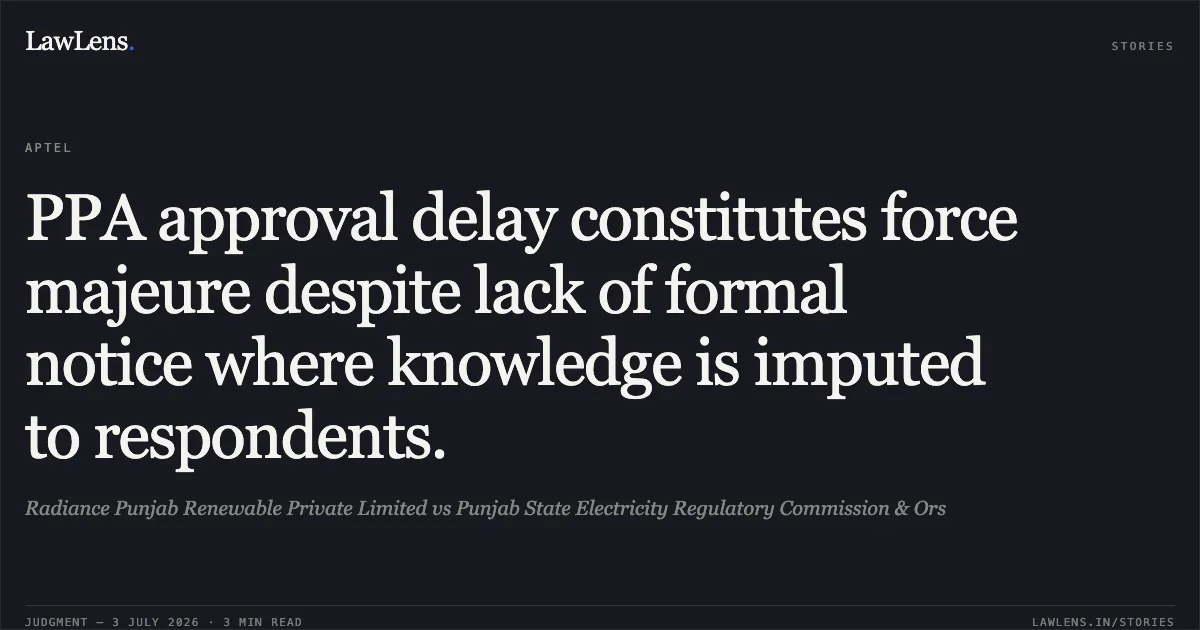
The Tribunal reasoned that a PPA is "only a piece of paper" until approved by the Commission; thus, the "Effective Date" for calculating commissioning timelines must be the date of approval (May 11, 2015) rather than the date of signing (March 31, 2015)
Source reference: para. 48Although the Appellant failed to issue a formal Force Majeure notice for this 41-day delay, the Tribunal carved out an exception: because the duty to seek PPA approval lay with the Respondent and the facts were within the Respondent's direct knowledge, a formal notice was a mere formality
Source reference: para. 52-53Conversely, the Tribunal upheld the Commission's calculation of 21–29 days of delay for grid connectivity, finding the timeline for administrative concurrence reasonable
Source reference: para. 58-60Finally, the claim regarding the "Jat agitation" was rejected because it was an external event requiring strict adherence to the contractual notice period under Article 10.4 of the IA, which the Appellant failed to provide
Source reference: para. 63Holding
The Tribunal set aside the impugned order in part, holding that the Appellant is entitled to a 41-day extension of the SCOD due to the regulatory delay in PPA approval
The findings regarding grid connectivity delays were affirmed, while the claim for the Jat agitation was dismissed. The case was remanded to the Commission to recompute the delay for each of the nine project sites by incorporating the 41-day credit and to determine the resulting tariff accordingly
Source reference: para. 64-65Acts & Sections Cited
6 provisions across 2 statutes referred to in this judgment. Each provision opens on LawLens.
Electricity Act, 20034
KARNATAKA ELECTRICITY REFORM ACT, 19992
Original Court PDF
Radiance Punjab Renewable Private LimitedvsPunjab State Electricity Regulatory Commission & Ors
Click to open original judgment
Original judgment, available to read, download and summarize on LawLens.in