Facts
The petitioners, claiming to be erosion-affected and landless, occupied separate portions of Government land measuring approximately 1 Katha 5 Lechas each in Dag No. 97, Ulubari, Guwahati, after relying on unregistered deeds of sale executed in 1992.
Source reference: pp. 5–8, paras. 6–8They constructed residential houses and later sought settlement of the land under the Assam Land Policy, 2019. Although the Sub-Divisional Land Advisory Committee approved their proposals in 2020, no lease was issued in their favour.
Source reference: pp. 5–8, paras. 6–8Notices were subsequently issued under Rule 18 of the Settlement Rules alleging encroachment over land reserved first for T.B. Hospital and subsequently for Pragjyotishpur Medical College and Hospital.
Source reference: pp. 8–14, paras. 9–18Pursuant to an earlier judgment, the petitioners submitted replies claiming a bona fide right to remain in possession; however, their claims and settlement applications were rejected by speaking orders dated 12 June 2026.
Source reference: pp. 8–14, paras. 9–18In the connected writ petition, WP(C) No. 3875/2026, they challenged the disconnection of electricity to their houses on 5 June 2026 and sought restoration of supply.
Source reference: p. 14, para. 19Issues
1. Whether the petitioners had a bona fide claim of right or any enforceable right to remain in occupation of Government land covered by Dag No. 97.
Source reference: p. 19, para. 25(i)2. Whether the speaking orders dated 12 June 2026, rejecting the petitioners’ objections and settlement claims, required interference.
Source reference: p. 29, para. 41; p. 19, para. 25(ii)3. Whether the petitioners were entitled to restoration of electricity supply to their houses.
Source reference: pp. 14, 37, paras. 19, 584. What relief, including consideration for settlement of alternative Government land, should be granted to the petitioners.
Source reference: p. 33, para. 52; p. 19, para. 25(iii)Law Applied
The Court applied Rule 15 of the Assam Land and Revenue Regulation Settlement Rules, under which mere occupation of Government land does not confer a right to settlement.
Source reference: pp. 20–21, paras. 27–28Rule 16 prohibits entry into waste land without a lease or written permission from the Deputy Commissioner, while Rule 18 authorises eviction proceedings in appropriate cases.
Source reference: p. 22, paras. 29–30The Court applied the Assam Land Policy, 2019: Clause 14.2 prescribes the general eligibility conditions for settlement in Guwahati or urban areas; Clause 14.3 clarifies that mere occupation, regardless of its duration, does not create an entitlement to settlement; and Clause 14.4 creates a limited relaxation for eligible indigenous landless persons continuously occupying Government land since or before 28 June 2001.
Source reference: pp. 24–32, paras. 35–36, 43–50The Court relied on Md. Salak Uddin v. State of Assam, 2024 SCC OnLine Gau 921, holding that land reserved for public purposes is generally outside the settlement scheme, while administrative discretion to settle or evict remains subject to proportionality.
Source reference: pp. 22–26, paras. 32–37It also followed Monmil Boro v. State of Assam, 2025 SCC OnLine Gau 4901, which held that land reserved for a hospital or medical college could not be settled with encroachers, although rehabilitation or consideration of alternative land could separately be examined.
Source reference: pp. 27–28, 33–36, paras. 39, 53–55Reasoning
The Court held that the unregistered deeds could, at most, be used collaterally to indicate possession and could not confer title or a right to settlement.
Source reference: p. 20, para. 26Since the petitioners had neither leases nor written permission to occupy the land, and Dag No. 97 was reserved for the essential public purpose of expanding and providing logistical facilities, including parking, for Pragjyotishpur Medical College and Hospital, their occupation was unauthorised and they had no bona fide claim of right against eviction.
Source reference: pp. 21–28, paras. 31–40The public purpose had a rational connection with the proposed eviction and satisfied proportionality.
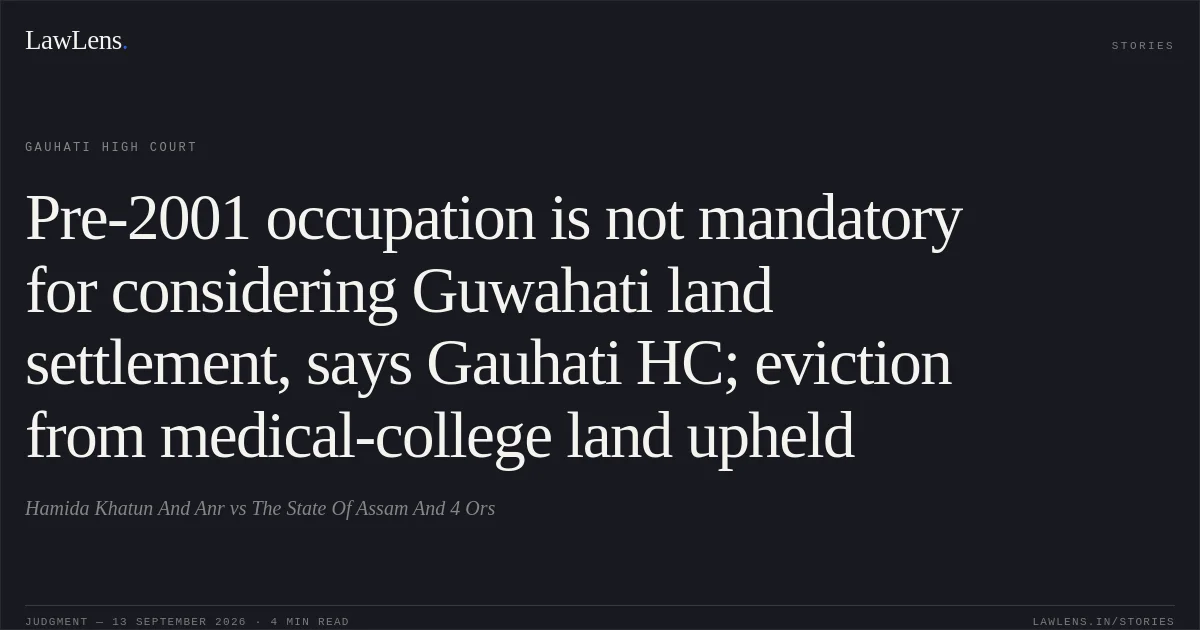
Source reference: pp. 26–27, para. 38However, the Court found that the authorities had incorrectly treated occupation before 28 June 2001 as a mandatory prerequisite for every urban settlement application.
Source reference: pp. 31–33, paras. 46–50Clause 14.4 only relaxes the homestead-land requirement under Clause 14.2 where that condition is satisfied; failure to satisfy Clause 14.4 does not independently bar consideration under Clause 14.2.
Source reference: pp. 31–33, paras. 46–50Accordingly, the speaking orders were upheld insofar as they directed eviction from Dag No. 97 but were set aside to the limited extent that they rejected the petitioners’ applications for settlement altogether.
Source reference: pp. 37–40, paras. 59(iii), 59(vi)–(xii)The applications were to be reconsidered for other waste land in Guwahati, not for Dag No. 97.
Source reference: pp. 37–40, paras. 59(iii), 59(vi)–(xii)Since the petitioners had no lawful right to continue in possession, restoration of electricity was also refused.
Source reference: p. 42, para. 59(xiv)Holding
The Court held that the petitioners had no bona fide claim of right to remain on Dag No. 97 and that they could be evicted under Rule 18 of the Settlement Rules.
The speaking orders dated 12 June 2026 were upheld concerning eviction but partly interfered with insofar as they rejected the settlement applications in their entirety.
Source reference: pp. 37–38, paras. 59(i)–(vi)The District Commissioner and Revenue Department were directed to reconsider the petitioners’ applications for settlement of other waste land in Guwahati, applying Clauses 14.2 and 14.4 of the Assam Land Policy, 2019, without treating the direction as an entitlement to settlement or rehabilitation.
Source reference: pp. 39–41, paras. 59(vii)–(xii)The petitioners were granted 30 days to vacate Dag No. 97, failing which eviction could be carried out.
Source reference: p. 41, para. 59(xiii)They were given 15 days to submit additional documents, and the authorities were directed to complete reconsideration within 45 days of receiving the certified judgment.
Source reference: p. 40, paras. 59(ix)–(xi)Restoration of electricity was denied, and both writ petitions were disposed of without costs.
Source reference: p. 42, paras. 59(xiv)–(xv)Acts & Sections Cited
2 provisions across 2 statutes referred to in this judgment. Linked provisions open on LawLens.
Assam Land Policy, 20191
the Act (alias, unresolved)1
Original Court PDF
Hamida Khatun And AnrvsThe State Of Assam And 4 Ors
Click to open original judgment
Original judgment, available to read, download and summarize on LawLens.in