Facts
The appellant, formerly known as M/s. Laser World (P) Ltd., was engaged in providing Business Auxiliary Service and exported output services.
Source reference: para. 2For the period January–March 2010, it claimed a refund of ₹29,94,464 under Rule 5 of the CENVAT Credit Rules, 2004, representing accumulated and unutilised CENVAT credit on input services used for exported services.
Source reference: para. 2The adjudicating authority sanctioned ₹22,47,988 and rejected ₹7,46,476, comprising ₹4,76,014 relating to Group Insurance and Club Services and ₹2,48,860 relating to services pertaining to a period after 31 March 2010.
Source reference: para. 2The rejection was upheld by the Commissioner (Appeals), leading to the present appeal.
Source reference: para. 2The change in the appellant’s name from M/s. Laser World (P) Ltd. to M/s. SPI Technologies India Pvt. Ltd. had earlier been permitted by the Tribunal.
Source reference: para. 1Issues
1. Whether Group Insurance and Club Services were eligible as “input services” under Rule 2(l) of the CENVAT Credit Rules, 2004, as applicable before 1 April 2011, and consequently refundable under Rule 5?
Source reference: para. 5(i)2. Whether ₹2,48,860 relating to services pertaining to a period after 31 March 2010 could be included in the refund claim for January–March 2010?
Source reference: para. 5(ii)Law Applied
The Tribunal applied Rule 2(l) of the CENVAT Credit Rules, 2004, as it stood during January–March 2010, when the definition of “input service” included services used directly or indirectly in or in relation to business and was wider than the definition applicable from 1 April 2011.
Source reference: para. 6It relied on CCE, Nagpur v. Ultratech Cement Ltd., 2010 (260) E.L.T. 369 (Bom.), which held that “activities relating to business” had a wide scope; Reliance Industries Ltd. v. Commissioner, Central Excise & Service Tax (LTU), Mumbai, 2015 (42) S.T.R. 384 (Tri.-Mumbai); and the Larger Bench decision in Tata Teleservices (Maharashtra) Ltd. v. Commissioner, Service Tax, Mumbai-II, 2024 (16) Centax 160 (Tri.-LB), which recognised that employee group insurance could fall within the pre-1 April 2011 definition.
Source reference: paras. 7–8For Club Services, the Tribunal applied Vinayak Steels Ltd. v. CCE & ST, Hyderabad, 2017 (7) TMI 346 (CESTAT Hyderabad) and Emco Ltd. v. Commissioner of Central Excise, Mumbai-III, 2023 (5) TMI 379 (CESTAT Mumbai), under which club membership could qualify where actual business use, such as customer entertainment or business meetings, was established.
Source reference: para. 9Rule 5 permits refund only of eligible accumulated CENVAT credit attributable to the relevant refund period; credit relating to a subsequent period could not be included without proof that it formed part of the eligible balance for January–March 2010.
Source reference: para. 12Reasoning
The Tribunal held that the rejection of Group Insurance solely because it was an employee-welfare service or lacked a direct nexus with the exported output service was inconsistent with the wider pre-1 April 2011 definition of “input service” and the authorities recognising group insurance as an eligible business-related service.
Source reference: paras. 6–8However, the appellant failed to produce material showing that the Club Services were used for business purposes such as entertaining customers, conducting business meetings, or sales activities.
Source reference: para. 9The factual basis recorded by the lower authority showed use for health, fitness, and recreational activities; accordingly, the precedents relied upon by the appellant were distinguishable.
Source reference: paras. 9–10The Tribunal further found that the ₹2,48,860 related to services after 31 March 2010 and that the appellant had not established that this amount formed part of the eligible accumulated credit for the January–March 2010 refund period.
Source reference: para. 12It therefore could not be included in the present Rule 5 claim.
Source reference: para. 12Holding
The appeal was partly allowed by way of remand.
The rejection of the Group Insurance component was set aside, and the matter was remanded to the adjudicating authority to verify the precise eligible amount and sanction consequential refund under Rule 5, subject to the remaining statutory requirements.
Source reference: para. 14The rejection of the Club Services component and ₹2,48,860 relating to services after 31 March 2010 was upheld.
Source reference: para. 15Consequential relief, if any, was directed to be granted in accordance with law.
Source reference: para. 15Original Court PDF
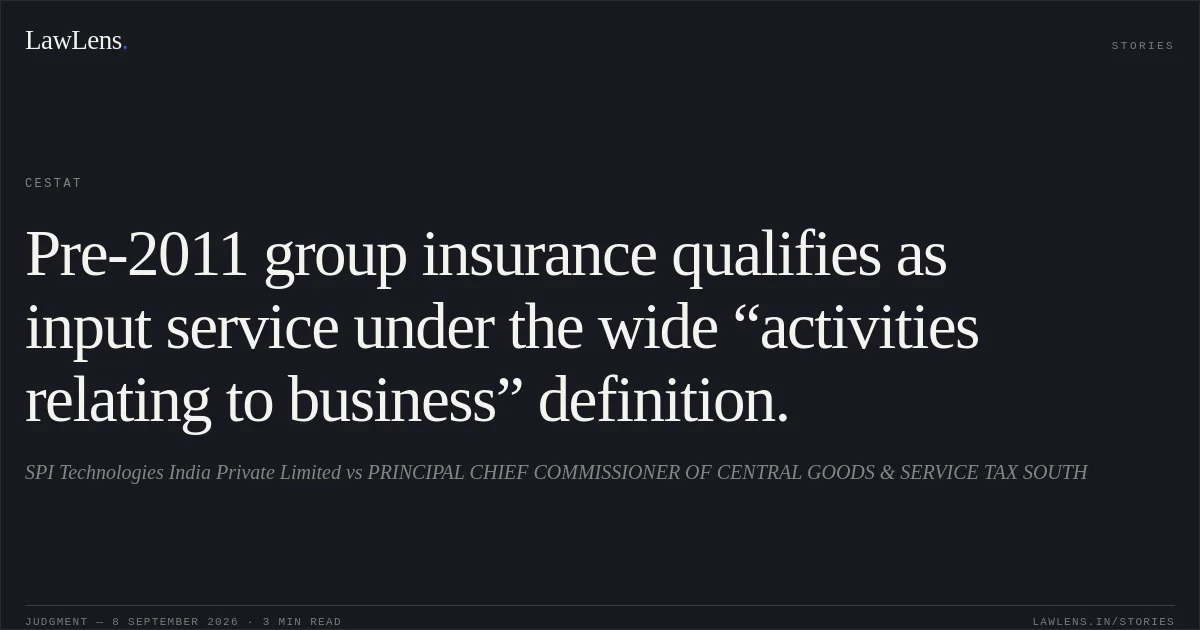
SPI Technologies India Private LimitedvsPRINCIPAL CHIEF COMMISSIONER OF CENTRAL GOODS & SERVICE TAX SOUTH
Click to open original judgment
Original judgment, available to read, download and summarize on LawLens.in
![Pay fixation under Rule 11, not Rule 7, applies to employees promoted before revised-pay adoption who opted from promotion date.. ANIL KUMAR & ORS vs General Manager N C Rly. CAT - ['Allahabad']. LawLens](/stories/thumbnails/pay-fixation-under-rule-11-not-rule-7-applies-to-employees-promoted-before-revised-pay-ado-ff90b7d9eeba468e8f873872fd10d767.webp)
![Post-acquittal representation against dismissal must be considered under Rule 12 by the competent authority.. VINIT YADAV vs HOME AFFAIRS. CAT - ['Delhi']. LawLens](/stories/thumbnails/post-acquittal-representation-against-dismissal-must-be-considered-under-rule-12-by-the-co-c979b525ee9a4311a0f3bf3d9621b50c.webp)