01Facts
The petitioner filed its return for Assessment Year (A.Y.) 2017–18 on 1 August 2017, declaring total income of ₹4,73,481; no scrutiny assessment was conducted and the return was accepted.
¶ 2 · p. 1A survey under Section 133A of the Income Tax Act, 1961 was conducted at the premises of Shripal Vrajlal Vora on 14 December 2016, which was converted into a search under Section 132 on 16 December 2016.
¶ 5 · p. 3Based on documents allegedly seized during the search, the Revenue alleged that the petitioner had received an accommodation entry of ₹1,33,72,000 from entities controlled by Shripal Vora during F.Y. 2016–17.
¶ 2.1, 5.1 · p. 1, 4The petitioner was first issued a notice under Section 148 dated 28 April 2021 and subsequently a notice under Section 148A(b) dated 30 May 2022. The petitioner’s objections were rejected, resulting in an order under Section 148A(d) dated 31 July 2022 and a notice under Section 148 issued on the same date.
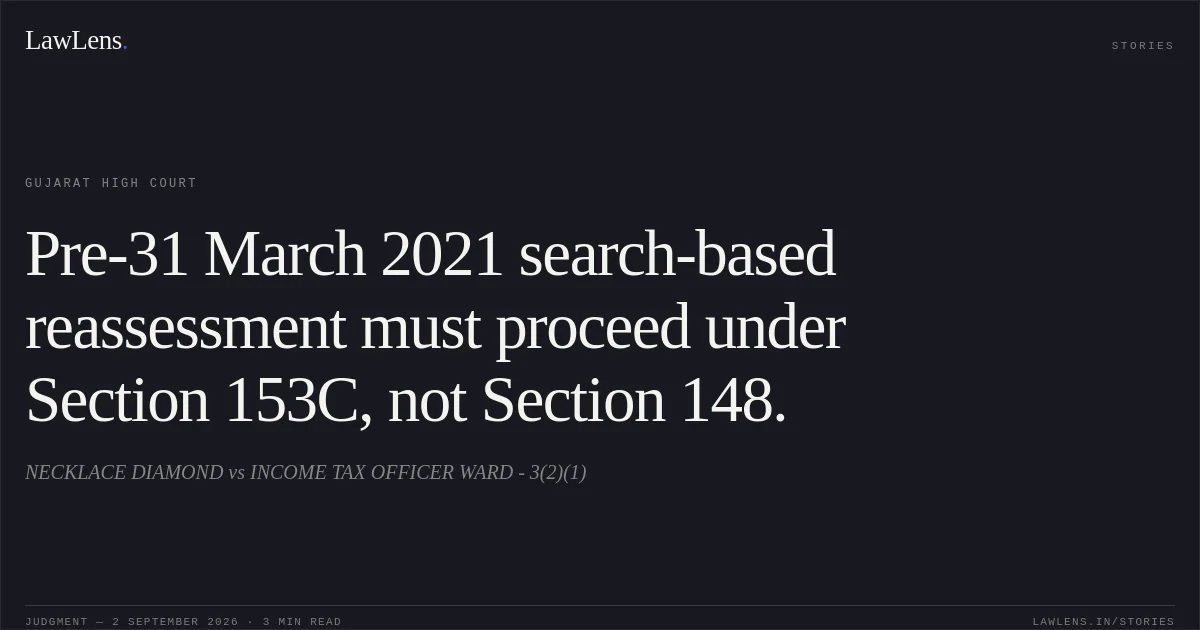
¶ 2–2.1 · p. 1The petitioner challenged the order and notice, contending that, since the reassessment was based on material seized during a search initiated before 31 March 2021, the Revenue could proceed only under Section 153C and not Sections 147/148.
¶ 3 · p. 202Issues
i.1. Whether the Assessing Officer could invoke Sections 147/148 of the Income Tax Act to reopen the petitioner’s assessment on the basis of incriminating material found during a search conducted under Section 132 against another person.
¶ 5–7 · pp. 3–5ii.2. Whether, in view of the second proviso to Section 149(1), a notice under Section 148 could be issued for A.Y. 2017–18 where the search under Section 132 had been initiated before 31 March 2021 and proceedings under Section 153C were the applicable statutory mechanism.
¶ 8–9 · pp. 5–603Law Applied
The Court applied Sections 147/148 of the Income Tax Act, which govern reassessment for income escaping assessment, and Section 153C, which provides the special assessment mechanism for a person other than the searched person when seized material belongs or relates to that person.
¶ 6–7 · pp. 4–5It relied on Section 149(1), particularly its second proviso, which provides that the limitation provisions for notices under Section 148 do not apply where notice under Section 153A or Section 153C read with Section 153A is required in relation to a search initiated under Section 132 or requisition under Section 132A on or before 31 March 2021.
¶ 8 · p. 5The Court followed Paras Chandreshbhai Koticha v. Income Tax Officer, Ward–1(2)(2), Special Civil Application No. 17933 of 2018 and allied matters, decided on 7 January 2026, which held that where the Assessing Officer relies on incriminating search material and records the requisite satisfaction, the appropriate course is to proceed under Section 153C, not Sections 147/148; Sections 147/148 remain available only on the basis of independent, post-search material.
¶ 6 · pp. 4–5Provisions in the judgment · 9
Income Tax Act, 1961 9 provisions
Section 132Section 132ASection 133ASection 147Section 148Section 148ASection 149Section 153ASection 153C04Reasoning
The Court found that the Revenue’s reopening was admittedly founded on documents and information obtained during the search under Section 132 conducted against Shripal Vora.
¶ 5–5.1 · p. 3Applying the principle in Paras Chandreshbhai Koticha, the Court held that search-based incriminating material cannot be used to bypass the special procedure under Section 153C by issuing a notice under Section 148.
¶ 6–7 · pp. 4–5Since the search had been initiated on 16 December 2016—well before 31 March 2021—the second proviso to Section 149(1) applied. Consequently, the ordinary reassessment route under Section 148 was unavailable in the circumstances, and the Revenue’s reliance on Sections 147/148 was legally impermissible.
¶ 8–9 · pp. 5–605Holding
The Court answered the issues in favour of the petitioner. It held that the Revenue could not reopen the petitioner’s assessment under Sections 147/148 on the basis of incriminating material seized during the pre-31 March 2021 search; the applicable statutory route was Section 153C.
¶ 7–9 · pp. 5–6The order under Section 148A(d) dated 31 July 2022 and the consequential notice under Section 148 were quashed and set aside. The writ petition was allowed, the Rule was made absolute, and no order as to costs was made.
¶ 9 · p. 6Original Court PDF
NECKLACE DIAMONDvsINCOME TAX OFFICER WARD - 3(2)(1)
Click to open original judgment
Original judgment, available to read, download and summarize on LawLens.in