Facts
Respondent No. 1, Vishwanath Singh, claimed rights over land comprised in old Khasra No. 386/new Khasra Nos. 630 and 631, measuring approximately 1.19 acres.
Source reference: paras. 2–3His father allegedly possessed the land from the pre-Independence period, using part of it for residential purposes and cultivating the remaining portion.
Source reference: paras. 2–3, 13–14The claim was based on long possession, historical revenue entries, municipal assessment records, and alleged rights as a Gair Haqdar Kashtkar under the Rewa State Land Revenue and Tenancy Code, 1935.
Source reference: paras. 2–3, 13–14The Sub-Divisional Officer, Huzur, allowed the claim on 29 December 1993 and directed that the respondent’s name be recorded as Bhumiswami.
Source reference: para. 3The Collector affirmed the decision on 5 March 2002.
Source reference: para. 3Subsequently, the Commissioner, exercising revisional jurisdiction, directed that 0.19 acre be recorded in the name of the Public Works Department on 1 February 2005.
Source reference: para. 3The Board of Revenue thereafter set aside the SDO’s order, principally on the ground that the State had not been afforded an effective opportunity of hearing, and directed that the land be recorded in the name of the PWD.
Source reference: para. 3The learned Single Judge allowed the writ petition on 22 July 2022, restored the orders of the SDO and Collector, and held that the revisional power had been exercised after an unreasonable delay of approximately 11–12 years.
Source reference: para. 3The State filed the present writ appeal with a delay of 855 days.
Source reference: paras. 1–2 of the order preceding the appealIssues
Whether the State’s delay of 855 days in filing the writ appeal ought to be condoned on the ground of sufficient cause?
Source reference: paras. 1–2 of the order preceding the appealWhether the respondent or his predecessor acquired rights as a Gair Haqdar tenant and consequently Bhumiswami rights under Section 158(1)(d)(ii) of the M.P. Land Revenue Code, 1959, read with Section 57(4) of the Rewa State Land Revenue and Tenancy Code, 1935?
Source reference: paras. 15–18, 21–24Whether Section 57(1) of the M.P. Land Revenue Code, 1959 could be invoked to defeat rights allegedly subsisting before the commencement of the Code?
Source reference: paras. 19–23Whether the Commissioner and Board of Revenue validly exercised revisional jurisdiction after an inordinate delay of approximately 11–12 years?
Source reference: paras. 10–11, 18, 25–26Whether the disputed land was Government/PWD land or land acquired or required for a Government or public purpose so as to exclude the respondent’s claim under Section 158(1)(d)(ii)?
Source reference: para. 24Law Applied
The Court applied Section 57(1) of the M.P. Land Revenue Code, 1959, which declares State ownership over lands but expressly preserves rights subsisting at the commencement of the Code.
Source reference: paras. 19–20Section 57(2), as it stood when the proceedings were initiated in 1993, conferred jurisdiction on the State Government to decide disputes concerning rights claimed against the State.
Source reference: para. 22Section 158(1)(d)(ii) confers Bhumiswami status on a person holding land in the Vindhya Pradesh region as a Gair Haqdar tenant, provided the land is not a grove, tank, or land acquired or required for Government or public purposes.
Source reference: para. 21Section 57(4) of the Rewa State Land Revenue and Tenancy Code, 1935 entitled a Gair Haqdar tenant occupying land with the express or implied consent of the competent authority or recorded holder to be recorded as a Pattedar tenant and obtain a patta.
Source reference: para. 15The Court held that a written patta was not indispensable where long and undisturbed possession established implied consent.
Source reference: para. 16It also relied on Mohammad Kavi v. Fatima Bai Ibrahim, 1997 (6) SCC 71, and the Full Bench decision in Ranveer Singh (since deceased) through LRs Kishori Singh v. State of M.P., 2010 (4) MPLJ 178, for the principle that suo motu revisional powers must be exercised within a reasonable period.
Source reference: para. 11Reasoning
The Court found that the historical revenue records, settlement entries, municipal assessment, continuous cultivation, and long possession established an uninterrupted chain of possession and recorded rights in favour of the respondent and his father.
Source reference: paras. 13–14, 17The absence of a formal patta did not defeat the claim because Section 57(4) of the Rewa Code recognised express or implied consent, and the prolonged, undisturbed possession supported an inference of implied consent.
Source reference: para. 16The proviso to Section 57(1) of the MPLRC protected rights existing before the Code came into force; therefore, the State could not rely on the general declaration of State ownership to extinguish the respondent’s pre-existing rights.
Source reference: paras. 19–23The Court further held that mere mutation in favour of the PWD did not establish Government ownership.
Source reference: para. 24The land had not been shown to have been acquired for, or actually occupied by, the PWD, nor was it proved to be required for a Government or public purpose.
Source reference: para. 24Finally, the Commissioner and Board of Revenue had interfered with the SDO’s order after an unreasonable delay of approximately 11–12 years, rendering the exercise of revisional power impermissible under the applicable reasonable-time principle.
Source reference: paras. 11, 18The Court therefore found no error in the Single Judge’s interference with the revisional orders.
Source reference: para. 25Holding
The application for condonation of delay was allowed, and the delay of 855 days was condoned because the State had shown sufficient cause and there was no indication of deliberate or mala fide delay.
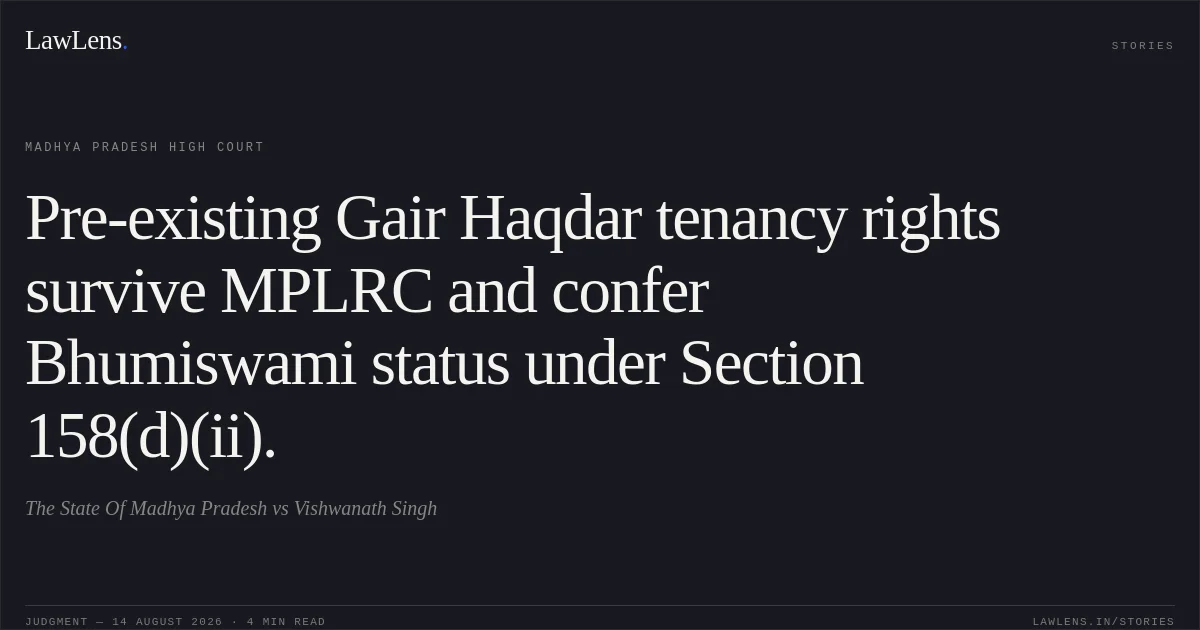
On the merits, the Division Bench held that the respondent’s pre-existing rights and status as a Gair Haqdar tenant were protected and that he had acquired Bhumiswami rights under Section 158(1)(d)(ii) of the MPLRC read with Section 57(4) of the Rewa Code.
Source reference: paras. 16–18, 21–24The revisional orders of the Commissioner and Board of Revenue were therefore unsustainable, and the order of the learned Single Judge restoring the SDO’s order dated 29 December 1993 and the Collector’s order dated 5 March 2002 was upheld.
Source reference: paras. 25–26Writ Appeal No. 539 of 2025 was dismissed.
Source reference: paras. 25–26Acts & Sections Cited
5 provisions across 1 statute referred to in this judgment. Each provision opens on LawLens.
MP Land Revenue Code 19595
Original Court PDF
The State Of Madhya PradeshvsVishwanath Singh
Click to open original judgment
Original judgment, available to read, download and summarize on LawLens.in