Facts
The Petitioners, appointed as Assistant Teachers in 1996, claimed status as members of the ‘Halba’ Scheduled Tribe
Source reference: p. 3-4They submitted several pre-1950 documents, including school records from 1904, 1909, and a registered Gift Deed from 1914 identifying their ancestors as ‘Halba’ or ‘Halbi’
Source reference: p. 4-5, 14-15Despite these, the Respondent No. 2 Scrutiny Committee invalidated their claims via a common order dated 29.09.2020
Source reference: p. 3The Committee relied on "contra-entries" from a Vigilance Cell report showing some relatives recorded as ‘Koshti’ (a Special Backward Class) between 1943 and 1950
Source reference: p. 6Consequently, the Petitioners' services were shifted to supernumerary posts
Source reference: p. 5, 8The Petitioners challenged the invalidation, asserting that ‘Koshti’ referred to their occupation (weaving) rather than a distinct caste
Source reference: p. 13Issues
1. Whether the Scrutiny Committee was justified in rejecting the tribe claim by prioritizing subsequent 'Koshti' entries over centenarian pre-constitutional documents recording 'Halba' status.
Source reference: p. 10, 162. Whether the affinity test can be used as the sole criteria to invalidate a tribe claim when corroborated by strong documentary evidence.
Source reference: p. 12-13Law Applied
The court primarily applied the principles from Madhuri Patil v. Additional Commissioner, Thane, which established that pre-Independence documents possess higher probative value and that the "affinity test" is not a "litmus test" but a corroborative tool that cannot override documentary evidence
Source reference: p. 12-13The court also applied Section 79 of the Indian Evidence Act, 1872, regarding the presumptive value of certified copies of old records
Source reference: p. 14Furthermore, it took judicial notice of "Tribes and Castes of the Central Provinces of India" (Vol-III), which recognizes that some Halba tribe members adopted the weaving profession and became associated with the 'Koshti' designation
Source reference: p. 13Reasoning
The Court reasoned that the Scrutiny Committee committed a patent error by disregarding a 1904 document—duly verified from original records by an appellate authority in a relative’s case—which clearly recorded the Petitioner's grandfather as ‘Halba’
Source reference: p. 9-10The Court found that the Committee’s allegation of differences in ink/handwriting in the 1904 record was perverse
Source reference: p. 10, 14It emphasized that documents from 1904, 1909, and a 1914 registered Gift Deed (verified by the Archaeological Department) carry significant evidentiary weight as they pre-date the Constitution (Scheduled Tribes) Order, 1950
Source reference: p. 15-16The Court accepted the Petitioners' explanation that 'Koshti' entries in later records were references to their traditional occupation of weaving, not their ethnic tribe
Source reference: p. 13, 16It further noted that the Committee failed to provide the Petitioners an opportunity to respond to all 12 contra-documents cited in the final order, violating principles of natural justice
Source reference: p. 10Holding
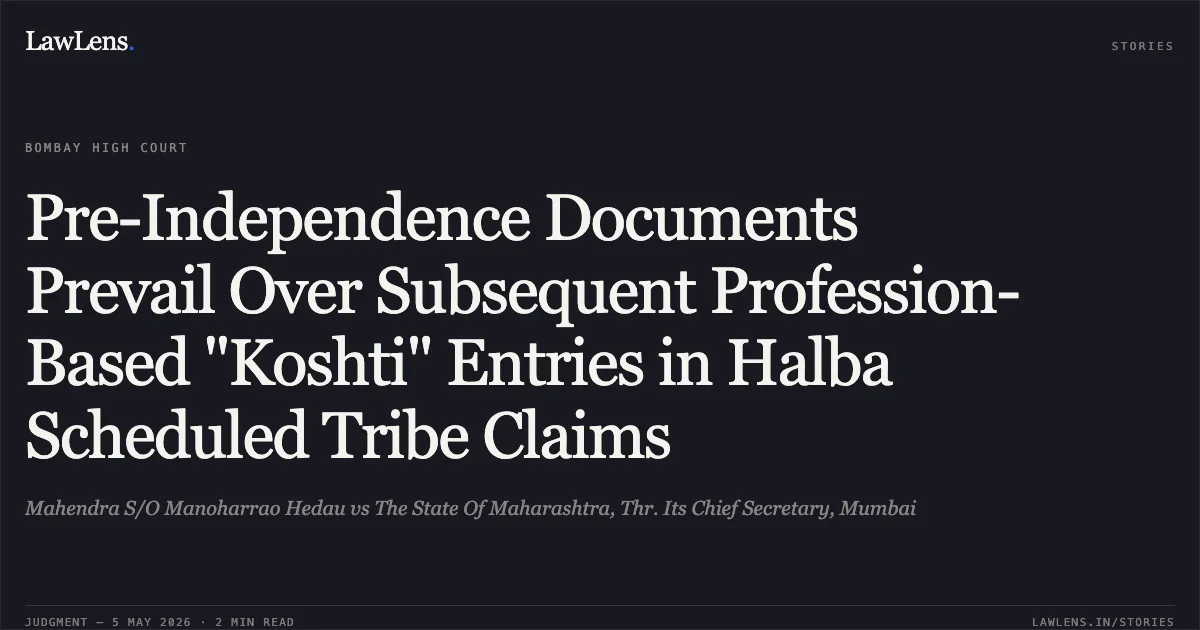
The Court answered both issues in favor of the Petitioners, holding that oldest documents prevail over subsequent entries and the affinity test cannot be the sole basis for rejection
The High Court quashed the Scrutiny Committee's orders dated 29.09.2020 and declared that the Petitioners belong to the "Halba" Scheduled Tribe; the Court directed Respondent No. 2 to issue Tribe Validity Certificates to both Petitioners within four weeks. Rule made absolute.
Source reference: p. 17-18Acts & Sections Cited
1 provisions across 1 statute referred to in this judgment. Linked provisions open on LawLens.
Indian Evidence Act, 18721
Original Court PDF
Mahendra S/O Manoharrao HedauvsThe State Of Maharashtra, Thr. Its Chief Secretary, Mumbai
Click to open original judgment
Original judgment, available to read, download and summarize on LawLens.in