Facts
The petitioner/plaintiff instituted a commercial suit seeking recovery of money and permanent injunction against the respondents.
Source reference: p.3, para.3It filed an application under Section 12A of the Commercial Courts Act, 2015, seeking dispensation of pre-institution mediation on the ground that, even before expiry of the notice period on 31 August 2026, the first respondent was allegedly attempting to dispossess it without repaying the advance amount.
Source reference: p.3, para.3The Principal Commercial Court, Egmore, dismissed the application, holding that the suit did not involve an urgent interim relief and did not fall within the circumstances identified in K. Varadhan v. Prakash Babu Nakundhi Reddy.
Source reference: pp.3–4, para.4The plaintiff challenged that order under Article 227 of the Constitution.
Source reference: p.2Issues
Whether the requirement of pre-institution mediation under Section 12A of the Commercial Courts Act could be dispensed with where the plaint and accompanying materials disclosed a potential and immediate threat of dispossession or other irreparable harm.
Source reference: p.4, para.5; p.6, paras.7–8Whether the Commercial Court had correctly assessed the existence of an urgent interim relief by refusing to consider the plaintiff’s apprehension from the plaintiff’s standpoint.
Source reference: p.4, para.5; p.6, para.8What consequential directions should be issued in light of the respondent’s proposal for an amicable settlement.
Source reference: p.6, para.9; p.7, para.10Law Applied
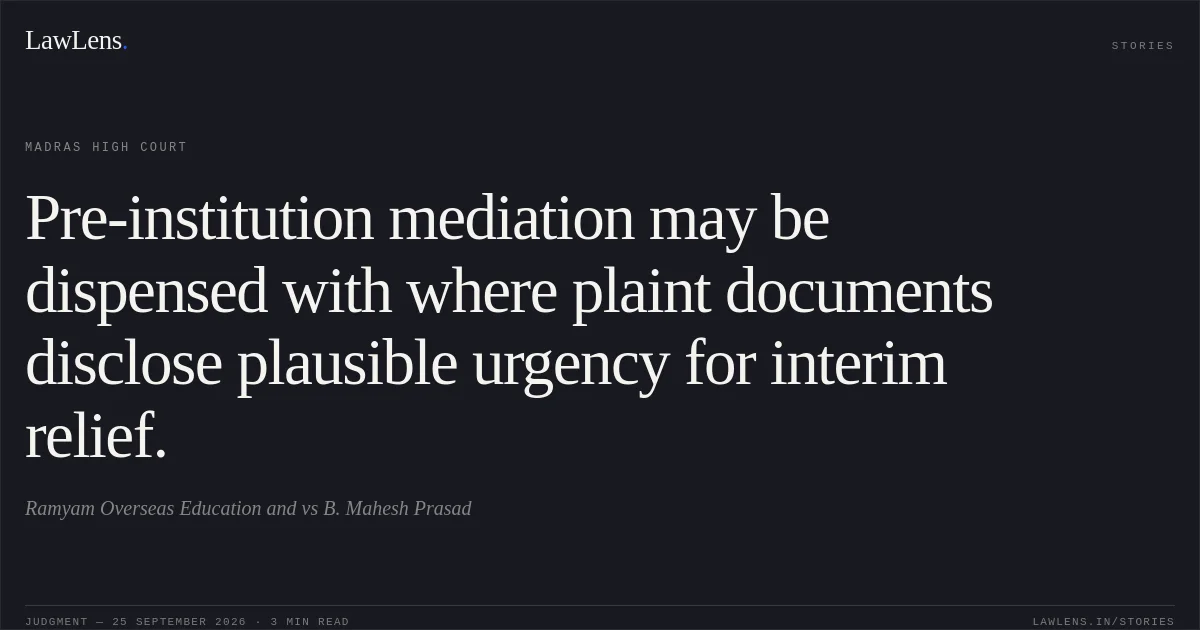
The Court applied Section 12A of the Commercial Courts Act, 2015, which ordinarily mandates pre-institution mediation for commercial suits, while permitting exemption where the plaint and supporting documents genuinely disclose a need for urgent interim intervention.
Source reference: p.4, para.5It relied on K. Varadhan v. Prakash Babu Nakundhi Reddy, reported in 2023 (1) CTC 201, and principally on Novenco Building & Industry A/S v. Xero Energy Engineering Solutions (P) Ltd., reported in 2026 (4) SCC 815, which held that urgency must be assessed from a holistic reading of the plaint and accompanying documents; relevant indicators include immediacy of peril, irreparable harm, risk of losing rights or assets, statutory timelines, perishability of the subject matter, or the possibility that delay would render the eventual relief ineffective.
Source reference: pp.4–6, para.6A merely pro forma or anticipatory prayer for urgent relief cannot be used to bypass Section 12A, but the court need not determine the merits of the interim relief if the urgency is plausibly established from the plaintiff’s standpoint.
Source reference: pp.4–6, para.6The Court exercised supervisory jurisdiction under Article 227 of the Constitution.
Source reference: p.2Reasoning
The High Court held that the Commercial Court had misdirected itself by treating the absence of an established urgent relief as decisive.
Source reference: p.4, para.5The proper inquiry was whether the plaint and supporting documents disclosed a plausible peril and whether delay could cause irreparable loss or hardship to the plaintiff.
Source reference: p.4, para.5The petitioner’s allegation that the first respondent was attempting to dispossess it before expiry of the notice period constituted a potential and immediate threat requiring consideration from the plaintiff’s perspective.
Source reference: p.6, para.8Applying the principles in Novenco Building, the Court concluded that the apprehension was sufficient to justify interference with the order refusing to dispense with pre-institution mediation.
Source reference: p.6, para.8Since the first respondent represented that the dispute could be amicably resolved and placed a settlement proposal before the Court, the Court directed that the parties be referred to mediation rather than permitting the matter to proceed immediately on the merits.
Source reference: pp.6–7, paras.9–10Holding
The revision petition was allowed.
The order dated 25 August 2026 dismissing the petitioner’s application under Section 12A was set aside.
Source reference: p.7, para.10The Principal Commercial Court was directed to refer the parties to mediation and grant four weeks for receipt of the mediation report.
Source reference: p.7, para.10If settlement was reached, it could be recorded and the proceedings closed; otherwise, the suit was to proceed in accordance with law.
Source reference: p.7, para.10Pending mediation and further proceedings, the petitioner’s possession was directed not to be disturbed.
Source reference: p.7, para.10No costs were awarded, and the connected miscellaneous petition was closed.
Source reference: p.7, para.10Acts & Sections Cited
1 provisions across 1 statute referred to in this judgment. Linked provisions open on LawLens.
COMMERCIAL COURTS ACT, 20151
Original Court PDF
Ramyam Overseas Education andvsB. Mahesh Prasad
Click to open original judgment
Original judgment, available to read, download and summarize on LawLens.in