01Facts
The petitioners (plaintiffs) filed a civil suit for a permanent injunction regarding land at Survey No. 77, Village Gopalpura, Morena, alleging that the respondents (defendants) attempted to forcibly construct on the land without a formal partition.
¶ 2The defendants contested the suit, claiming construction began prior to the litigation.
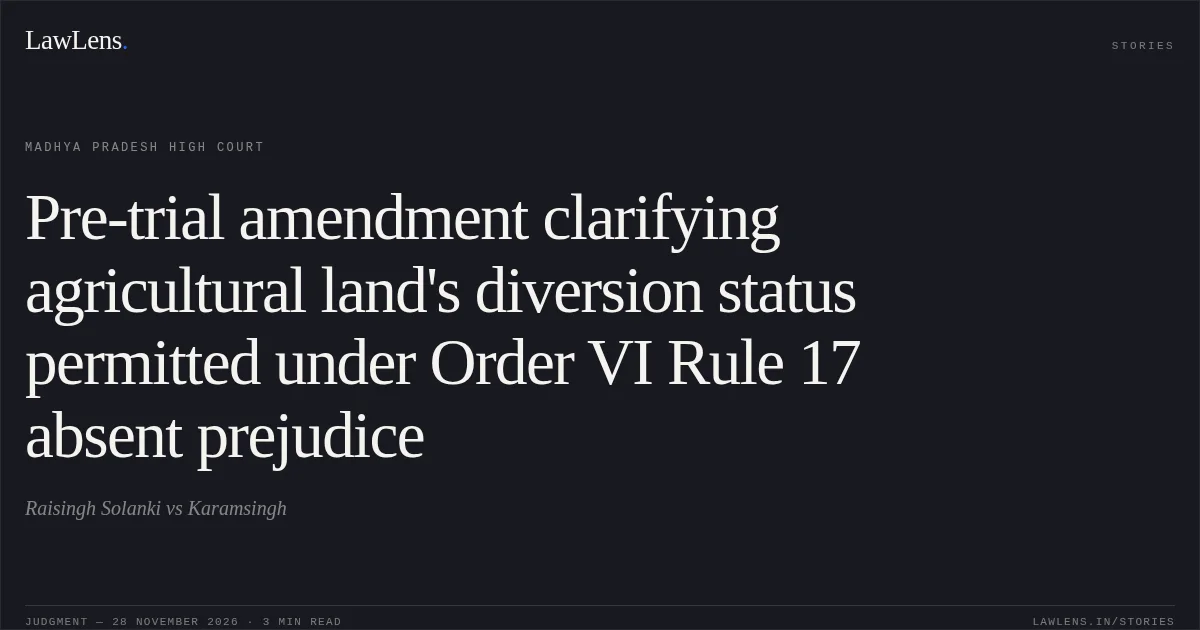
¶ 3Following the framing of issues on January 6, 2023, but before the commencement of evidence, the petitioners filed an application under Order 6 Rule 17 of the CPC to amend the plaint.
¶ 3They sought to include allegations of encroachment and construction that occurred during the pendency of the suit.
¶ 3The trial court dismissed the application on April 29, 2023, citing delay and a lack of explanation regarding when the plaintiffs gained knowledge of the construction.
¶ 3The petitioners challenged this dismissal under Article 227 of the Constitution.
¶ 102Issues
i.1. Whether the trial court erred in dismissing an application for amendment of pleadings at a pre-trial stage on the grounds of delay and lack of due diligence.
¶ 4, 7ii.2. Whether the strict proviso of Order 6 Rule 17 of the CPC regarding due diligence applies when the trial (recording of evidence) has not yet commenced.
¶ 703Law Applied
Order 6 Rule 17 of the Code of Civil Procedure (CPC), which governs the amendment of pleadings.
¶ 3, 7Amendments necessary for determining the real controversy should be allowed if they cause no uncompensable prejudice as established in Life Insurance Corporation of India v. Sanjeev Builders Pvt. Ltd. (AIR 2022 SC 4256).
¶ 6A liberal approach toward amendments at the pre-trial stage to prevent a multiplicity of proceedings as emphasized in Rajesh Kumar Aggarwal v. K.K. Modi [(2006) 4 SCC 385].
¶ 6Provisions in the judgment · 1 · Linked ones open on LawLens
Code of Civil Procedure, 1908 Section 6
04Reasoning
Since the recording of evidence had not yet begun, the strict "due diligence" requirement found in the proviso to Order 6 Rule 17 does not operate with the same rigour as it would post-trial.
¶ 7The allegations of encroachment and construction during the pendency of the suit were vital for the final adjudication of the dispute.
¶ 7The trial court's focus on technicalities—specifically the lack of a "date of knowledge" for the construction—improperly overrode the substantive requirement of resolving the actual controversy.
¶ 7By denying the amendment, the trial court failed to exercise its discretion to ensure a complete and effective adjudication of the matter.
¶ 705Holding
Amendments should be liberally permitted at the pre-trial stage to resolve the real questions in controversy.
¶ 7The High Court set aside the trial court's order dated April 29, 2023, and allowed the petitioners' application under Order 6 Rule 17 of the CPC.
¶ 8The petitioners were directed to incorporate the amendments within the stipulated time, and the respondents were granted liberty to file additional written statements in response to the amended portions.
¶ 8The petition was allowed with no order as to costs.
¶ 9Original Court PDF
ShriramvsAnil Kumar Rathore
Click to open original judgment
Original judgment, available to read, download and summarize on LawLens.in