Facts
The petitioner was serving a sentence of imprisonment for life following his conviction for offences under Sections 302, 365, 201, 120-B and 34 of the IPC in FIR No. 170/2010, P.S. Paharganj.
Source reference: para. 2The Trial Court convicted him on 13.02.2019, and his conviction and sentence were affirmed by the Delhi High Court on 20.10.2022 and by the Supreme Court upon dismissal of his SLP on 03.07.2023.
Source reference: para. 2–3By the time his case was considered, he had undergone approximately 15 years and 11 months of actual incarceration and earned approximately 2 years and 3 months of remission.
Source reference: para. 4The Sentence Review Board (SRB), in its meeting dated 24.04.2025, declined to recommend premature release, relying principally on the gravity and circumstances of the offence, the petitioner’s previous criminal involvement, his age, and the apprehension that he might again commit an offence.
Source reference: para. 5–6The petitioner challenged the SRB’s decision under Article 226, relying on his satisfactory jail conduct, educational achievements, constructive prison activities, commendation certificates, and furlough/parole releases without misuse of liberty.
Source reference: para. 7–10The State opposed the petition, contending that eligibility for consideration did not create an automatic right to release and that the SRB’s assessment was entitled to judicial deference.
Source reference: para. 11–13Issues
Whether the SRB’s decision dated 24.04.2025 was legally sustainable when it relied on the gravity of the offence and previous criminal cases without adequately considering the petitioner’s present conduct, reformation, rehabilitation and prospects of reintegration.
Source reference: para. 15–19, 25–28Whether the petitioner’s completion of the requisite period of actual incarceration under the Delhi Prison Rules, 2018 entitled him to premature release.
Source reference: para. 16–17Whether, upon finding the SRB’s decision deficient, the High Court could itself direct premature release or should remit the matter for fresh consideration by the SRB.
Source reference: para. 12, 39–41Law Applied
The Court applied Rule 1251 of the Delhi Prison Rules, 2018, read with Section 433A of the Code of Criminal Procedure, 1973, under which a life convict becomes eligible for consideration of premature release after 14 years of actual imprisonment, without remission, but acquires no automatic right to release.
Source reference: para. 16–17The SRB must assess, inter alia, whether the convict has lost his potential to commit crime, whether he can be reclaimed as a useful member of society, and the socio-economic condition of his family.
Source reference: para. 16Rule 1257(c) requires consideration of the circumstances of the offence, the likelihood of reoffending, the welfare of the prisoner and society, and relevant material beyond a mechanical reliance on an adverse police opinion.
Source reference: para. 18Relying on Laxman Naskar v. Union of India, (2000) 2 SCC 595, State of Haryana v. Jagdish, (2010) 4 SCC 216, Zahid Hussein v. State of West Bengal, (2001) 3 SCC 750, Sharafat Ali v. State of U.P., 2022 SCC OnLine SC 193, Rajo @ Rajwa @ Rajendra Mandal v. State of Bihar, 2023 INSC 771, and Bilkil Yakub Rasool v. Union of India, (2024) 5 SCC 481, the Court held that premature-release assessment must be holistic and include the convict’s conduct in prison, post-conviction conduct, reformation, age, health, family circumstances, remission, educational or vocational development and prospects of reintegration.
Source reference: para. 20–24The Court also relied on Ram Chander v. State of Chhattisgarh, (2022) 12 SCC 52, for the principle that judicial review does not ordinarily permit substitution of the Court’s assessment for that of the competent authority.
Source reference: para. 12, 39Reasoning
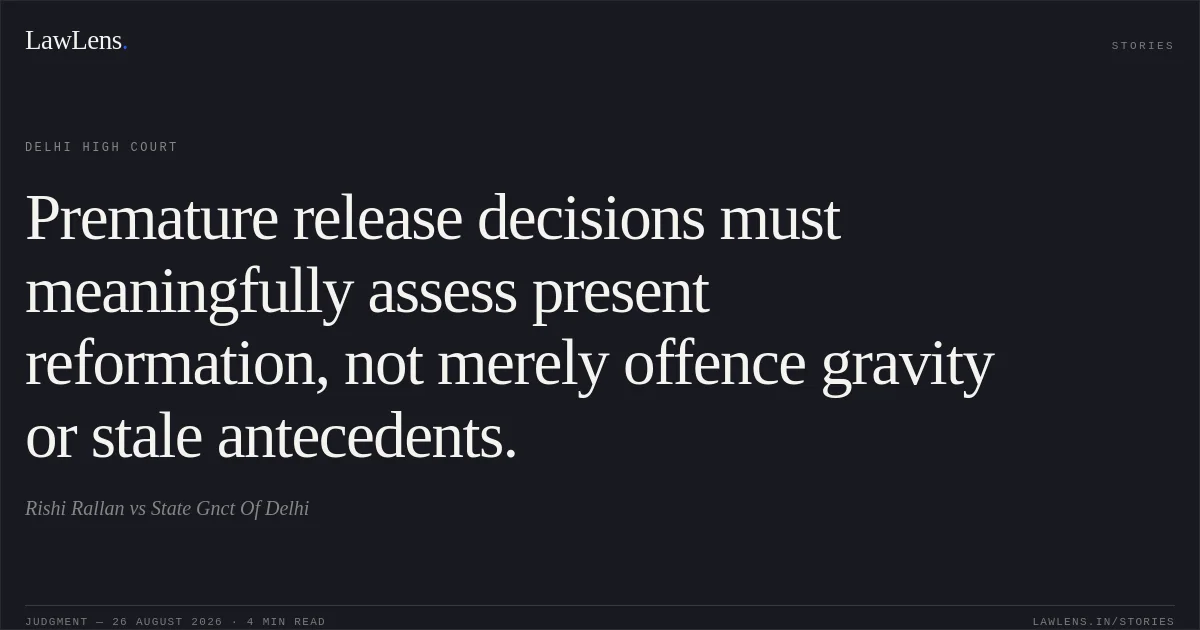
The Court held that although the SRB was entitled to consider the serious nature of the offence and the petitioner’s antecedents, its minutes did not demonstrate meaningful consideration of material directly bearing on his present propensity to commit crime.
Source reference: para. 25–28The SRB failed to discuss the petitioner’s satisfactory jail conduct, educational achievements, constructive prison work, commendation certificates, conduct during furlough/parole, or the fact that his previous cases all preceded the 2010 offence and that there was no subsequent criminal involvement.
Source reference: para. 28, 32–36His repeated furloughs without misuse of liberty and his participation in IGNOU and other constructive activities constituted relevant evidence of reformation and reduced likelihood of reoffending.
Source reference: para. 29–33The conclusion that the possibility of future criminality “cannot be ruled out” was therefore found to be speculative and unsupported by an adequate assessment of the complete record.
Source reference: para. 24, 28, 38However, since the determination of suitability for premature release remained within the SRB’s domain, the Court declined to substitute its own assessment for that of the Board.
Source reference: para. 39Holding
The Court held that the SRB’s decision dated 24.04.2025 could not be sustained because it did not adequately consider the petitioner’s present conduct, reformation and prospects of rehabilitation.
The decision was set aside, and the matter was remitted to the SRB for fresh consideration in accordance with the Delhi Prison Rules, 2018.
Source reference: para. 39–41The SRB was directed to consider the petitioner’s period of incarceration, jail conduct, conduct during furlough/parole, relevant reports, educational and constructive activities, and potential for social reintegration, and to pass a reasoned order within three months.
Source reference: para. 39–41The petition and pending application were disposed of accordingly; no direct order for premature release was issued.
Source reference: para. 41–42Acts & Sections Cited
4 provisions across 2 statutes referred to in this judgment. Each provision opens on LawLens.
Indian Penal Code, 18603
Code of Criminal Procedure, 19731
Original Court PDF
Rishi RallanvsState Gnct Of Delhi
Click to open original judgment
Original judgment, available to read, download and summarize on LawLens.in
![Courts will not interfere with transfers absent mala fides or violation of statutory rules.. M Ramya vs EMPLOYEES STATE INSURANCE CORPORATION (ESIC). CAT - ['Chennai']. LawLens](/stories/thumbnails/courts-will-not-interfere-with-transfers-absent-mala-fides-or-violation-of-statutory-rules-a6845e9ca6f548fca284c51c8351957f.webp)
![Courts cannot direct one-time recruitment age relaxation absent authority in the governing rules or advertisement.. UT OF PUDUCHERRY vs M ANDAL. CAT - ['Chennai']. LawLens](/stories/thumbnails/courts-cannot-direct-one-time-recruitment-age-relaxation-absent-authority-in-the-governing-895d78fde47143e2a8ed0207c4b6a44f.webp)
![A review cannot correct an allegedly erroneous decision absent an error apparent on the record.. Ajit Kumar Jha vs RAILWAY BOARD. CAT - ['Delhi']. LawLens](/stories/thumbnails/a-review-cannot-correct-an-allegedly-erroneous-decision-absent-an-error-apparent-on-the-re-8ac952fd4eba470c92f7da20af72a220.webp)