Facts
The petitioner entered government service as a Junior Clerk on 17 April 1995 and was subsequently promoted from Senior Assistant to Assistant Commercial Tax Officer (ACTO) by order dated 9 October 2017.
Source reference: p. 2He also successfully passed the relevant departmental examination papers in February 2018.
Source reference: p. 2On the basis of recommendations of the Review Committee dated 27 December 2019, the petitioner was prematurely retired under Rule 71(a) of the Odisha Service Code by order dated 5 October 2020.
Source reference: pp. 2, 10The State justified the action on the grounds that the petitioner lacked proficiency in GST-related work, was allegedly ineffective and irregular, and had received an “Average” assessment in certain performance-related aspects for 2018–19, notwithstanding an overall “Good” rating.
Source reference: pp. 8–9The petitioner challenged the premature-retirement order, relying on the Government guideline dated 24 September 2019, particularly paragraphs 4, 6(c), and 7.
Source reference: no citationDuring the pendency of the writ petition, he attained the age of superannuation on 31 May 2022.
Source reference: p. 7Issues
Whether the petitioner’s case could validly be referred to and considered by the Review Committee for premature retirement when he had already attained 57 years of age by the time of the Committee’s proceedings dated 27 December 2019, contrary to paragraphs 4 and 7 of the Government guideline dated 24 September 2019?
Source reference: pp. 3–6, 10–11Whether the petitioner could ordinarily be prematurely retired on the ground of ineffectiveness when he had been promoted to the post of ACTO in 2017, within the preceding five-year period, in view of paragraph 6(c) of the guideline?
Source reference: pp. 6–7, 11Whether the premature-retirement order dated 5 October 2020 was legally sustainable under Rule 71(a) of the Odisha Service Code?
Source reference: pp. 2, 10–11Law Applied
The Court applied Rule 71(a) of the Odisha Service Code, which governs premature retirement in the public interest.
Source reference: no citationIt further applied paragraphs 4 and 7 of the Government and P.G. Department guideline dated 24 September 2019, which prescribe the categories of government servants whose cases may be reviewed and the applicable review schedule based on completion of qualifying service or attainment of specified ages.
Source reference: pp. 3–5Paragraph 6(c) of the guideline provides that, although the entire service record may be considered, an employee should ordinarily not be retired for ineffectiveness where his service during the preceding five years, or his service in a higher post obtained by promotion during that period, has been satisfactory.
Source reference: p. 6The Court also relied on its earlier decision in Ratnakar Mallick v. State of Odisha, W.P.(C) No. 14146 of 2022, decided on 28 October 2025, which held that a case could not be taken up by the Review Committee contrary to the age-based requirements and schedule contained in paragraphs 4 and 7 of the guideline.
Source reference: pp. 5–6Reasoning
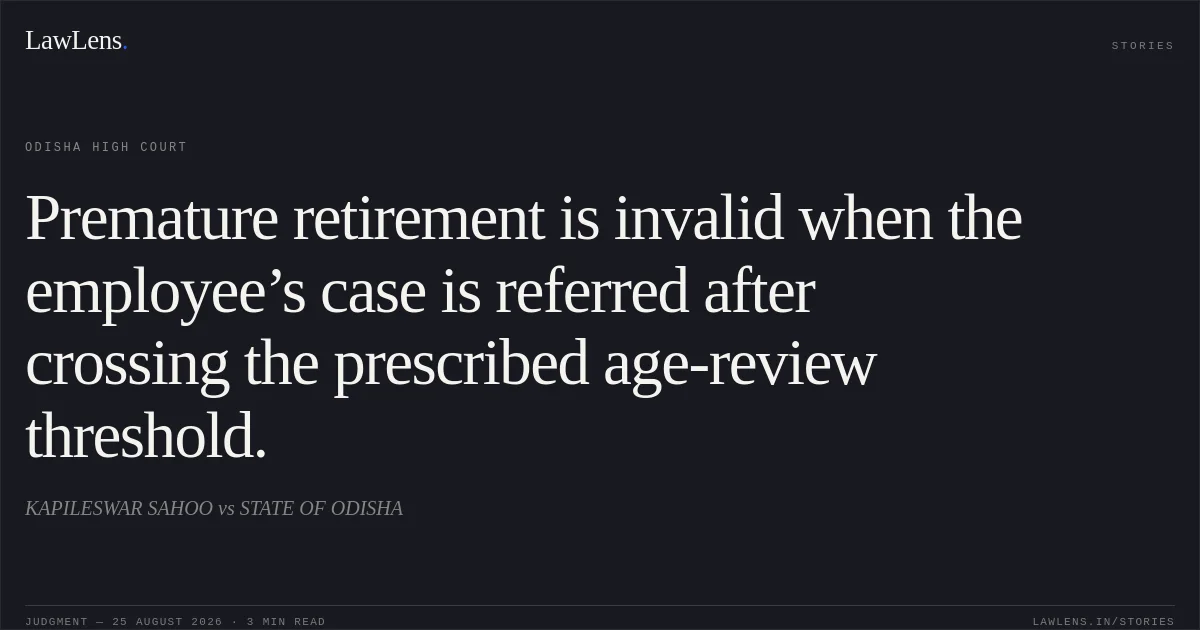
The Court found from the petitioner’s service record that his date of birth was 25 May 1962 and that he had already attained 57 years of age when his case was referred to, and considered by, the Review Committee on 27 December 2019.
Source reference: p. 10Applying paragraphs 4 and 7 of the 24 September 2019 guideline, the Court held that the petitioner’s case could not have been referred for premature retirement at that stage because the prescribed age-based review framework did not authorise such consideration after the relevant review stage had passed.
Source reference: pp. 10–11Independently, the Court noted that the petitioner had been promoted to ACTO in October 2017.
Source reference: pp. 6–7, 11Since the alleged basis of retirement was ineffectiveness and the promotion had occurred within the preceding five years, paragraph 6(c) required consideration of his service in the higher post and ordinarily protected him from premature retirement where such service was satisfactory.
Source reference: pp. 6–7, 11The Court therefore treated the referral and the consequent Review Committee recommendation as irregularities apparent on the face of the record, rendering the order under Rule 71(a) unsustainable.
Source reference: p. 11Holding
The Court answered the issues in favour of the petitioner and quashed the premature-retirement order dated 5 October 2020 issued under Annexure-6.
As the petitioner had already reached the age of superannuation on 31 May 2022, the Court directed Opposite Party No. 1 to treat him as having continued in service until superannuation, on a notional basis, and to extend all retiral benefits legally due and admissible to him.
Source reference: p. 11The exercise was directed to be completed within four months from receipt of the judgment.
Source reference: p. 11The writ petition was accordingly disposed of.
Source reference: p. 12Original Court PDF
KAPILESWAR SAHOOvsSTATE OF ODISHA
Click to open original judgment
Original judgment, available to read, download and summarize on LawLens.in
![Courts will not interfere with transfers absent mala fides or violation of statutory rules.. M Ramya vs EMPLOYEES STATE INSURANCE CORPORATION (ESIC). CAT - ['Chennai']. LawLens](/stories/thumbnails/courts-will-not-interfere-with-transfers-absent-mala-fides-or-violation-of-statutory-rules-a6845e9ca6f548fca284c51c8351957f.webp)
![Courts cannot direct one-time recruitment age relaxation absent authority in the governing rules or advertisement.. UT OF PUDUCHERRY vs M ANDAL. CAT - ['Chennai']. LawLens](/stories/thumbnails/courts-cannot-direct-one-time-recruitment-age-relaxation-absent-authority-in-the-governing-895d78fde47143e2a8ed0207c4b6a44f.webp)
![A review cannot correct an allegedly erroneous decision absent an error apparent on the record.. Ajit Kumar Jha vs RAILWAY BOARD. CAT - ['Delhi']. LawLens](/stories/thumbnails/a-review-cannot-correct-an-allegedly-erroneous-decision-absent-an-error-apparent-on-the-re-8ac952fd4eba470c92f7da20af72a220.webp)