Facts
The appellants, who were already functioning as temporary Anganwadi workers and helpers in the Union Territory of Puducherry, filed a writ appeal challenging the order dated 01-12-2025 in W.P. No. 46298 of 2025
Source reference: p. 1, 2The underlying writ petition challenged a recruitment notification dated 26.05.2021, which invited applications for the posts of Anganwadi worker and helper on a short-term honorarium basis
Source reference: p. 2The appellants contended that the notification prescribed higher educational qualifications than what they possessed, effectively barring them from the selection process
Source reference: p. 3The Single Judge had dismissed the writ petition but directed the respondents not to disengage the appellants until the completion of their current extension period
Source reference: p. 3Issues
1. Whether the prescription of educational qualifications and recruitment criteria by an employer is subject to judicial interference
Source reference: p. 3 / para 42. Whether the appellants were entitled to challenge a recruitment notification on the grounds that they did not meet the newly prescribed qualifications
Source reference: p. 3 / para 4Law Applied
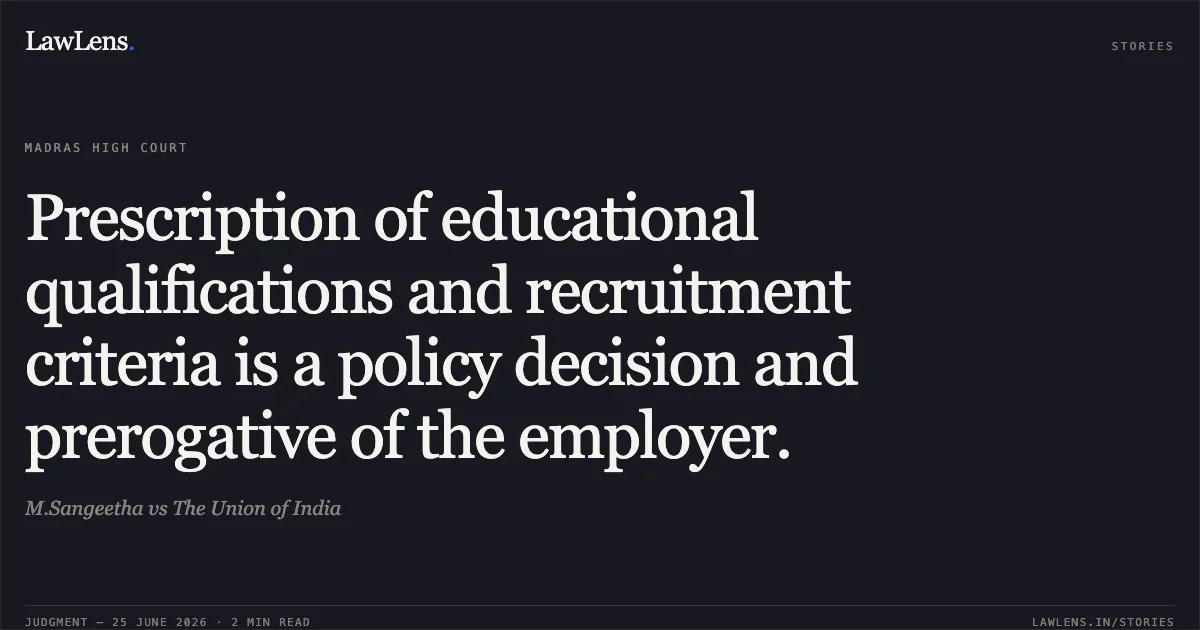
The Court applied the principle of judicial restraint in matters of executive policy, specifically holding that the prescription of educational qualifications, age limits, and other recruitment criteria is the exclusive prerogative of the employer and a matter of government policy
Source reference: p. 3Such policy decisions cannot be challenged unless they are found to be in direct violation of statutory provisions or existing rules
Source reference: p. 3Reasoning
The Bench, led by S.M. Subramaniam J., reasoned that the appellants, as temporary employees, do not have a vested right to dictate the terms of a new recruitment notification
Source reference: p. 3The Court determined that the government has the mandate to set higher standards for recruitment to improve service quality. Since the appellants failed to demonstrate that the new qualifications violated any specific Statute or Rule, the Court held there was no legal basis for interference
Source reference: p. 3The Court noted that the Single Judge had already protected the appellants' current interests by directing that they not be disengaged until their current extension expires and by allowing them to participate in the new process if they meet the criteria
Source reference: p. 3Holding
The Court held that there was no infirmity in the order of the Writ Court and dismissed the Intra-Court Appeal (WA No. 1645 of 2026)
The Court affirmed that the prescription of qualifications is a policy decision of the State. The connected miscellaneous petition was closed, and no costs were awarded
Source reference: p. 3, 4, 5Acts & Sections Cited
1 provisions across 1 statute referred to in this judgment. Linked provisions open on LawLens.
Letters Patent1
Original Court PDF
M.SangeethavsThe Union of India
Click to open original judgment
Original judgment, available to read, download and summarize on LawLens.in


