Facts
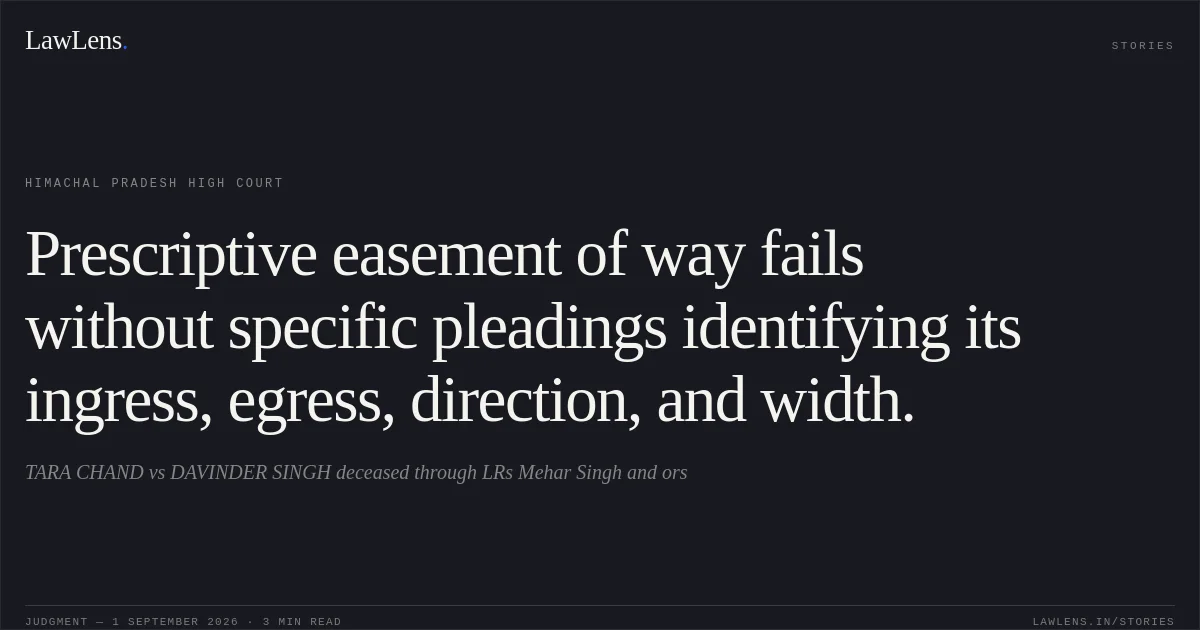
The plaintiff sought a declaration that he had a right to use an ancestral path passing through the defendants’ land and a permanent prohibitory injunction restraining the defendants from blocking it by construction. He claimed uninterrupted use of the path for more than 20 years and asserted that a prescriptive easement had accrued in his favour. Defendant No. 2 had exchanged part of the land with Defendant No. 1, who thereafter raised a two-storeyed structure over it.
Source reference: para. 2–4The Trial Court held that the plaintiff had used the path for 20–25 years, relied upon the tatima showing the path, and decreed the suit. On appeal, the Additional District Judge reversed the decree, finding that the path was not reflected in the revenue record, an alternative passage existed, and the Trial Court had not identified the portion requiring demolition. The plaintiff preferred the present second appeal, which was admitted on two substantial questions of law.
Source reference: para. 8–10Issues
Whether the plaintiff pleaded and proved his claim for a right of way by prescription so as to justify the decree passed by the Trial Court?
Source reference: para. 10(ii)Whether the First Appellate Court could reverse the entire decree when Defendant No. 2 had not preferred an appeal?
Source reference: para. 10(i); paras. 25–27Whether the First Appellate Court’s failure to decide the application for additional evidence invalidated its judgment?
Source reference: paras. 15–17Law Applied
A claim of easementary right by prescription must be supported by specific pleadings and proof identifying the route, including its points of ingress and egress, direction and width, and establishing the requisite period and character of use. The Court relied on Savitri Devi v. Gauri Dutt, 2000(1) S.L.J. 404, which holds that a right of way cannot be claimed where the passage is not properly described.
Source reference: paras. 19–20Under Order XLI Rules 4 and 33 CPC, an appellate court may reverse or vary a decree in favour of all parties having a common interest, even where only one party appeals; this principle was affirmed in Ratan Lal Shah v. Lalmandas Chhadammalal, (1969) 2 SCC 70, and Chandramohan Ramchandra Patil v. Bapu Koyappa Patil, (2003) 3 SCC 552.
Source reference: paras. 25–27An objection based on non-disposal of an application under Order XLI Rule 27 CPC cannot ordinarily be raised in second appeal where no substantial question of law concerning that omission was framed and the party raising the objection was not prejudiced by it.
Source reference: paras. 15–17Reasoning
The plaintiff’s pleadings did not clearly identify the ingress and egress of the alleged path or establish why access through the defendants’ land was necessary.
Source reference: para. 18His own witnesses admitted that the PWD/motorable Devidhar-Badyara road was adjacent to the relevant khasra numbers and that a common public passage existed near the land of PW-3, undermining the assertion that the path passed through the defendants’ land.
Source reference: paras. 19, 21The tatima could not reliably establish the path because its maker was deceased and the witness produced to prove it lacked knowledge of the spot position.
Source reference: para. 22Further, the plaintiff admitted that a recent settlement had depicted passages in the revenue record, yet the alleged path was absent from that record, making his claim doubtful.
Source reference: para. 23Consequently, the First Appellate Court correctly found that the essential factual foundation for a prescriptive right of way had not been proved.
Source reference: no citationThe non-appeal by Defendant No. 2 did not restrict the appellate court’s power under Order XLI Rules 4 and 33 CPC to reverse a decree founded on grounds common to the defendants.
Source reference: paras. 25–27The challenge based on non-disposal of the additional-evidence application also failed because no corresponding ground or substantial question of law had been raised, and the appellant was not the party who had filed that application.
Source reference: paras. 15–17Holding
The High Court answered the substantial questions of law against the plaintiff. It held that the plaintiff neither adequately pleaded nor proved a prescriptive right of way through the defendants’ land, and that the First Appellate Court was competent to reverse the entire decree despite Defendant No. 2 not having filed an appeal.
The judgment and decree of the First Appellate Court were upheld, the second appeal was dismissed, and all pending applications were disposed of.
Source reference: paras. 29–32Original Court PDF
TARA CHANDvsDAVINDER SINGH deceased through LRs Mehar Singh and ors
Click to open original judgment
Original judgment, available to read, download and summarize on LawLens.in