Facts
The applicant’s father, an Assistant Sub Inspector (ASI) in the Delhi Police, died in service on 26.02.2018
Source reference: para. 1(i)The applicant’s mother applied for his compassionate appointment on 25.05.2018
Source reference: para. 1(ii)On 11.10.2018, the Screening Committee rejected the request because the applicant was overage (28 years and 10 months, exceeding the 27-year limit for the MTS post) and was deemed "less deserving" compared to other candidates
Source reference: para. 1(iii), 3(ii)An appeal to the Hon’ble Lieutenant Governor (LG) was rejected on 04.07.2019
Source reference: para. 1(iv)The applicant filed the present Original Application (OA) seeking appointment, arguing that his mother’s cancer treatment expenses exceeded the family’s pension income and that his elder brother (already serving in the Delhi Police) had lived separately since 2011
Source reference: para. 5Issues
1. Whether the applicant was eligible for compassionate appointment despite exceeding the maximum age limit prescribed in Standing Order No. 39/2018
Source reference: para. 6, 8(iv)2. Whether the presence of an elder brother already serving in the Delhi Police bars the applicant’s claim under the relevant policy
Source reference: para. 6, 8(i)3. Whether the family’s financial condition and the mother’s medical expenses necessitated a departure from the recruitment policy
Source reference: para. 8(ii)-(iii)Law Applied
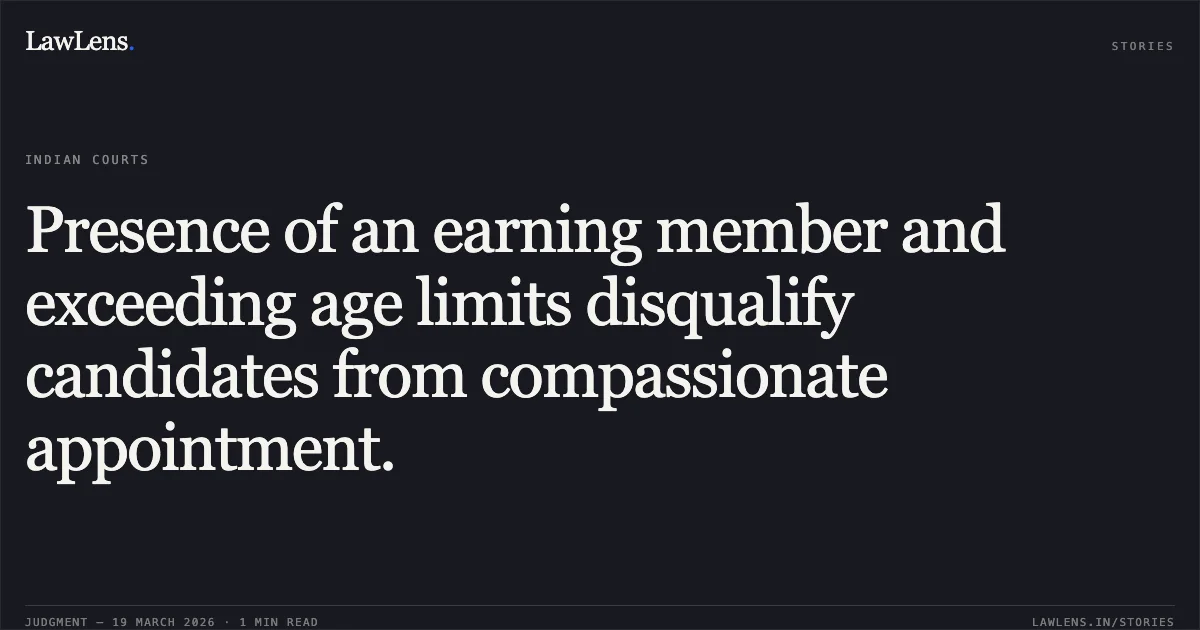
The Tribunal applied Delhi Police Standing Order No. 39/2018, specifically Clause 6(b), which mandates that compassionate appointment shall not be offered if there is already an earning member (Government servant) in the family
Source reference: para. 3(iii), 6The Tribunal relied on the Supreme Court precedent in Punjab Power Corporation Ltd. v. Nirval Singh (2019), which established that there is no inherent right to compassionate appointment and it must follow the existing policy
Source reference: para. 9It further applied State Bank of India v. Jaspal Kaur (2007), which held that public office is not heritable and the primary test for such appointments is whether the deceased left the family in penury
Source reference: para. 10Reasoning
The Tribunal found that the applicant failed to meet the eligibility criteria on multiple grounds.
Source reference: no citationFirst, at the time of the application, the applicant was 28 years and 10 months old, whereas the maximum age for a General category candidate for the MTS post is 27 years
Source reference: para. 3(ii), 8(iv)Second, the Tribunal noted that under Clause 6(b) of the Standing Order, the applicant was ineligible because his elder brother is already serving in the Delhi Police
Source reference: para. 8(i)Third, the Tribunal rejected the plea of financial penury, noting that the family received ₹59,40,959 in retiral benefits and receives a combined monthly income (family pension and LIC pension) of approximately ₹50,000
Source reference: para. 8(ii)Regarding the mother’s cancer treatment, the Tribunal observed that she is a CGHS beneficiary, meaning her medical expenses are reimbursable
Source reference: para. 7, 8(iii)Consequently, the Tribunal determined that the Screening Committee and the LG had issued reasoned orders that did not warrant interference
Source reference: para. 8(v)Holding
The Tribunal answered the issues in the negative, holding that the applicant had no right to compassionate appointment as he did not meet the age criteria and the family was not in a state of penury as defined by law.
The OA was dismissed, and all pending miscellaneous applications were disposed of
Source reference: para. 11-12Original Court PDF
BRIJESH CHAUBEYvsDELHI POLICE
Click to open original judgment
Original judgment, available to read, download and summarize on LawLens.in