Facts
The petitioner filed a complaint against Respondent No. 2 under Section 138 of the Negotiable Instruments Act, 1881, regarding five dishonored cheques totaling ₹10 lakhs
Source reference: p. 6During the trial, after his Section 313 CrPC statement was recorded, Respondent No. 2 moved an application (Exh-54) under Section 311(A) of the CrPC.
Source reference: p. 2-3He requested that the cheques and certain settlement documents (Exh-14 to 18 and 45 to 47) be sent to a handwriting expert, alleging that while the signatures were his, the details on the cheques were filled in by the petitioner’s son
Source reference: p. 2-3The Trial Court dismissed the application, but the Sessions Court reversed this in revision, ordering the expert examination
Source reference: p. 3Issues
1. Whether an application under Section 311(A) of the CrPC is maintainable to obtain handwriting specimens of a person (the petitioner's son) who has not been arrested in connection with the proceedings
Source reference: p. 3, 122. Whether the fact that details on a signed cheque were filled by a person other than the drawer necessitates a handwriting expert's opinion to rebut the presumption under Section 139 of the Negotiable Instruments Act
Source reference: p. 8-11Law Applied
The Court applied Section 311(A) of the CrPC, which empowers a Magistrate to order a person to provide specimen signatures or handwriting only if that person has been arrested in connection with an investigation or proceeding
Source reference: p. 3, 12Regarding the Negotiable Instruments Act, the Court relied on Sections 20, 87, and 139, as interpreted by the Supreme Court in Oriental Bank of Commerce v. Prabodh Kumar Tiwari (2024) and Bir Singh v. Mukesh Kumar, which establish that once a signature on a cheque is admitted, it is immaterial who filled the remaining details; the statutory presumption of an enforceable debt remains valid until rebutted by cogent evidence
Source reference: p. 9-11Reasoning
The Court reasoned that Section 311(A) CrPC was inapplicable because the petitioner’s son was never arrested as an accused in the case
Source reference: p. 12Following Supreme Court precedents, the Court held that a drawer who signs and delivers a cheque is liable for the amount filled in, even if the particulars are entered by someone else
Source reference: p. 9Therefore, a handwriting expert's report on the body of the cheque is legally irrelevant to the defense of whether the debt existed
Source reference: p. 11The Court found the Sessions Court’s reasoning—that such an examination was necessary to prove repayment—erroneous, as the burden of proof lies on the accused to rebut the presumption through substantive evidence rather than attacking the handwriting of the cheque's contents
Source reference: p. 12Holding
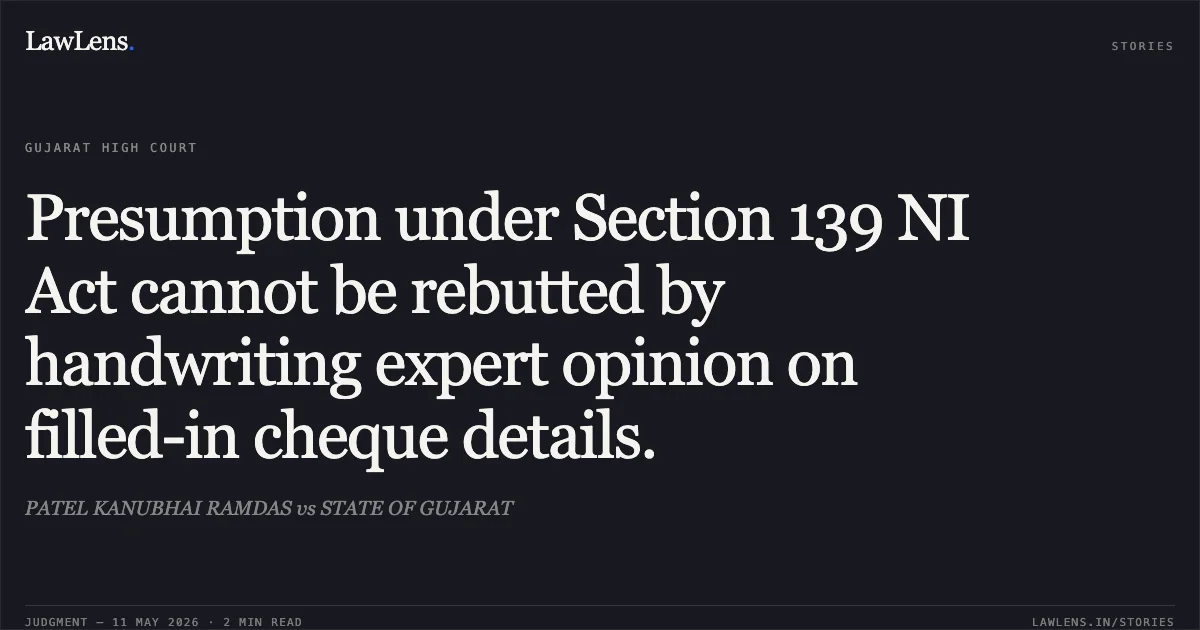
It held that Respondent No. 2 cannot claim for the cheques to be sent for examination because: (1) Section 311(A) CrPC does not apply to non-arrested persons, and (2) the opinion of a handwriting expert regarding who filled the details of an admittedly signed cheque is immaterial to rebutting the presumption under Section 139 of the NI Act
The High Court allowed the petition and quashed the Sessions Court's order dated 19.02.2024. Rule was made absolute
Source reference: p. 13Acts & Sections Cited
7 provisions across 2 statutes referred to in this judgment. Each provision opens on LawLens.
Code of Criminal Procedure, 19733
Negotiable Instruments Act, 18814
Original Court PDF
PATEL KANUBHAI RAMDASvsSTATE OF GUJARAT
Click to open original judgment
Original judgment, available to read, download and summarize on LawLens.in