Facts
The petitioner, Mohd. Asgar @ Tola, through his wife, challenged detention order No. PSA 32 of 2023 dated 24.11.2023, issued by the District Magistrate, Jammu under Section 8(1)(a) of the Jammu and Kashmir Public Safety Act, 1978, on the ground that he was acting prejudicially to the maintenance of public order.
Source reference: paras. 1–2; pp. 1–2The petitioner had earlier challenged the detention order at the pre-execution stage in HCP No. 130/2024, which was dismissed on 07.03.2025; his subsequent LPA was dismissed for non-prosecution on 20.05.2026.
Source reference: para. 1; p. 1The detention order, originally passed on 24.11.2023, was executed only on 23.04.2026.
Source reference: para. 5; p. 3The grounds of detention relied upon eight FIRs registered between 2002 and 2023.
Source reference: paras. 8–9; pp. 5–6The petitioner contended that the older FIRs were stale, while the later cases concerned family property disputes and had subsequently been quashed pursuant to compromises.
Source reference: paras. 5, 12; pp. 3, 7–8The respondents maintained that the petitioner had been absconding, that the delay in execution was attributable to him, and that the detention order was based on the detaining authority’s subjective satisfaction regarding the threat posed by his criminal activities.
Source reference: paras. 6, 11; pp. 4–6Issues
1. Whether the detention order was founded on vague and mechanical grounds, merely relying upon registration of FIRs that did not disclose activities prejudicial to the maintenance of public order.
Source reference: paras. 3, 10–14; pp. 2, 6–92. Whether the reliance on FIRs dating from 2002 to 2023 was stale and lacked a live and proximate link with the detention order passed in 2023.
Source reference: paras. 3, 15–17; pp. 2, 9–123. Whether failure to clearly inform the detenue of his right to make an effective representation to the Government and the detaining authority violated Article 22(5) of the Constitution.
Source reference: paras. 3, 8, 18; pp. 2, 5, 124. Whether the delayed execution of the detention order, after approximately two years, rendered the detention illegal.
Source reference: paras. 5–6; pp. 3–5Law Applied
The Court applied Section 8(1)(a) of the Jammu and Kashmir Public Safety Act, 1978, under which preventive detention may be ordered to prevent a person from acting prejudicially to the maintenance of public order.
Source reference: para. 2; p. 2It distinguished “law and order” from “public order,” relying on K.K. Saravana Babu v. State of Tamil Nadu, (2008) 9 SCC 89, which holds that public-order cases involve conduct having the potential to disturb the peace and tranquillity or the even tempo of community life.
Source reference: para. 14; p. 8The Court further relied on Sama Aruna v. State of Telangana, (2018) 12 SCC 150, holding that past conduct can support preventive detention only where it has a live and proximate nexus with the likelihood of future prejudicial activity; stale incidents cannot sustain detention.
Source reference: para. 16; pp. 9–11It also relied on Khaja Bilal Ahmed v. State of Telangana, (2020) 13 SCC 632, which reiterates that previous criminal cases may be considered only if they have a direct nexus with the immediate need for detention and that a mere reference to stale criminal cases is insufficient.
Source reference: para. 17; pp. 11–12Article 22(5) of the Constitution requires that the detenue be communicated the grounds of detention and informed of the earliest opportunity to make an effective representation to the appropriate authorities.
Source reference: para. 18; p. 12Reasoning
The Court found that the eight FIRs relied upon by the detaining authority did not establish a continuing propensity to disturb public order.
Source reference: no citationThe FIRs from 2002, 2011, 2012 and 2014 were too remote to constitute a live link with the detention order of 24.11.2023; in some cases, the petitioner had been acquitted or cleared during investigation, while one investigation had been stayed.
Source reference: para. 12; pp. 7–8The FIRs from 2021 to 2023 arose from family or property disputes involving the petitioner’s cousins and were subsequently quashed on the basis of compromise.
Source reference: para. 12; pp. 7–8Applying the principles in K.K. Saravana Babu, Sama Aruna and Khaja Bilal Ahmed, the Court held that the material did not demonstrate any act that disturbed, or had the potential to disturb, the even tempo of public life; at most, it disclosed isolated law-and-order disputes.
Source reference: paras. 13–17; pp. 8–12The detaining authority therefore failed to establish the necessary causal and proximate connection between the past incidents and the apprehended future threat.
Source reference: no citationOn the representation ground, however, the Court held that the communication dated 24.11.2023 informed the detenue that he could make a representation to both the Government and the detaining authority, and accordingly no violation of Article 22(5) was established.
Source reference: para. 18; p. 12Although the parties advanced rival submissions regarding the delayed execution of the detention order, the operative basis of the decision was the absence of relevant, proximate and public-order-related material.
Source reference: no citationHolding
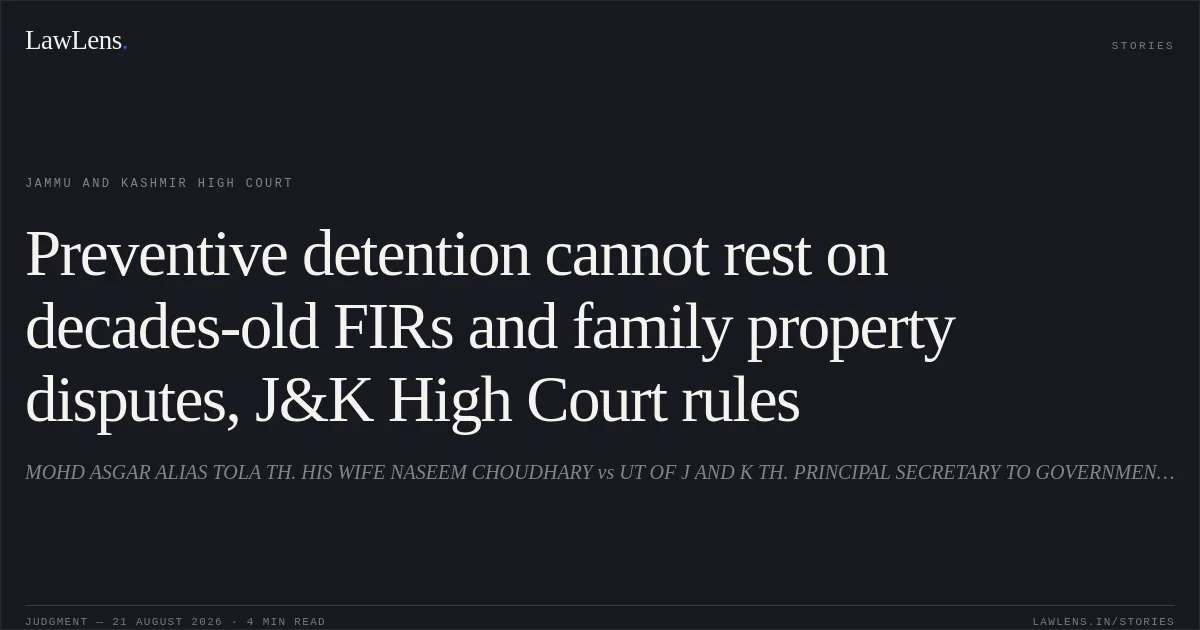
The Court answered the principal issues in favour of the petitioner, holding that mere involvement in eight FIRs was insufficient to justify preventive detention where the incidents were stale, lacked a live link with the detention order, or arose from private family/property disputes without any demonstrated impact on public order.
The Article 22(5) challenge was rejected because the detenue had been informed of his right to make representations to the Government and the detaining authority.
Source reference: para. 18; p. 12The detention order No. PSA 32 of 2023 dated 24.11.2023 was quashed, and the detenue was directed to be released forthwith, unless required in any other case; the detention record was ordered to be returned to the respondents.
Source reference: para. 20; p. 13Acts & Sections Cited
8 provisions across 3 statutes referred to in this judgment. Linked provisions open on LawLens.
Jammu And Kashmir Public Safety Act, 19781
Ranbir Penal Code, 19326
the Act of 1986 (alias, unresolved)1
Original Court PDF
MOHD ASGAR ALIAS TOLA TH. HIS WIFE NASEEM CHOUDHARYvsUT OF J AND K TH. PRINCIPAL SECRETARY TO GOVERNMENT HOME DEPARTMENT, JAMMU AND OTHERS
Click to open original judgment
Original judgment, available to read, download and summarize on LawLens.in