Facts
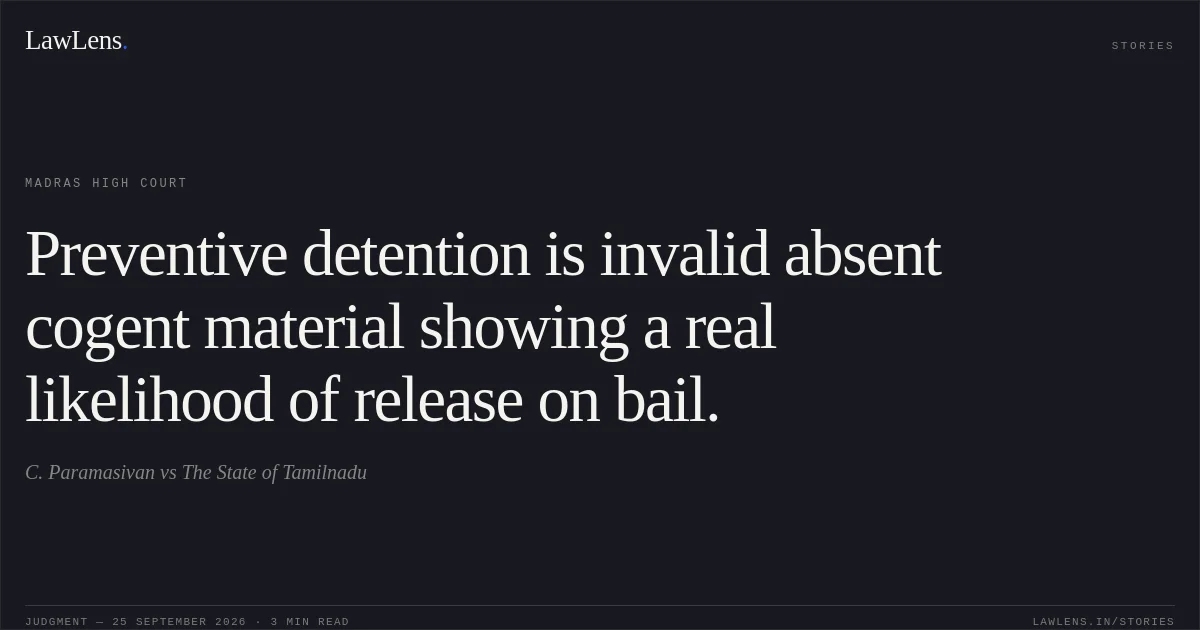
The petitioner, father of Balamurugan, challenged the detention order dated 29 April 2026 issued by the Commissioner of Police, Tirunelveli City, under the Tamil Nadu Prevention of Dangerous Activities of Bootleggers, Cyber Law Offenders, Drug Offenders, Forest Offenders, Goondas, Immoral Traffic Offenders, Sand Offenders, Sexual-offenders, Slum-grabbers and Video Pirates Act, 1982 (“Tamil Nadu Act 14 of 1982”).
Source reference: p.2, para.1Balamurugan, aged about 19 years, had been detained as a “Goonda” under Section 2(f) of the Act.
Source reference: p.2, para.1The petitioner contended that Balamurugan had not filed any bail application and that the detaining authority nevertheless concluded that he was likely to be released on bail by relying on an allegedly similar case.
Source reference: p.2, para.2The relied-upon case concerned a different crime number from 2024 and did not involve a co-accused in the ground case.
Source reference: p.2, para.2The Habeas Corpus Petition sought quashing of the detention order and Balamurugan’s release.
Source reference: p.2, para.2Issues
Whether the detention order was legally sustainable when the detenu had not filed any bail application and there was no pending application indicating a real possibility of his release on bail.
Source reference: p.2, para.2; p.3, para.4Whether reliance on bail granted in a different case, involving neither a co-accused nor adequately disclosed comparable facts, constituted cogent material for the detaining authority’s subjective satisfaction.
Source reference: p.3, para.4Whether the detenu was entitled to release upon the detention order being found invalid for want of a legally sustainable satisfaction regarding the likelihood of release on bail.
Source reference: p.9, para.5Law Applied
The Court exercised jurisdiction under Article 226 of the Constitution in a habeas corpus proceeding and examined the detention under Section 2(f) of Tamil Nadu Act 14 of 1982.
Source reference: no citationIt applied the principle that preventive detention of a person already in custody requires reliable and cogent material showing, first, a real possibility of release on bail and, second, the likelihood of prejudicial activity upon release, as stated in Union of India v. Paul Manickam.
Source reference: p.8, para.18Under Rekha v. State of Tamil Nadu, where no bail application is pending, likelihood of release may ordinarily be inferred only where a similarly placed co-accused has been granted bail; details of the comparable bail order must be disclosed, otherwise the satisfaction is mere ipse dixit.
Source reference: pp.4–5, para.15Huidrom Konungjao Singh further establishes that bail granted to a person in an unrelated case cannot justify an inference that the detenu is likely to obtain bail.
Source reference: pp.5–7, para.16Rajesh Gulati holds that a subsequent grant of bail cannot cure a detention order that was unsupported by cogent material when originally passed.
Source reference: p.8, para.17The Court also relied on Alagu v. State of Tamil Nadu, 2026 SCC OnLine SC 976, which reiterated these principles.
Source reference: p.3, para.4Reasoning
The detenu had not filed a bail application, and therefore there was no pending proceeding evidencing a real possibility of his release.
Source reference: p.3, para.4The exception recognised in Rekha—reliance on bail granted to a similarly placed co-accused—was unavailable because the detaining authority relied on a different crime registered in 2024, not on bail granted to a co-accused in the ground case.
Source reference: p.3, para.4; pp.7–9, paras.16–20Further, the detention materials did not disclose sufficient facts demonstrating that the relied-upon case was genuinely comparable.
Source reference: pp.7–9, paras.16–20Accordingly, the authority lacked cogent material to form the required subjective satisfaction that Balamurugan was likely to be released on bail.
Source reference: p.3, para.4; pp.7–9, paras.16–20The satisfaction was therefore a mere ipse dixit, rendering the detention order legally invalid.
Source reference: p.3, para.4; pp.7–9, paras.16–20Holding
The Habeas Corpus Petition was allowed.
The detention order in No.70/BBCDEFGISSSV/2026 dated 29 April 2026 was set aside because the detaining authority’s conclusion regarding the likelihood of release on bail was unsupported by cogent material.
Source reference: p.9, para.5Balamurugan was directed to be released forthwith, unless his detention was required in connection with any other case.
Source reference: p.9, para.5Acts & Sections Cited
1 provisions across 1 statute referred to in this judgment. Linked provisions open on LawLens.
Tamil Nadu Act 14 of 19821
Original Court PDF
C. ParamasivanvsThe State of Tamilnadu
Click to open original judgment
Original judgment, available to read, download and summarize on LawLens.in