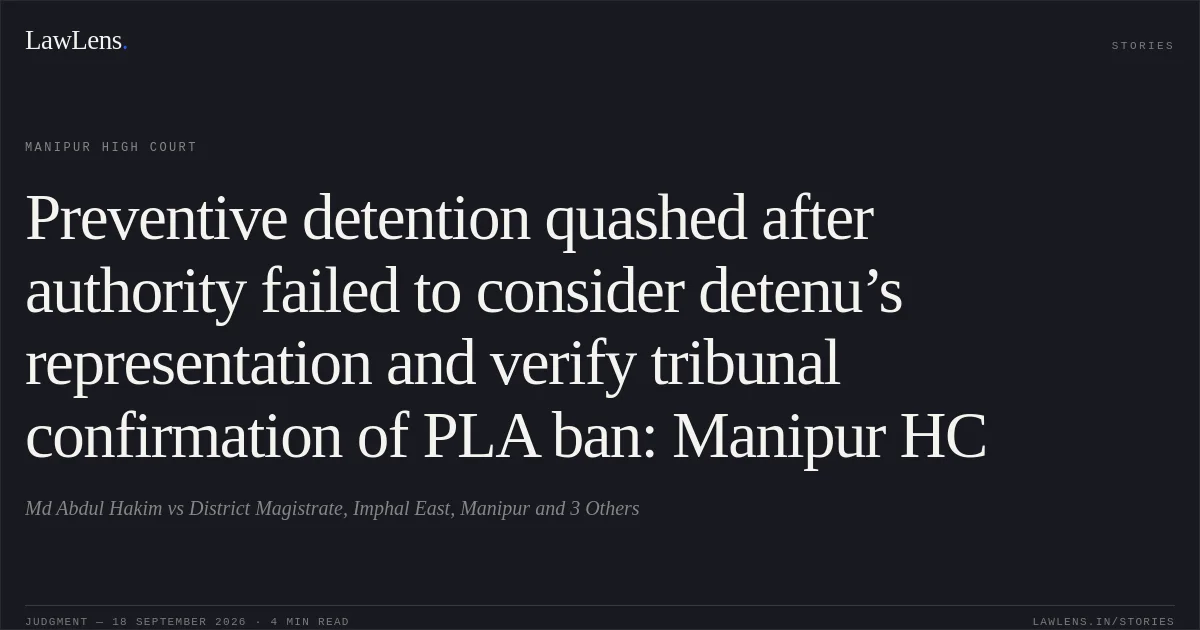
Facts
The petitioner was arrested on 26 March 2026 pursuant to an FIR alleging offences under Sections 17 and 20 of the Unlawful Activities (Prevention) Act, 1967 (UAPA), Section 5 of the Explosive Substances Act, 1908, Section 308 of the Bharatiya Nyaya Sanhita, 2023, and Sections 13(2) and 18 of the UAPA.
Source reference: para. 3While he remained in custody, the District Magistrate, Imphal East, passed a preventive detention order under Section 3(2) of the National Security Act, 1980 (NSA) on 21 April 2026, which was served on the petitioner on the same day. The grounds of detention dated 22 April 2026 were served on 25 April 2026.
Source reference: para. 3The petitioner submitted a representation to the District Magistrate on 29 April 2026. Instead of independently considering and deciding it, the District Magistrate forwarded it to the Commissioner (Home), who disposed of it on 13 May 2026.
Source reference: paras. 3, 11–12, 16The State Government approved the detention order on 1 May 2026 and confirmed it on 27 May 2026 under Sections 3(4) and 12(1) of the NSA, respectively.
Source reference: para. 1Issues
Whether the failure of the detaining authority to independently consider and decide the petitioner’s representation dated 29 April 2026 violated the constitutional safeguard under Article 22(5) of the Constitution.
Source reference: paras. 3, 11–16Whether the detaining authority’s reliance on the 13 November 2023 notification declaring the PLA an unlawful association, without verifying the status of the mandatory Tribunal proceedings under Section 4 of the UAPA, demonstrated non-application of mind and vitiated the subjective satisfaction underlying the detention order.
Source reference: paras. 3, 18–22Law Applied
The Court applied Article 22(5) of the Constitution, which guarantees a preventive detenu the right to make an effective representation and requires the competent authority to consider it independently and expeditiously.
Source reference: paras. 13–16Under Sections 3(2), 3(4), and 12(1) of the NSA, a detention order made by the District Magistrate requires State approval and subsequent confirmation within the statutory framework.
Source reference: para. 1Relying on Smt. Santosh Anand v. Union of India, (1981) 2 SCC 420, and Union of India v. Sneha Khemka, (2004) 2 SCC 570, the Court held that the detaining authority must independently decide a representation addressed to it; forwarding the representation to another authority without such consideration violates Article 22(5).
Source reference: paras. 13–16Under Sections 3 and 4 of the UAPA, a declaration of an association as unlawful, even when given immediate effect under the proviso to Section 3(3), remains subject to adjudication by the Tribunal, which must confirm or cancel the declaration and whose order must be published in the Official Gazette.
Source reference: paras. 18–20Applying Ameena Begum v. State of Telangana, (2023) 9 SCC 587, the Court reiterated that subjective satisfaction is judicially reviewable where there is non-application of mind, misconception of statute, or reliance on materials lacking rational probative value.
Source reference: paras. 21–23Reasoning
The petitioner’s representation dated 29 April 2026 was expressly addressed to the detaining authority, who had the power to revoke the detention order during the period before State approval. The District Magistrate did not consider the representation or record an independent decision, but merely forwarded it to the Commissioner (Home), who later disposed of it.
Source reference: paras. 11–16This was inconsistent with the principle that the authority to whom a representation is made must apply its own mind and decide it independently. The Court therefore held that the petitioner’s right under Article 22(5) had been infringed.
Source reference: paras. 11–16The Court further found that the detaining authority relied on the 13 November 2023 UAPA notification nearly two and a half years after its issuance without ascertaining whether the notification had been referred to the Tribunal within the statutory period or whether the Tribunal had confirmed or cancelled it.
Source reference: paras. 18–22Since the notification itself made its operation subject to the Tribunal’s order, the Tribunal’s decision was material to the detaining authority’s subjective satisfaction. Failure to obtain or verify that decision amounted to non-application of mind, misconception of the statutory scheme, and reliance on material that was not shown to have continuing legal validity.
Source reference: paras. 18–22The Court clarified that it was not quashing the detention merely because the preventive detention was based on a single FIR or because the petitioner had obtained default bail; the decision rested on the two established constitutional and administrative-law defects.
Source reference: para. 26Holding
The High Court allowed the writ petition and held that the detention order was invalid because the detaining authority failed to independently consider the petitioner’s representation, thereby violating Article 22(5), and because its subjective satisfaction was vitiated by failure to verify the status of the Section 4 UAPA Tribunal proceedings concerning the PLA notification.
Accordingly, the detention order dated 21 April 2026, the State approval order dated 1 May 2026, and the confirmation order dated 27 May 2026 were set aside.
Source reference: para. 27The petitioner was directed to be released forthwith, unless required in connection with any other case. No order as to costs was made.
Source reference: para. 27Acts & Sections Cited
14 provisions across 6 statutes referred to in this judgment. Each provision opens on LawLens.
National Security Act, 19802
Unlawful Activities (Prevention) Act, 19677
Explosive Substances Act, 19081
Conservation of Foreign Exchange and Prevention of Smuggling Activities Act, 19742
Bharatiya Nyaya Sanhita, 20231
General Clauses Act, 18971
Original Court PDF
Md Abdul HakimvsDistrict Magistrate, Imphal East, Manipur and 3 Others
Click to open original judgment
Original judgment, available to read, download and summarize on LawLens.in
![Competent authority must consider casual workers’ wage-benefit representation and issue a reasoned order.. Rati bhan singh and others vs DEPARTMENT OF CULTURE. CAT - ['Allahabad']. LawLens](/stories/thumbnails/competent-authority-must-consider-casual-workers-wage-benefit-representation-and-issue-a-r-ed76119895494f67a72a389de9ebe846.webp)
![Pay protection cannot be withdrawn or recovered without individual determination and prior hearing.. Mehraj Ud Din Wani vs D/o Education Ut Of J & K. CAT - ['Srinagar']. LawLens](/stories/thumbnails/pay-protection-cannot-be-withdrawn-or-recovered-without-individual-determination-and-prior-f1030926f7764c7fb6d8bce15c5054b2.webp)