Facts
The Petitioner, a former Cabinet Minister in Jharkhand, was implicated in a money laundering investigation (ECIR-02/2023) following predicate FIRs involving corruption by Chief Engineer Veerendra Kumar Ram.
Source reference: para. 7(i)-(ii)Investigations revealed a syndicate where a 3% commission was allegedly collected from contractors for tender allotments, with 1.35% earmarked for the Petitioner.
Source reference: para. 29Following searches, approximately ₹35 crores in cash were recovered from the premises of Jahangir Alam, an associate of the Petitioner’s Personal Secretary (PS), Sanjeev Lal.
Source reference: para. 7(vi)-(ix)The Petitioner was arrested and subsequently filed a discharge petition after the Special Judge took cognizance of offences under Sections 3 and 4 of the PMLA.
Source reference: para. 7(xiii)-(xvii)Specifically, Revision No. 208/2025 challenges the rejection of the discharge petition (dated 03.12.2024), and Revision No. 120/2026 challenges the subsequent framing of charges (dated 07.12.2024).
Source reference: para. 3-4Issues
1. Whether the orders rejecting discharge and framing charges under Sections 3 and 4 of the PMLA suffer from legal error.
Source reference: para. 39(i)2. Whether the evidence collected during the investigation establishes a prima facie case against the Petitioner to warrant a trial.
Source reference: para. 39(ii)Law Applied
The court applied Section 3 of the PMLA (definition of money laundering) and Section 2(1)(u) (definition of proceeds of crime), noting that "proceeds of crime" include property derived directly or indirectly from criminal activity relatable to a scheduled offence.
Source reference: para. 44-50It relied on Vijay Madanlal Choudhary v. Union of India, which established that PMLA is a standalone process and the ED need only show a "reason to believe" the accused possesses proceeds of crime based on tangible evidence.
Source reference: para. 54-57Regarding discharge and framing of charges, the court applied Section 250 of the Bharatiya Nagarik Suraksha Sanhita (BNSS) (corresponding to Section 227 CrPC), holding that at this stage, the court must only look for a "prima facie" case or "grave suspicion" rather than proof beyond reasonable doubt, as held in Sajjan Kumar v. CBI and Amit Kapoor v. Ramesh Chander.
Source reference: para. 66-71It further applied Section 50 of the PMLA, affirming that statements recorded by the ED are admissible judicial proceedings.
Source reference: para. 145-149Reasoning
The court reasoned that at the stage of discharge, a "mini-trial" is impermissible; the judge must only sift the evidence to see if the allegations are "groundless".
Source reference: para. 63, 71It found that the statements of co-accused (Veerendra Ram and Sanjeev Lal) under Section 50 PMLA directly implicated the Petitioner in a commission-sharing syndicate.
Source reference: para. 106-107This was corroborated by the recovery of ₹32.20 crores in cash and handwritten "Hisab-Kitab" (account) diaries using code names for the Petitioner.
Source reference: para. 108, 118The court rejected the Petitioner's argument regarding the lack of a "money trail," stating that under the amended Section 3, mere possession or concealment of proceeds of crime is a sufficient act of money laundering.
Source reference: para. 121-123Regarding Section 197 CrPC (Sanction), the court determined that collecting bribes or laundering money cannot be construed as an act performed in "discharge of official duty," thereby negating the need for prior sanction.
Source reference: para. 134, 142The court concluded that the foundational facts establishing the generation of "proceeds of crime" were sufficiently met for the purpose of framing charges.
Source reference: para. 162-163Holding
The High Court answered both issues in the negative, holding that there were ample materials—including Section 50 statements, recovery of huge cash, and incriminating documents—to presume the Petitioner's involvement.
The final holding dismissed both Criminal Revision petitions, affirming the orders dated 03.12.2024 and 07.12.2024, and the trial court was directed to proceed with the trial uninfluenced by the observations in this judgment.
Source reference: para. 174-175, 177Acts & Sections Cited
49 provisions across 6 statutes referred to in this judgment. Each provision opens on LawLens.
Bharatiya Nagarik Suraksha Sanhita, 20238
Code of Criminal Procedure, 1973
Indian Penal Code, 1860
Prevention of Money-Laundering Act, 2002
Prevention of Corruption Act, 19881
Original Court PDF
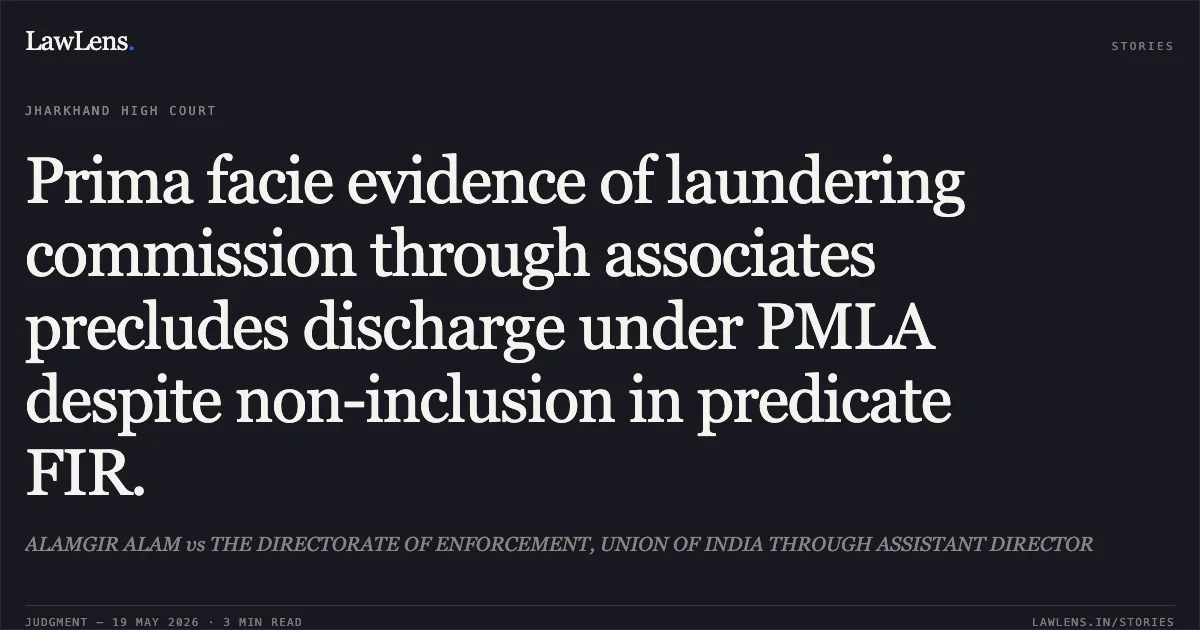
ALAMGIR ALAMvsTHE DIRECTORATE OF ENFORCEMENT, UNION OF INDIA THROUGH ASSISTANT DIRECTOR
Click to open original judgment
Original judgment, available to read, download and summarize on LawLens.in