Facts
The applicant was engaged to the deceased, Nafisa Joseph, after informing her that he had divorced his earlier wife through a memorandum of understanding. When he failed to produce divorce documents, disputes arose between them. On 28 July 2004, the deceased and her mother confronted the applicant at his residence, following which the applicant stated that he would not marry the deceased. On 29 July 2004, he reiterated his refusal to marry her. The deceased became distressed, refused to visit a doctor unless accompanied by the applicant, and later committed suicide by hanging herself at her residence.
Source reference: pp. 2–3; paras. 2–4An FIR was registered and, after investigation, a chargesheet was filed for an offence under Section 306 of the Indian Penal Code, 1860 (“IPC”). The applicant’s application for discharge under Section 227 of the Code of Criminal Procedure, 1973 (“CrPC”) was rejected by the Additional Sessions Judge. He challenged that order in revision under Sections 397 and 401 CrPC.
Source reference: pp. 3–4; paras. 5–6Issues
Whether the materials collected during investigation, taken at their face value, disclosed sufficient grounds to proceed against the applicant for abetment of suicide under Section 306 read with Section 107 IPC?
Source reference: pp. 16–17; paras. 19–21Whether the Sessions Court committed a manifest error of law or procedure in refusing to discharge the applicant under Section 227 CrPC?
Source reference: pp. 13, 17; paras. 16, 22Whether the revisional court could assess the evidentiary value of the prosecution material or conduct a mini-trial at the stage of discharge?
Source reference: pp. 7–13; paras. 10–16Law Applied
Section 306 IPC criminalises abetment of suicide, while Section 107 IPC defines abetment through instigation, conspiracy, or intentional aid. At the stage of discharge under Section 227 CrPC, the court must assume that the prosecution material is true and determine whether it discloses the ingredients of the alleged offence; it must not conduct a detailed appreciation of evidence or determine whether conviction is probable.
Source reference: pp. 7–10; paras. 11–12The Supreme Court’s decisions in Union of India v. Prafulla Kumar Samal, (1979) 3 SCC 4, and State of Tamil Nadu v. N. Suresh Rajan, (2014) 11 SCC 709, establish that strong suspicion may justify framing a charge, though it cannot substitute proof at trial. State of Rajasthan v. Ashok Kumar Kashyap, (2021) 11 SCC 191, and State of Gujarat v. Dilipsinh Kishorsinh Rao, (2023) 17 SCC 688, hold that a mini-trial and detailed evaluation of inconsistencies are impermissible at the discharge stage. Revisional jurisdiction under Sections 397 and 401 CrPC is limited and may be exercised to correct a manifest error of law or procedure, not to function as appellate jurisdiction.
Source reference: pp. 7–13; paras. 11–15Reasoning
The Court found that the prosecution material established a proximate sequence of events: the applicant’s failure to produce the promised divorce documents, the quarrel on 28 July 2004, his refusal to marry the deceased on 29 July 2004, the deceased’s distressed condition, and her suicide shortly thereafter. The marriage had allegedly been fixed for 7 August 2004, invitations had been distributed, and the deceased had been preparing for the marriage, making the applicant’s refusal a potentially significant and immediate circumstance.
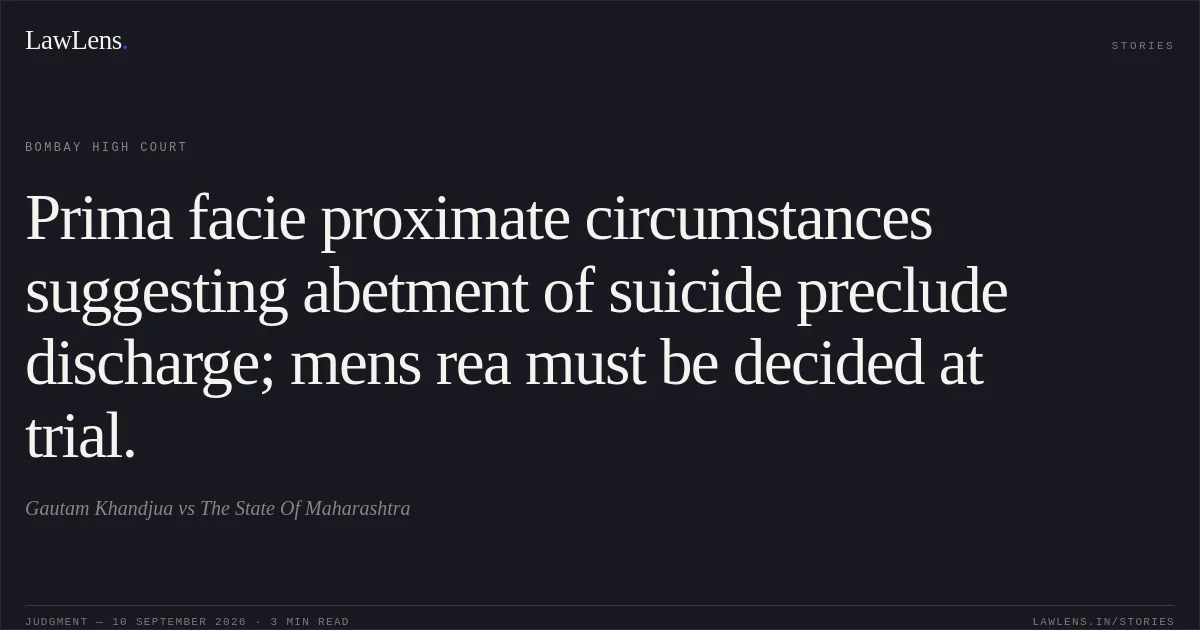
Source reference: pp. 14–16; para. 18Although the applicant argued that refusal to marry, emotional distress, and failure to accompany the deceased to a doctor did not constitute instigation or intentional aid, the Court held that whether these circumstances reflected the requisite intention, instigation, or aid could be determined only after trial and evaluation of evidence. At the discharge stage, the Court could not decide the applicant’s mens rea conclusively or assess the credibility and weight of witness statements.
Source reference: pp. 16–17; paras. 19–25The authorities relied upon by the applicant were distinguished because several concerned appeals after conviction or proceedings under Section 482 CrPC, involving a different scope of judicial scrutiny.
Source reference: pp. 18–20; paras. 27–31Holding
The Court held that the chargesheet material, if accepted at face value, disclosed sufficient grounds and circumstances to proceed against the applicant for the alleged offence under Section 306 read with Section 107 IPC. The Sessions Court had not committed any manifest error of law or procedure in rejecting the discharge application, and the High Court declined to undertake a mini-trial or reassess the prosecution evidence in revision.
The Criminal Revision Application was dismissed, the Rule was discharged, and the stay of trial was vacated. However, at the applicant’s request, the interim stay was continued for six weeks from 10 September 2026.
Source reference: p. 21; paras. 32–34Acts & Sections Cited
8 provisions across 3 statutes referred to in this judgment. Each provision opens on LawLens.
Code of Criminal Procedure, 19735
Indian Penal Code, 18602
Prevention of Corruption Act, 19881
Original Court PDF
Gautam KhandjuavsThe State Of Maharashtra
Click to open original judgment
Original judgment, available to read, download and summarize on LawLens.in