Facts
The deceased, Venkatachala Rajagopal, was the proprietor of M/s. Dinesh Contracts, a firm specialized in repairing boilers.
Source reference: no citationRespondent No. 1 (BBM Ispat Ltd) entrusted the firm to repair a boiler leakage at its premises
Source reference: p. 4, para 4On June 6, 2016, while the deceased was personally performing the repair work, the boiler blasted, causing fatal injuries
Source reference: p. 4-5, para 4The Appellants (legal heirs) filed a claim for compensation.
Source reference: no citationThe Commissioner for Workmen’s Compensation, Raichur, dismissed the claim in ECA No. 04/2017, holding that there was no jural relationship of employer-employee as the deceased was an independent contractor and not a "workman" under Section 2(n) of the Act
Source reference: p. 9, para 11; p. 24, para 10The Appellants challenged this dismissal before the High Court.
Source reference: no citationIssues
1. Whether the appellants established a jural relationship between Respondent No. 1 and M/s. Dinesh Contracts sufficient to bind Respondent No. 1 to make good the loss under the Act?
Source reference: p. 3, para 32. Whether Respondent No. 5 (Insurer) is liable to compensate the appellants by treating the deceased proprietor, who was personally working, as a "workman"?
Source reference: p. 4, para 3Law Applied
Section 12 of the Employees' Compensation Act, 1923, which establishes the liability of a "Principal Employer" to pay compensation to employees engaged through a contractor for work that is part of the principal's trade or business
Source reference: p. 9-11, para 11Section 2(e) (definition of employer) and Section 2(n) (definition of workman)
Source reference: p. 22-23The Act is a piece of social security and welfare legislation requiring a purposive, non-technical interpretation to effectuate the legislative intent of protecting those exposed to occupational risks
Source reference: p. 13-16, paras 1-19; p. 62, para 18.6Reasoning
The Court found that the Commissioner erred by applying a narrow, technical test of direct employment under Section 2.
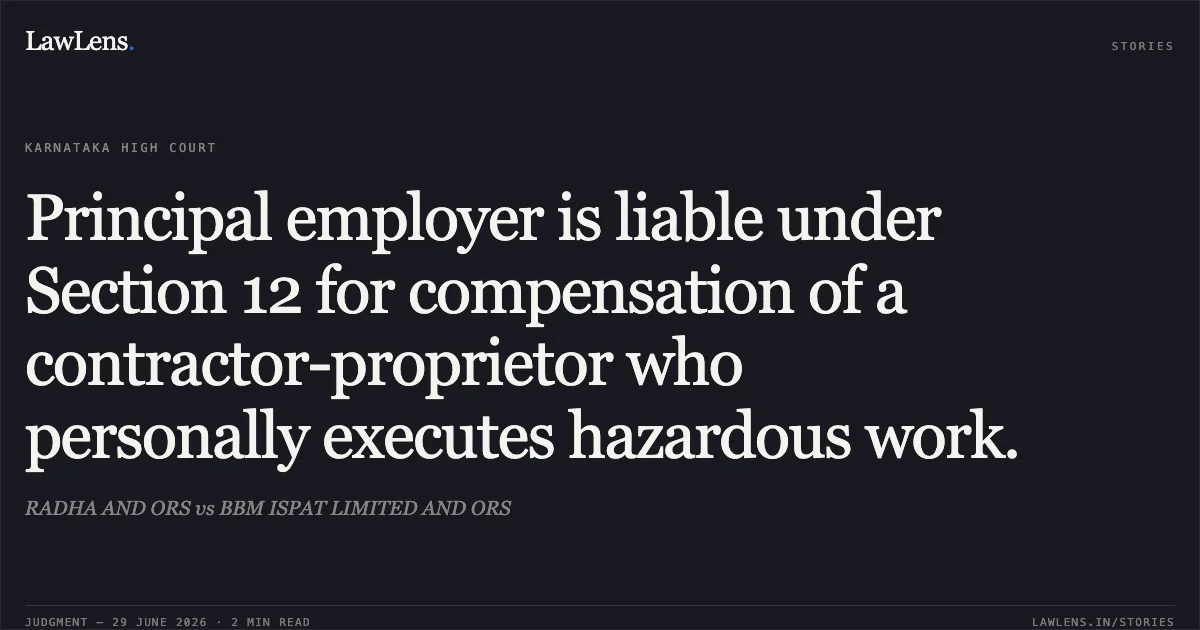
Source reference: no citationThe Court reasoned that Section 12 creates a statutory fiction where the Principal Employer (Respondent No. 1) is liable for injuries to workers engaged via a contractor if the work is for the principal's business and occurs on their premises
Source reference: p. 11-12, para 12Regarding the deceased’s status as a proprietor, the Court observed that in small proprietary concerns, the owner often acts as the primary technician/labourer
Source reference: p. 67, para 18.16Since the deceased was personally executing hazardous repair work for the benefit of Respondent No. 1's business, he was exposed to the same occupational risks as any other labourer
Source reference: p. 69, para 18.21The Court held that the status of "proprietor" and "workman" are not mutually exclusive under Section 12; excluding a working proprietor would defeat the welfare object of the Act
Source reference: p. 70, para 18.25Furthermore, as the insurance policy (Ex.R1) covered three labourers and contained no express exclusion for a working proprietor, the insurer was bound by the risk undertaken
Source reference: p. 7-8, para 9-10; p. 73, para 18.33Holding
The Court set aside the Commissioner's order and allowed the appeal in part
It held that a jural relationship existed under Section 12 of the Act, making Respondent No. 1 (Principal) and Respondent No. 5 (Insurer) jointly and severally liable
Source reference: p. 18, para 15The court awarded total compensation of Rs. 7,07,760/- with 12% interest per annum from the date of the accident
Source reference: p. 18, para 15Respondent No. 1 was granted liberty to recover the paid amount from the Insurance Company (Respondent No. 5)
Source reference: p. 19, para 15(v)Acts & Sections Cited
1 provisions across 1 statute referred to in this judgment. Each provision opens on LawLens.
Railways Act, 19891
Original Court PDF
RADHA AND ORSvsBBM ISPAT LIMITED AND ORS
Click to open original judgment
Original judgment, available to read, download and summarize on LawLens.in


