Facts
Punjab National Bank challenged the Controlling Authority’s order dated 30 December 2025 directing it to pay a former contract worker ₹47,335 with interest as gratuity.
Source reference: para. 1The worker had served at the Bank through different contractors; the Bank maintained that it had not appointed him, paid his wages, or had an employer–employee relationship with him, and that the contractors bore statutory liabilities under their agreements with the Bank.
Source reference: paras. 3–7The Bank filed a writ petition rather than an appeal. The respondents objected that the order was appealable and alleged that the writ petition was intended to avoid the limitation period and mandatory pre-deposit.
Source reference: paras. 15–19Issues
Whether the Bank, as principal employer, was liable for the worker’s gratuity despite his engagement through contractors.
Source reference: paras. 8–14, 18–20Whether the Court should interfere in writ jurisdiction with the Controlling Authority’s order when the Bank had not pursued the statutory appeal.
Source reference: paras. 15–20Law Applied
The Court applied the Payment of Gratuity Act, 1972, under which the Controlling Authority had made the impugned gratuity order.
Source reference: paras. 1, 21It treated the principal employer as responsible for workers’ dues, including statutory dues, where workers were engaged through contractors to perform work for the principal employer; the principal employer could seek recovery from the contractors if it had already paid them.
Source reference: para. 20The judgment identifies no specific statutory provision or judicial precedent.
Source reference: no citationReasoning
Although the Bank argued that contract engagement did not create a direct employment relationship and that the contractors bore gratuity liability, the Court noted that the worker had continuously provided services to the Bank through successive contractors and that the Bank was the principal employer.
Source reference: paras. 10–14, 20It considered the Bank responsible for the worker’s dues, while preserving its ability to recover from contractors who had defaulted after receiving payment.
Source reference: para. 20The Court also noted that the Bank had not appealed and regarded the writ petition as seeking to avoid the limitation period and pre-deposit requirement. It found no basis to interfere with the Controlling Authority’s order.
Source reference: paras. 19–21Holding
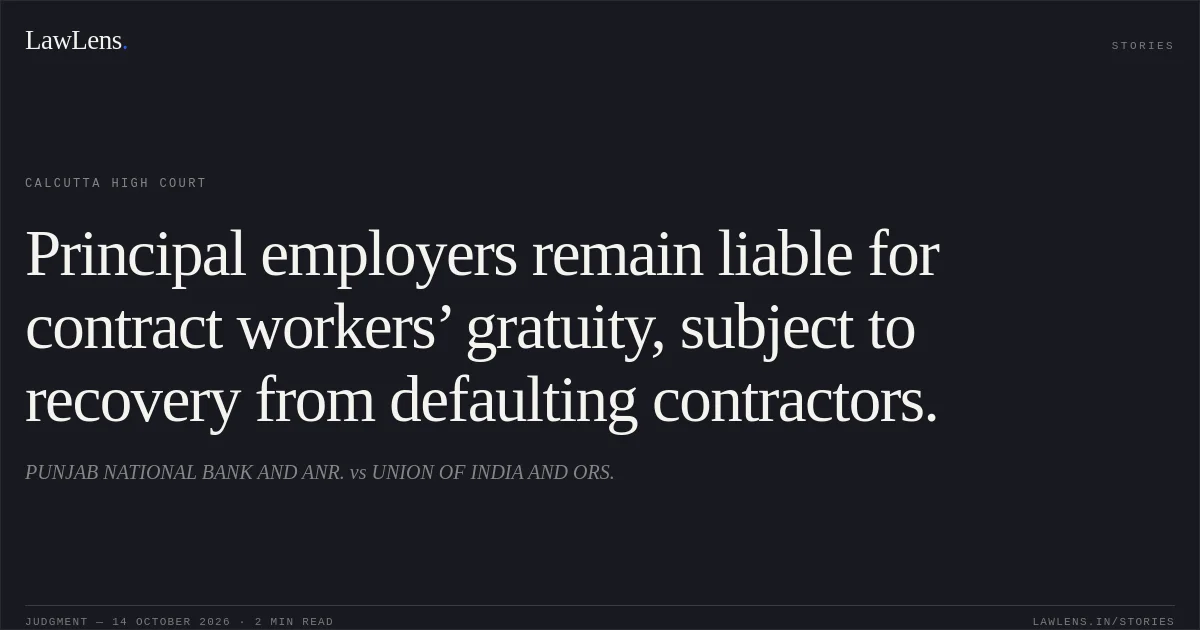
The Court dismissed the writ petition and declined to set aside the order directing the Bank to pay ₹47,335 with interest.
Connected applications, if any, were disposed of consequentially.
Source reference: para. 23Original Court PDF
PUNJAB NATIONAL BANK AND ANR.vsUNION OF INDIA AND ORS.
Click to open original judgment
Original judgment, available to read, download and summarize on LawLens.in


