Facts
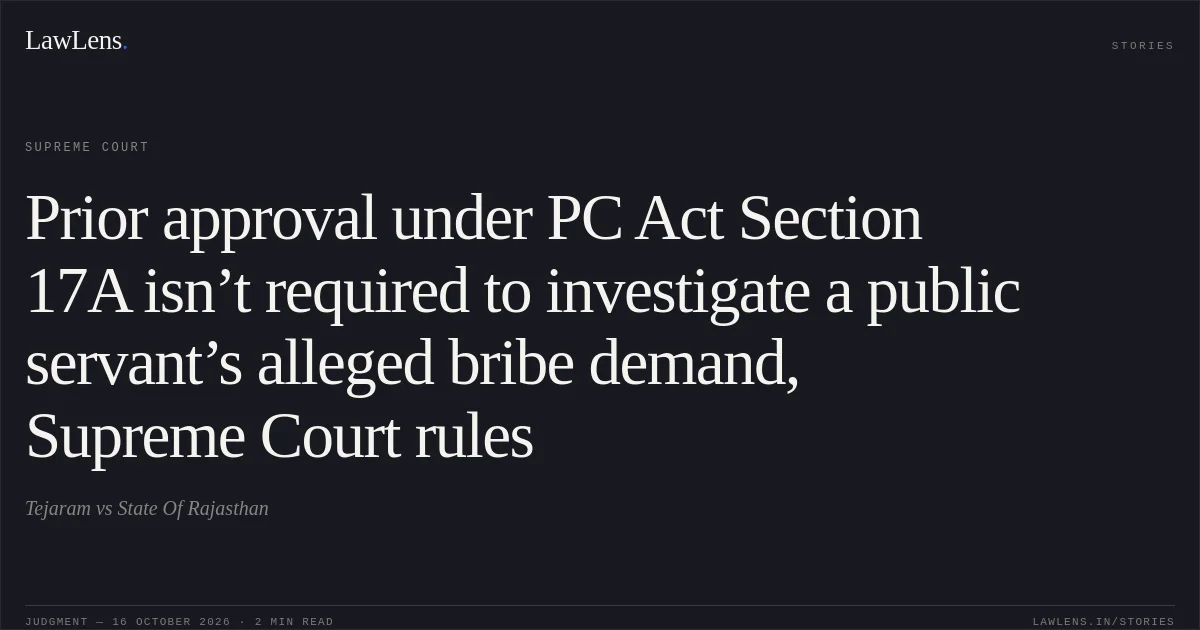
The appellant, a constable, was accused of demanding a bribe of ₹1.5 lakh on behalf of the Superintendent of Police.
Source reference: p. 2–4Following a complaint dated 22 April 2021, an FIR was registered on 4 June 2021, and the appellant was charged under Section 7 of the Prevention of Corruption Act, 1988 (PC Act).
Source reference: p. 2–4The Trial Court framed the charge on 12 September 2024; the High Court dismissed the appellant’s revision petition.
Source reference: p. 2–4Before the Supreme Court, the appellant contended that the investigation was invalid because prior approval under Section 17A of the PC Act had not been obtained.
Source reference: p. 6–7Prosecution sanction under Section 19 had been granted on 8 December 2023, before the chargesheet was filed.
Source reference: p. 6–7Issues
1. Whether prior approval under Section 17A of the PC Act was required before investigating the allegation that the appellant demanded illegal gratification.
Source reference: p. 4–6, 13–152. Whether the timing of the sanction under Section 19 of the PC Act vitiated the criminal proceedings.
Source reference: p. 8, 16Law Applied
Section 17A of the PC Act requires prior approval for an inquiry or investigation only where the alleged offence is relatable to a recommendation made or decision taken by a public servant in the discharge of official functions or duties; it does not provide blanket protection for criminal conduct unrelated to such functions.
Source reference: p. 7–9, 13–15In Central Bureau of Investigation v. Santosh Karnani, the Court held that Section 17A does not apply to an allegation of demanding a bribe where the accusation is not connected to an official recommendation or decision.
Source reference: p. 9–10The Court also relied on Surendra Dhariwal v. State of Rajasthan and Anil Daima v. State of Rajasthan as consistent authorities on the inapplicability of Section 17A to allegations of illegal gratification.
Source reference: p. 11–12As to Section 19, the Court held that the sanction had been obtained before cognizance and that the alleged delay did not, in the circumstances, vitiate the proceedings.
Source reference: p. 16Reasoning
The Court found that the accusation was that the appellant demanded illegal gratification—a criminal act neither forming part of his official duties nor linked to any recommendation or decision made in their discharge.
Source reference: p. 13–15The essential conditions for Section 17A approval were therefore absent, and the proceedings were not invalid for want of that approval.
Source reference: p. 13–15The Court considered the challenge concerning Section 19 and concluded that sanction had been obtained before cognizance; the asserted delay amounted only to an irregularity and did not invalidate the proceedings or the trial.
Source reference: p. 16The pending reference concerning the validity of Section 17A did not need to be awaited because that provision did not apply to the facts of this case.
Source reference: p. 15–16Holding
The Supreme Court held that Section 17A of the PC Act did not apply to the allegation of demand for a bribe and that the absence of prior approval did not vitiate the criminal proceedings.
The Section 19 sanction challenge also failed.
Source reference: p. 16–17The appeal was dismissed, and the High Court’s order upholding the framing of charge was affirmed.
Source reference: p. 16–17Acts & Sections Cited
5 provisions across 3 statutes referred to in this judgment. Each provision opens on LawLens.
Prevention of Corruption Act, 19882
Indian Penal Code, 18602
Code of Criminal Procedure, 19731
Original Court PDF
TejaramvsState Of Rajasthan
Click to open original judgment
Original judgment, available to read, download and summarize on LawLens.in