Facts
The Appellant, an Assistant Teacher at Saai Memorial Girls School (a private unaided school), was issued a charge-sheet on 16 October 2006 alleging inefficiency, misbehaviour with the Principal/staff, and refusal to attend a parent-teacher meeting.
Source reference: p. 2-3An Inquiry Officer (IO) found the charges proved/partly proved.
Source reference: p. 5Consequently, the School Management removed her from service on 29 March 2007 without obtaining prior approval from the Director of Education (DOE).
Source reference: p. 6The Delhi School Tribunal (DST) and a Single Judge of the High Court dismissed her challenges.
Source reference: p. 6-8The Appellant filed two Letters Patent Appeals (LPAs): LPA 266/2017 challenging the termination and LPA 268/2017 regarding allegations of "salary kickbacks" (taking back salary in cash).
Source reference: p. 2, 23Issues
1. Whether the termination of an employee of a private unaided school is valid without the prior approval of the Director of Education under Section 8(2) of the DSE Act.
Source reference: p. 9 / para. 172. Whether the disciplinary proceedings were vitiated by the inclusion of the complainants/witnesses within the Disciplinary Authority (DA) under the principle of nemo judex in causa sua.
Source reference: p. 14 / para. 283. Whether the High Court can adjudicate disputed questions of fact regarding salary kickbacks under Article 226.
Source reference: p. 23 / para. 57Law Applied
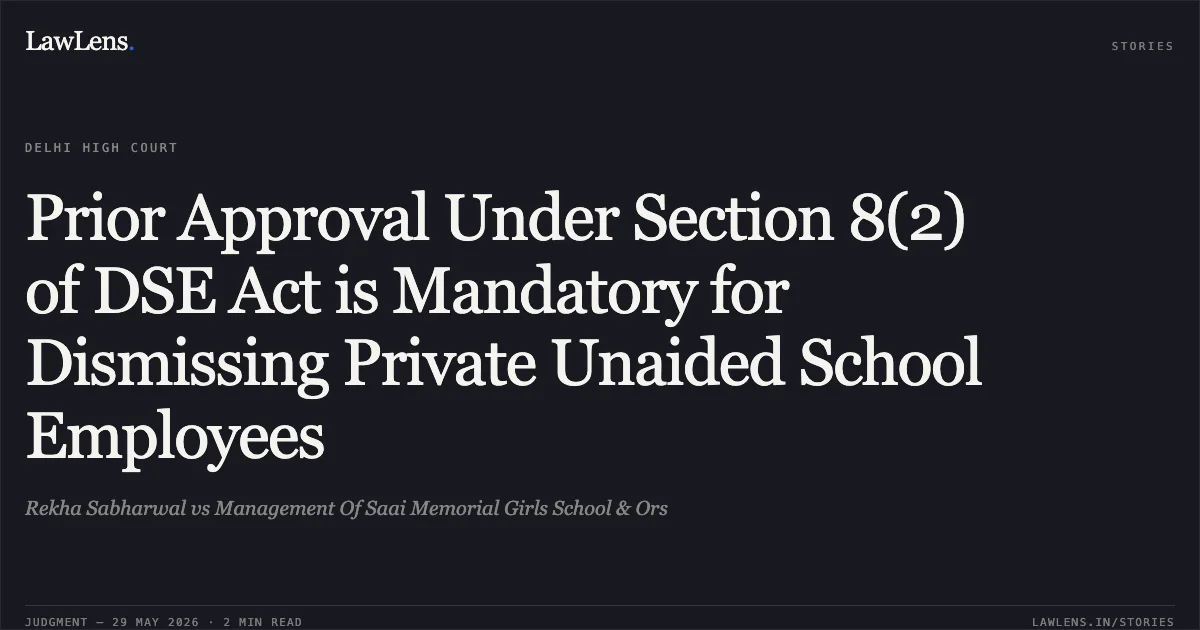
The Court applied Section 8(2) of the Delhi School Education (DSE) Act, 1973, which mandates prior approval of the Director for the dismissal of any employee of a recognized private school.
Source reference: p. 9It relied on the Supreme Court precedents in Raj Kumar v. Director of Education and Marwari Balika Vidyalaya v. Asha Srivastava, which settled that Section 8(2) applies to unaided schools and operates retrospectively.
Source reference: p. 10The Court also applied the principle of nemo judex in causa sua (no man shall be a judge in his own cause) to ensure unbiased disciplinary adjudication and the "Doctrine of Severability" regarding charges.
Source reference: p. 14, 15Reasoning
In LPA 266/2017, the Court held that the termination was void ab initio because the School failed to obtain prior approval from the DOE, a mandatory jurisdictional requirement under Section 8(2) as clarified in Raj Kumar.
Source reference: p. 12-13Furthermore, the Court found the Disciplinary Authority's composition biased; the Principal and Vice-Principal, who were complainants and witnesses, were also part of the deciding body, violating principles of natural justice.
Source reference: p. 15Regarding the merits, the Court noted the Appellant was a Hindi graduate suddenly asked to teach English, suggesting potential harassment that required a de novo inquiry by an independent officer.
Source reference: p. 17-18In LPA 268/2017, the Court held that allegations of the school taking back salary in cash involved complex disputed facts and lacked conclusive evidence, making them unsuitable for writ jurisdiction.
Source reference: p. 23-24Holding
The Court allowed LPA 266/2017, setting aside the termination and the Single Judge’s judgment.
It ordered the Appellant's reinstatement with continuity of service and 50% back wages and directed a de novo inquiry into the original charge-sheet by an independent IO and a reconstituted DA, emphasizing that any fresh penalty must comply with Section 8(2) approval. LPA 268/2017 was dismissed as it involved disputed questions of fact.
Source reference: p. 21-22, 24Acts & Sections Cited
1 provisions across 1 statute referred to in this judgment. Each provision opens on LawLens.
Delhi School Education Act, 19731
Original Court PDF
Rekha SabharwalvsManagement Of Saai Memorial Girls School & Ors
Click to open original judgment
Original judgment, available to read, download and summarize on LawLens.in