Facts
The appellant, an Assistant Sub-Inspector (Ministerial) posted in the Sports Cell of CISF Headquarters, handled matters concerning the complainant Inspector Ajay Kumar Vats’s kit allowance of ₹10,000 for participation as Coach of the Indian Junior Judo Team at the 5th Asian Junior Judo Championship.
Source reference: pp. 1–6, paras. 1–12The prosecution alleged that the appellant demanded ₹5,000 from the complainant for release of the allowance and reiterated the demand after handing over the cheque. The complainant lodged a complaint with the CBI, following which a trap was conducted on 28 October 2004. The appellant was allegedly apprehended after accepting ₹3,000 in tainted currency; the notes were recovered from him and the hand-wash and pocket-wash tests were positive for phenolphthalein.
Source reference: pp. 1–6, paras. 1–12The appellant denied the allegations and claimed that the money represented repayment of a friendly loan. The Trial Court convicted him under Sections 7 and 13(2) read with Section 13(1)(d) of the Prevention of Corruption Act, 1988, and sentenced him to concurrent rigorous imprisonment of two years with fines.
Source reference: pp. 1–6, paras. 1–12Issues
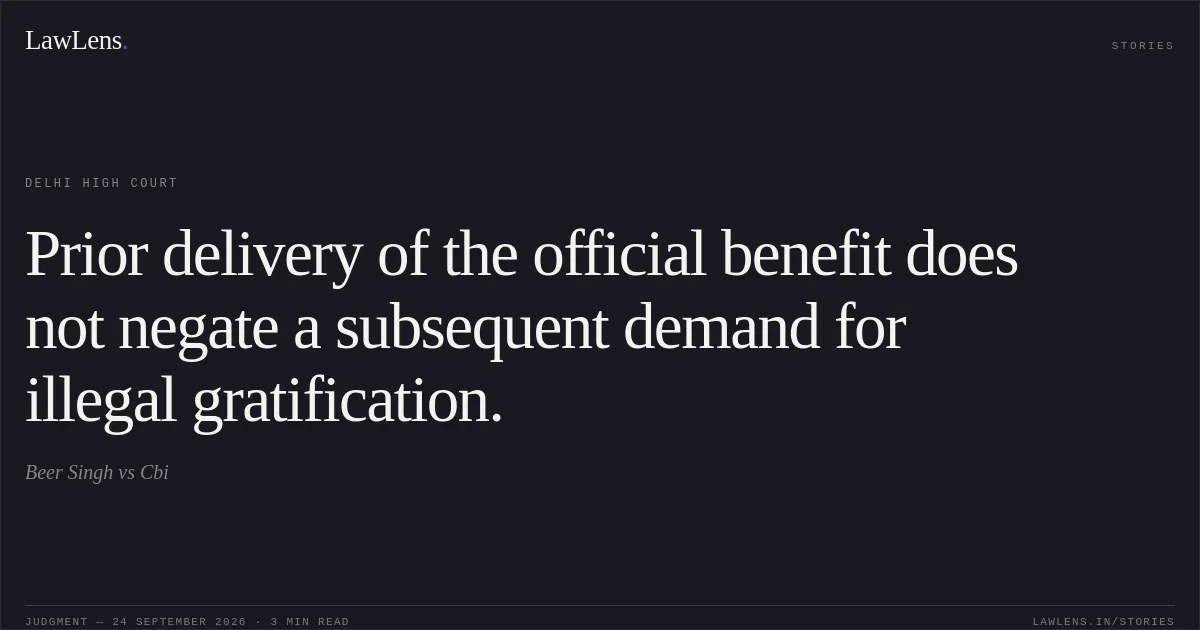
Whether the prosecution proved beyond reasonable doubt that the appellant demanded and accepted ₹3,000 as illegal gratification in connection with the complainant’s official kit allowance, notwithstanding that the cheque had already been delivered.
Source reference: pp. 15–18, paras. 25–31Whether the recovery of tainted currency, positive chemical tests, recorded conversation, and trap evidence established the foundational facts necessary to invoke the presumption under Section 20 of the Prevention of Corruption Act.
Source reference: pp. 12–15, 24–28, paras. 24–25, 44, 48–49Whether the appellant’s defence that the money was repayment of a friendly loan, together with alleged inconsistencies in the prosecution evidence and the appellant’s limited official authority, created a reasonable doubt.
Source reference: pp. 8–11, 19–27, paras. 16–23, 33–47Law Applied
The Court applied Sections 7 and 13(1)(d), punishable under Section 13(2), of the Prevention of Corruption Act, 1988.
Source reference: pp. 12–15, 22–24, paras. 24–25, 40It held, following the Constitution Bench decision in Neeraj Dutta v. State (Govt. of NCT of Delhi), (2023) 4 SCC 731, that proof of demand and acceptance or obtainment of illegal gratification is indispensable; mere recovery of money is insufficient.
Source reference: pp. 12–15, 22–24, paras. 24–25, 40Demand and acceptance may be proved through direct or circumstantial evidence, and the presumption of fact may arise only after the foundational facts are established.
Source reference: pp. 12–15, 22–24, paras. 24–25, 40Once acceptance of gratification is proved for Section 7, Section 20 mandates a rebuttable presumption that the money was accepted as a motive or reward.
Source reference: pp. 12–15, 22–24, paras. 24–25, 40Section 20 does not apply independently of proof of the foundational facts and does not govern Section 13(1)(d).
Source reference: pp. 12–15, 22–24, paras. 24–25, 40The Court also relied on Sita Soren v. Union of India, (2024) 5 SCC 629, for the principle that the offence of bribery is complete upon acceptance of, or agreement to accept, the bribe and does not depend upon the subsequent performance or non-performance of the promised official act.
Source reference: pp. 12–15, 22–24, paras. 24–25, 40Reasoning
The Court held that the appellant’s lack of final sanctioning authority did not preclude a demand for gratification because he was the dealing hand associated with processing the allowance and had access to and delivered the cheque.
Source reference: pp. 15–21, 25–29, paras. 26–39, 41–51Although the cheque had been handed over before the trap, the complainant’s testimony established that the appellant continued to demand ₹5,000 as a reward, and this account was corroborated by the recorded pre-trap conversation, the testimony of the trap witnesses, recovery of the tainted notes, and positive hand- and pocket-wash results.
Source reference: pp. 15–21, 25–29, paras. 26–39, 41–51The discrepancy between the demanded ₹5,000 and the recovered ₹3,000 was explained by the complainant’s inability to arrange the full amount.
Source reference: pp. 15–21, 25–29, paras. 26–39, 41–51Variations concerning the motorcycle, clothing, pocket of recovery, and peripheral details were treated as immaterial because they did not undermine the core evidence of demand, acceptance, and recovery.
Source reference: pp. 15–21, 25–29, paras. 26–39, 41–51The appellant’s statement that he was “taking a loan,” his prior acquaintance with the complainant, and the alleged friendly-loan explanation were found unsupported by particulars or independent evidence and insufficient to rebut the statutory presumption.
Source reference: pp. 15–21, 25–29, paras. 26–39, 41–51Holding
The High Court held that the prosecution proved the essential elements of demand and acceptance of illegal gratification independently of mere recovery.
The presumption under Section 20 was therefore validly attracted, and the appellant failed to rebut it.
Source reference: pp. 29–30, paras. 48–56His conviction under Section 7 and under Section 13(2) read with Section 13(1)(d) of the Prevention of Corruption Act was upheld.
Source reference: pp. 29–30, paras. 48–56The appeal was dismissed, and the appellant was directed to surrender forthwith to undergo the sentence, with the benefit of set-off under Section 428 Cr.P.C.
Source reference: pp. 29–30, paras. 48–56Acts & Sections Cited
5 provisions across 2 statutes referred to in this judgment. Each provision opens on LawLens.
Prevention of Corruption Act, 19883
Code of Criminal Procedure, 19732
Original Court PDF
Beer SinghvsCbi
Click to open original judgment
Original judgment, available to read, download and summarize on LawLens.in