Facts
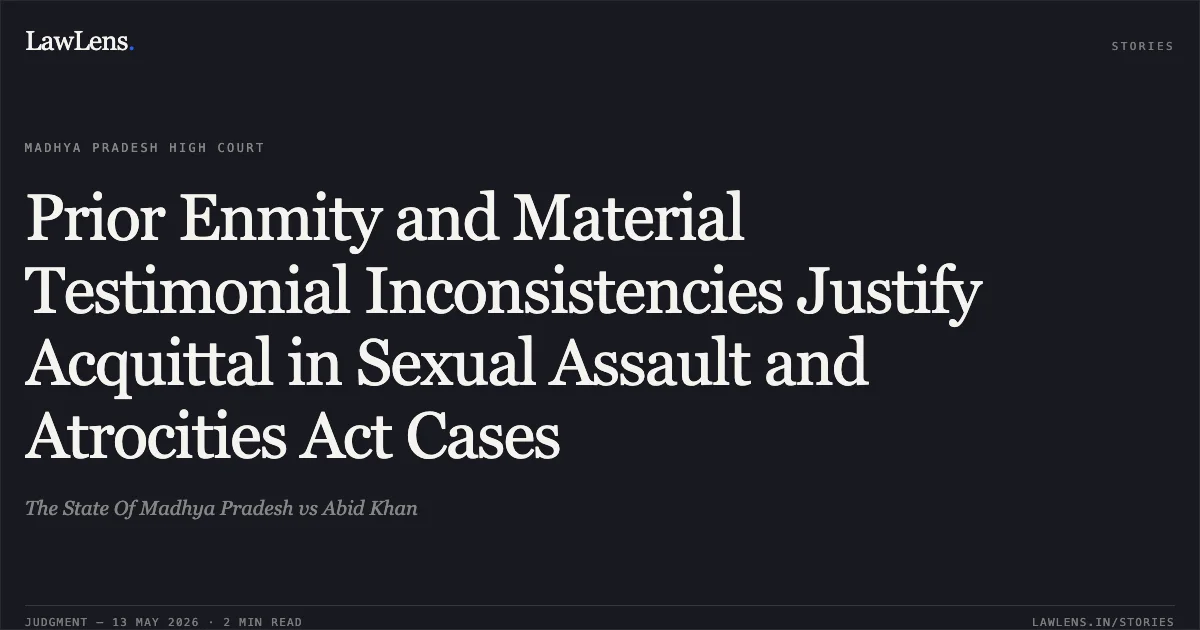
The State appealed against the judgment dated 20.10.2022 passed by the Special Judge, POCSO Act, Bhopal, which acquitted the respondent of charges under Sections 354, 354-A, and 323 of the IPC; Sections 7/8 of the POCSO Act; and various sections of the SC/ST (Prevention of Atrocities) Act.
Source reference: para. 1The prosecution alleged that on 10.03.2019, the respondent caught the minor prosecutrix’s hand with ill-intent and assaulted her with a bamboo stick when she resisted.
Source reference: para. 2The trial court acquitted the accused despite finding that the prosecutrix was a minor and belonged to the Scheduled Caste community.
Source reference: para. 6The State contended that the testimonies of the prosecutrix (PW-2) and her family members (PW-1, PW-3, PW-4) were sufficient for conviction.
Source reference: para. 6Issues
1. Whether the trial court’s findings regarding the material contradictions and inconsistencies in the prosecution's evidence were perverse or manifestly erroneous so as to warrant interference in an appeal against acquittal.
Source reference: para. 16-222. Whether the potential for false implication due to prior enmity between the parties rendered the prosecution’s version doubtful.
Source reference: para. 15Law Applied
The court applied Section 378 of the CrPC regarding appeals against acquittal.
Source reference: para. 1The court relied on the principles established in H.D. Sundara v. State of Karnataka (2023) and Mallappa v. State of Karnataka (2024), which mandate that an appellate court should not overturn an acquittal if the trial court’s view is a "legally plausible view," even if a contrary view is possible.
Source reference: para. 17, 21The court referred to Babu Sahebagouda Rudragoudar v. State of Karnataka (2024), stating interference is only justified in cases of patent perversity or misreading of material evidence.
Source reference: para. 18Reasoning
The High Court found significant discrepancies in the prosecution's narrative. While the sister (PW-3) claimed to have witnessed the assault, the prosecutrix (PW-2) stated her sister had already left to call their father when the assault occurred.
Source reference: para. 10There were contradictions regarding whether the father (PW-4) was present at the house or at a water tap during the incident.
Source reference: para. 11, 13While the father claimed the accused entered the house, the spot map (Ex. P/2) indicated the incident occurred in an open courtyard.
Source reference: para. 11Crucially, the court noted admitted prior enmity and previous police reports filed by the prosecutrix’s father against the respondent concerning disputes over a water tap, suggesting a motive for false implication.
Source reference: para. 15The court reasoned that in light of these inconsistencies and the lack of naturalness in the testimony, the trial court's decision to acquit was a reasonable and plausible view.
Source reference: para. 14, 22Holding
The Court held that the trial court's appreciation of evidence was not faulty and that no grounds for interference existed under the limited scope of Section 378 CrPC.
The appeal was dismissed, and the judgment of acquittal was affirmed.
Source reference: para. 23Acts & Sections Cited
9 provisions across 4 statutes referred to in this judgment. Each provision opens on LawLens.
Code of Criminal Procedure, 19733
Indian Penal Code, 18602
Scheduled Castes and the Scheduled Tribes (Prevention of Atrocities) Act, 19891
Original Court PDF
The State Of Madhya PradeshvsAbid Khan
Click to open original judgment
Original judgment, available to read, download and summarize on LawLens.in