01Facts
A complaint was lodged alleging that the petitioner, while serving as President of Amarnath Grih Nirman Sahakari Sanstha, fraudulently re-allotted/resold Plot No. 38, Khasra No. 17/1/2, Gram Damkheda, Bhopal, to Sunita Kushwaha on 6 May 2009, despite its earlier allotment to the complainant in 1997. An FIR was registered, followed by investigation and filing of a charge-sheet. The Judicial Magistrate First Class convicted the petitioner under Sections 420 and 421 of the IPC and sentenced him to one year’s simple imprisonment under each provision, with fines of Rs. 5,000 under each section, by judgment dated 28 January 2023.
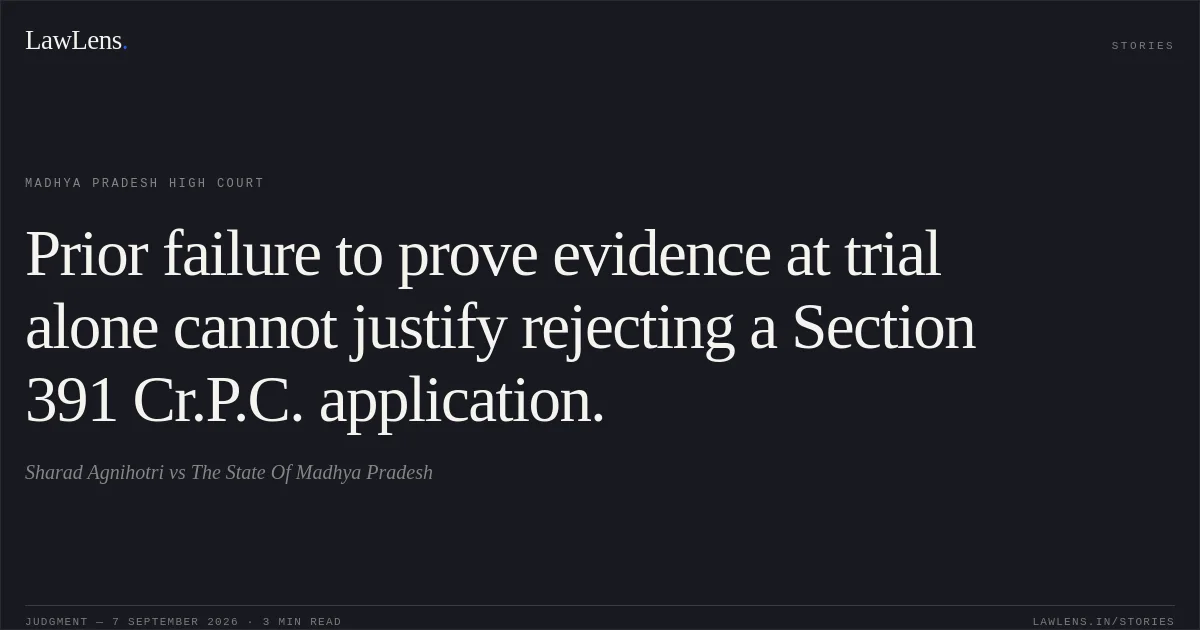
¶ 2The petitioner preferred Criminal Appeal No. 121/2023 before the Additional Sessions Judge, Bhopal. During the appeal, he sought permission under Section 391 Cr.P.C. to produce additional evidence, including Society notices, newspaper publications, and Society proceedings/minutes concerning cancellation of the complainant’s allotment. He contended that the documents were already part of the trial record but had not been formally exhibited due to an omission by defence counsel. The appellate court rejected the application on the ground that the petitioner had sufficient opportunity during trial to produce and prove the documents. The petitioner challenged that order under Section 528 BNSS before the High Court.
¶ 302Issues
i.1. Whether the appellate court was justified in rejecting the petitioner’s application under Section 391 Cr.P.C. solely because the petitioner had an earlier opportunity to produce and prove the documents during trial?
¶ 6ii.2. Whether the proposed additional evidence was necessary for the just and effective adjudication of the criminal appeal, notwithstanding its non-exhibition during trial?
¶ 7–1003Law Applied
Section 391 Cr.P.C. empowers an appellate court to take additional evidence or direct that it be taken when such evidence is necessary for a just decision of the case. Although the provision cannot be used merely to enable a party to fill a deliberately created lacuna, the decisive consideration is whether consideration of the evidence is necessary to prevent failure of justice, rather than merely whether it could have been produced earlier.
¶ 7The appellate court must assess whether the evidence has a direct bearing on a material finding and is required for proper and effective adjudication. Any prejudice to the prosecution may be addressed by granting full opportunity to object to admissibility, genuineness, relevancy and mode of proof, to cross-examine witnesses, and to lead rebuttal evidence. The High Court exercised its inherent jurisdiction under Section 528 BNSS to correct the restrictive approach adopted by the appellate court.
¶ 1, 10–12, 14Provisions in the judgment · 4 · Linked ones open on LawLens
Bharatiya Nagarik Suraksha Sanhita, 2023 Section 528
Code of Criminal Procedure, 1973 Section 391
Indian Penal Code, 1860 Section 420Section 421
04Reasoning
The proposed documents directly concerned the petitioner’s defence that the complainant’s allotment had been validly cancelled. The notices dated 23 February 2008, 13 November 2009, 15 December 2009 and 26 December 2009, along with newspaper publications and Society minutes, addressed the very issue on which the trial court had drawn an adverse inference—namely, the absence of proof that notice had been given and that the Society had taken a decision to cancel the allotment.
¶ 8The High Court found that the petitioner was not seeking to introduce a wholly new defence or factual foundation; the documents related to the original transaction and were stated to have been available in the trial record.
¶ 9Although the petitioner’s failure to formally prove the documents during trial was relevant, it was not conclusive. Since the evidence could materially assist determination of the correctness of the conviction, exclusion of the documents merely because of an earlier omission could result in incomplete adjudication. The prosecution’s interests could be protected through objections, cross-examination and rebuttal evidence.
¶ 10–1305Holding
The High Court held that the appellate court had adopted an unduly restrictive approach by rejecting the Section 391 Cr.P.C. application solely on the ground that the petitioner had earlier opportunities to produce the documents.
¶ 15The application under Section 528 BNSS was allowed, and the order dated 23 May 2026 in Criminal Appeal No. 121/2023 was set aside. The appellate court was directed to permit the petitioner to produce and prove the documents, subject to law, while granting the prosecution full opportunity to object, cross-examine and adduce rebuttal evidence. The High Court expressly left the genuineness, admissibility, evidentiary value of the documents and the merits of the criminal appeal open for independent determination by the appellate court.
¶ 16–17Original Court PDF
Sharad AgnihotrivsThe State Of Madhya Pradesh
Click to open original judgment
Original judgment, available to read, download and summarize on LawLens.in