Facts
The petitioner sought 28 days’ ordinary leave for her husband, Muthurasa, a convict imprisoned for an offence under the NDPS Act.
Source reference: p. 1–2The prison authority rejected the application on 21 August 2026, relying on Rule 21(h)(3) of the Tamil Nadu Suspension of Sentence Rules, 1982, which it treated as barring ordinary leave for prisoners convicted in cases involving commercial quantities of narcotic or psychotropic substances.
Source reference: p. 1–2The petitioner challenged that rejection under Article 226, relying on a coordinate Bench order and stating that her husband had been incarcerated for nearly seven years.
Source reference: p. 3Issues
1. Whether a prisoner convicted under the NDPS Act in a case involving a commercial quantity is eligible for ordinary leave under the Tamil Nadu Suspension of Sentence Rules, 1982.
Source reference: p. 2, 4–52. Whether the petitioner’s reliance on a coordinate Bench order and the prisoner’s period of incarceration justified setting aside the rejection of ordinary leave.
Source reference: p. 3, 5Law Applied
Rule 3 of the Tamil Nadu Suspension of Sentence Rules, 1982 provides that leave is a concession and cannot be claimed as a matter of right.
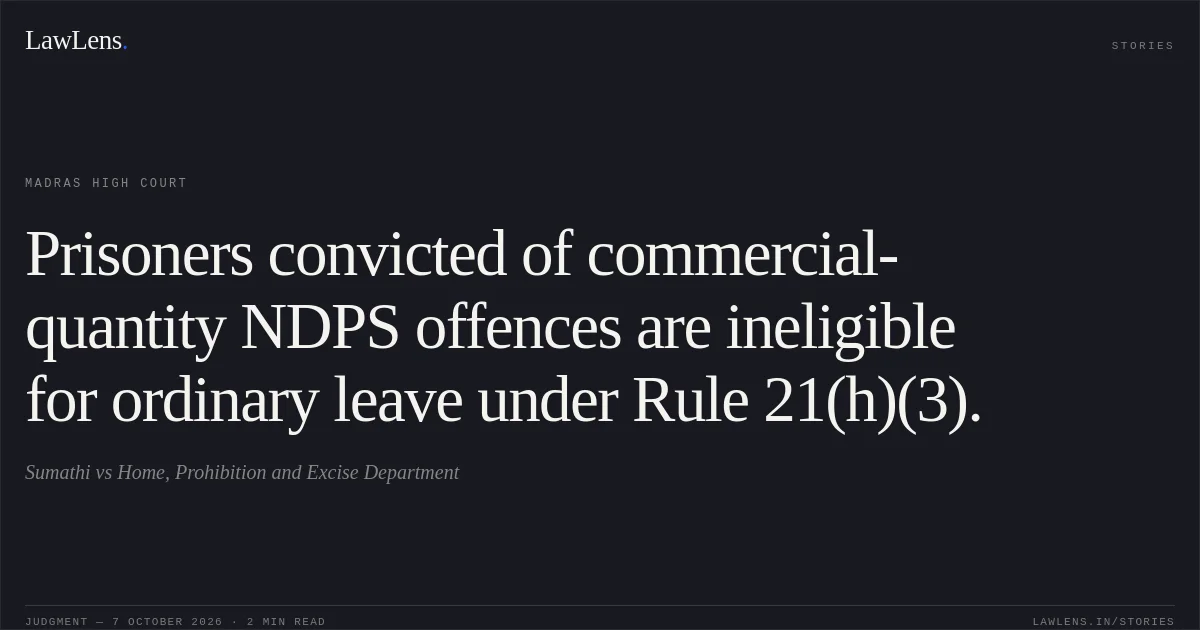
Source reference: p. 3Rule 21 sets out categories of prisoners ineligible for ordinary leave; the Court read Rule 21(h)(3) as barring ordinary leave for prisoners convicted under the NDPS Act in cases involving commercial quantities.
Source reference: p. 3–5Rule 22 concerns eligibility, duration and intervals for ordinary leave, but, in the Court’s view, does not displace the Rule 21 bar.
Source reference: p. 4The Court also observed that emergency leave was not barred, but the petitioner had sought only ordinary leave.
Source reference: p. 5Reasoning
The Court held that the petitioner’s husband’s NDPS conviction brought him within the category barred from ordinary leave under Rule 21(h)(3).
Source reference: p. 4–5His period of incarceration and the cited coordinate Bench order did not establish an entitlement to leave: the Court considered that order inapplicable because it had not examined the relevant rule position.
Source reference: p. 3, 5Since the application sought ordinary leave, the Court did not grant relief on the separate possibility of emergency leave.
Source reference: p. 5Holding
The Court found no infirmity in the prison authority’s rejection of the application for 28 days’ ordinary leave and dismissed the writ petition.
The connected writ miscellaneous petition was closed, with no order as to costs.
Source reference: p. 6Acts & Sections Cited
12 provisions across 2 statutes referred to in this judgment. Each provision opens on LawLens.
Indian Penal Code, 1860
Explosive Substances Act, 19081
Original Court PDF
SumathivsHome, Prohibition and Excise Department
Click to open original judgment
Original judgment, available to read, download and summarize on LawLens.in