Facts
Respondent No. 1, a primary teacher at the Petitioner-School since 2008, sustained a 90% locomotor disability (traumatic paraplegia) on 22.08.2013.
Source reference: paras. 3–4The injury occurred when she attempted to save a student threatening to jump from a windowsill.
Source reference: para. 6The Petitioner paid initial medical bills and salary up to May 2015, but then offered her a lower-paying "retainer role" rather than reinstating her as a teacher with accommodations.
Source reference: paras. 7–9Treating the refusal as a lapse in service, the School effectively terminated her.
Source reference: para. 23.40In 2019, the Teacher filed a complaint before Respondent No. 2 (State Commissioner for Persons with Disabilities).
Source reference: para. 10The Commissioner ordered the School to pay ₹10 lakhs for medical expenses and future costs.
Source reference: para. 11The Petitioner challenged this order, claiming the Commissioner lacked jurisdiction over private unaided schools and that the claim was barred by limitation.
Source reference: paras. 12.3–12.4Issues
1. Whether the Rights of Persons with Disabilities Act (RPwD Act), 2016, applies to private unaided educational institutions.
Source reference: para. 19, Point 12. Whether the State Commissioner has the power to issue binding corrective directions and compensatory orders against private establishments.
Source reference: para. 19, Point 93. Whether the complaint was barred by limitation given the multi-year delay between termination and filing.
Source reference: para. 19, Point 84. Whether the denial of "reasonable accommodation" by a private employer constitutes actionable discrimination.
Source reference: para. 19, Point 7Law Applied
The Court applied the Rights of Persons with Disabilities Act, 2016, specifically Section 2(i) which expands "establishment" to include private entities.
Source reference: para. 21.21Section 3(3) regarding universal non-discrimination.
Source reference: para. 25.4Section 2(y) defining "reasonable accommodation".
Source reference: para. 23.20Section 82(2), which deems the Commissioner a civil court for specific judicial proceedings, distinguishing it from the 1995 Act.
Source reference: para. 29.12Precedentially, it followed Vikash Kumar v. UPSC, which designated the RPwD Act a "watershed" legislation applying to the private sector.
Source reference: para. 21.26In Re: Recruitment of PWD Candidates (Rajasthan), which labeled it a "super statute".
Source reference: para. 21.27Kabir Paharia v. NMC, establishing reasonable accommodation as a fundamental right under Articles 14 and 21.
Source reference: para. 25.10Reasoning
The Court rejected the Petitioner's reliance on Dalco Engineering and Vinesh Kumar Bhasin, noting those were decided under the narrower 1995 Act.
Source reference: paras. 21.25, 29.13Under the 2016 Act, "establishment" expressly includes private institutions.
Source reference: para. 21.21The Court found that while Section 20 applies to government jobs, Section 3(3) imposes a universal prohibition on discrimination that binds private employers.
Source reference: para. 23.32The School’s failure to provide a ground-floor classroom or accessible restrooms—and offering a demotion instead—constituted "discrimination by omission".
Source reference: paras. 25.30, 27.37Regarding jurisdiction, the Court held that Section 82(2) of the 2016 Act gives the Commissioner broader powers than the 1995 Act, including the power to direct "corrective action".
Source reference: para. 29.30The limitation plea was dismissed because disability rights violations constitute a "continuing cause of action".
Source reference: para. 28.28A three-year delay for a paraplegic person following rehabilitation is "reasonable".
Source reference: para. 28.35Holding
The Court dismissed the writ petition and upheld the Commissioner’s order.
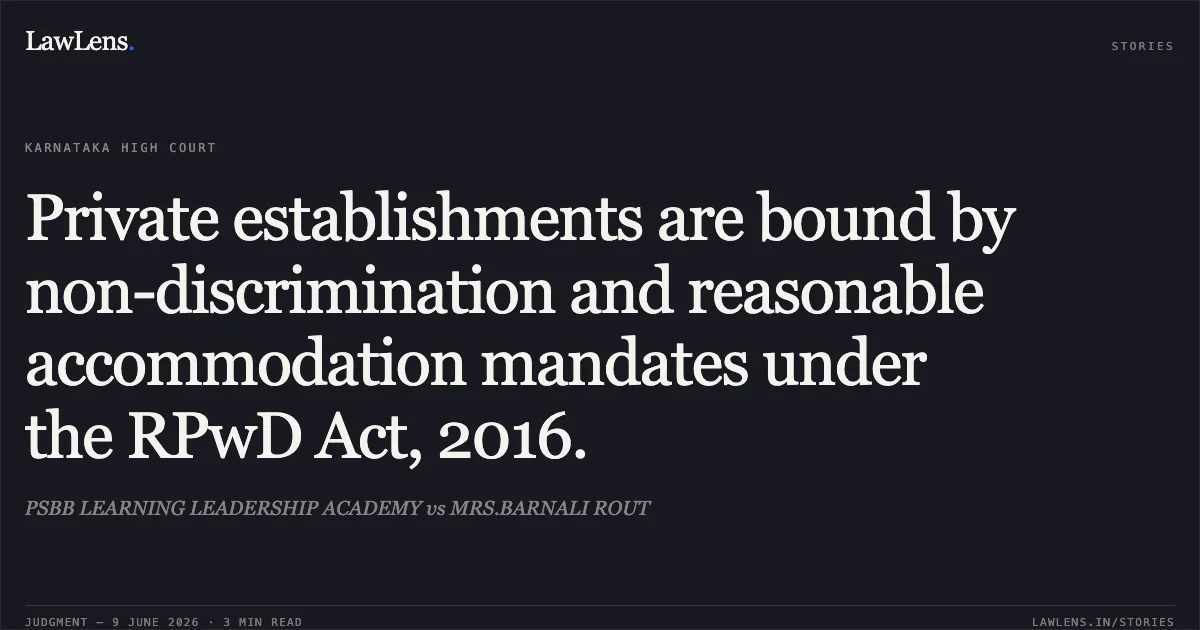
The Court held that the RPwD Act, 2016, applies to private schools and the Commissioner has the power to award compensation.
Source reference: paras. 21.47, 29.33The Court ordered the Petitioner to: (i) pay ₹10,00,000 within three months; (ii) frame an Equal Opportunity Policy; (iii) conduct an accessibility audit; and (iv) offer formal reinstatement to the Teacher with specific accommodations—including a ground-floor classroom and transport allowance—with seniority protected but without back wages.
Source reference: Orders ii, iii(a), iii(b), iii(c), ivThe Court issued a comprehensive Standard Operating Procedure (SOP) for universal accessibility in Karnataka.
Source reference: p. 421Acts & Sections Cited
36 provisions across 6 statutes referred to in this judgment. Each provision opens on LawLens.
Rights of Persons with Disabilities Act, 2016.
Limitation Act, 19631
Code of Civil Procedure, 19081
Indian Penal Code, 18603
Code of Criminal Procedure, 19731
Companies Act, 20131
Original Court PDF
PSBB LEARNING LEADERSHIP ACADEMYvsMRS.BARNALI ROUT
Click to open original judgment
Original judgment, available to read, download and summarize on LawLens.in