Facts
The petitioners (Apollo Hospital) admitted Ms. Poonam Gupta (respondent no. 3) on September 15, 2021, following a severe traumatic head injury
Source reference: p. 2Despite recovering sufficiently for discharge, her husband (respondent no. 8) refused to take her home or pay the outstanding medical bills, which exceeded ₹1.09 Crores (minus insurance portions)
Source reference: p. 3, 5The hospital approached the West Bengal Clinical Establishment Regulatory Commission, which directed them to seek legal recourse
Source reference: p. 3The petitioners sought a court direction for the State to frame guidelines for patients overstaying after discharge and for the transfer of the patient to a state-run facility
Source reference: p. 2The court commissioned an independent medical board from Calcutta Medical College, which concluded that the patient was hemodynamically stable and fit for discharge to home care
Source reference: p. 4-6Issues
1. Whether the State can be directed to take custody or provide care for a stable patient whose family refuses to take her after discharge from a private hospital
Source reference: p. 72. Whether the petitioners are entitled to recover outstanding dues from a respondent claiming financial incapacity
Source reference: p. 8Law Applied
The court exercised its extraordinary writ jurisdiction under Article 226 of the Constitution of India.
Source reference: no citationIt applied the principle of the right to health and medical care, balanced against the operational limitations of private clinical establishments and State-run Shelters for Urban Homeless (SUHs).
Source reference: no citationThe court noted that SUHs under the Deendayal Antyodaya Yojana-National Urban Livelihoods Mission (DAY-NULM) are not equipped for medical rehabilitation or post-operative care
Source reference: p. 6-7The court also applied equity principles regarding the recovery of dues in "peculiar circumstances" where a party is financially insolvent
Source reference: p. 8Reasoning
The court relied heavily on the expert committee report from Calcutta Medical College, which determined that the patient was conscious, stable, and did not require indoor hospitalization, provided she had home-based rehabilitation and periodic tracheostomy care
Source reference: p. 5-6The State clarified that urban shelters lack the expertise to handle recovering patients, placing the primary responsibility back on the family
Source reference: p. 7The court reconciled the hospital’s right to free up beds for acute patients with the patient's need for continued, though non-indoor, care. It determined that since the patient was fit for discharge, the husband—despite his protests of financial hardship—was legally and morally obligated to resume custody.
Source reference: p. 7-8To bridge the gap in care, the court leveraged State resources to provide priority outpatient treatment and equipment
Source reference: p. 7-8Holding
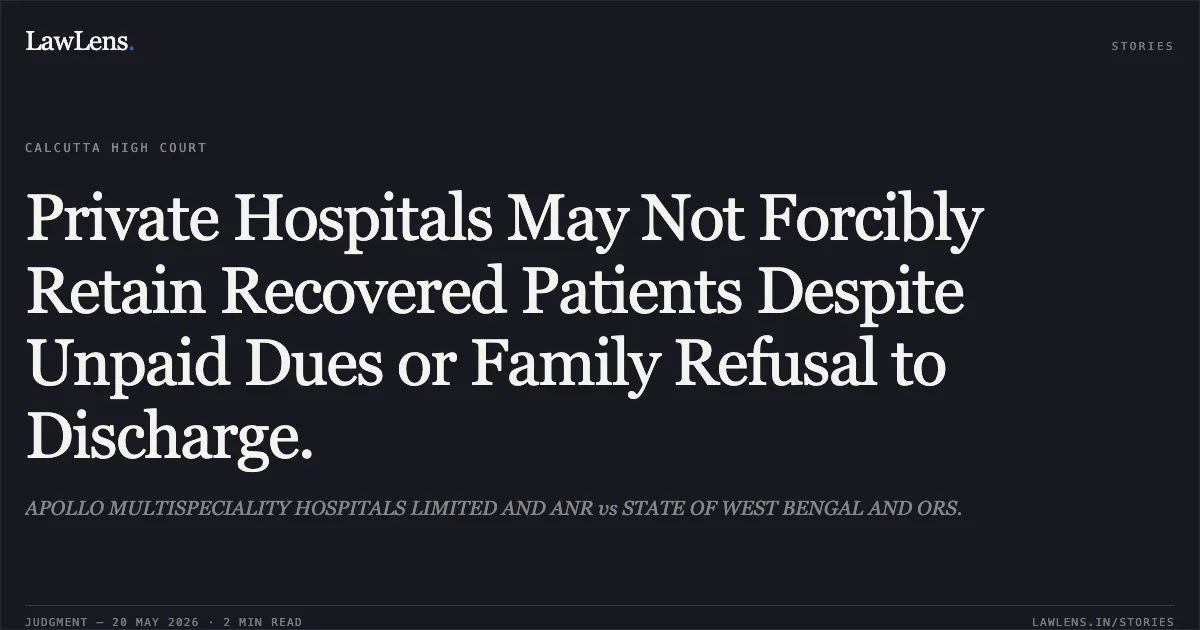
The court disposed of the writ petition by directing respondent no. 8 to take his wife home within one week
The State was ordered to provide a wheelchair free of cost and ensure priority medical treatment at government hospitals if her condition requires review or future admission
Source reference: p. 8The court held that given the respondent's financial state, the hospital shall not claim any further bill amounts from the patient or her husband, though they may pursue insurance claims
Source reference: p. 8Use of this judgment as a precedent was expressly barred due to the "peculiar circumstances" of the case
Source reference: p. 8Acts & Sections Cited
1 provisions across 1 statute referred to in this judgment. Linked provisions open on LawLens.
West Bengal Clinical Establishments (Registration, Regulation and Transparency) Act, 20171
Original Court PDF
APOLLO MULTISPECIALITY HOSPITALS LIMITED AND ANRvsSTATE OF WEST BENGAL AND ORS.
Click to open original judgment
Original judgment, available to read, download and summarize on LawLens.in


![Subsequent exoneration does not retrospectively invalidate a finalized promotion select list.. UNNIKRISHNAN M vs M/o Environment And Forests. CAT - ['Ernakulam']. LawLens](/stories/thumbnails/subsequent-exoneration-does-not-retrospectively-invalidate-a-finalized-promotion-select-li-ce80a0e84f2f4887857271e8b4341c42.webp)