Facts
The revisionist, an elected ward member of Gram Panchayat Majhauva Bakunth, filed an application under Section 173(4) of the Bhartiya Nagarik Suraksha Sanhita, 2023 (BNSS) before the A.C.J.M.-I, Basti, seeking directions for the registration of an FIR against the Gram Pradhan and others for alleged embezzlement of MNREGA funds via fictitious job cards and fraudulent transfers
Source reference: para 3-6An inquiry report by the Chief Development Officer (CDO) found no major financial embezzlement but noted procedural lapses regarding job cards, for which administrative action was already taken
Source reference: para 4, 9The Magistrate rejected the application on 20.12.2024, prompting this revision
Source reference: para 1Issues
1. Whether an application under Section 173(4) of the BNSS is maintainable at the instance of a private individual (revisionist) in light of the special statutory mechanism provided under the MNREGA Act, 2005
Source reference: para 122. Whether the provisions of the MNREGA Act, 2005, have an overriding effect over general criminal procedure and the U.P. Panchayat Raj Act, 1947, regarding the initiation of criminal proceedings
Source reference: para 12, 26Law Applied
Section 173(4) of the BNSS, noting it as a discretionary, enabling provision rather than a mandatory one
Source reference: para 18-20Section 28 of the MNREGA Act, 2005, which grants the Act overriding effect over inconsistent laws
Source reference: para 25Schedule I (Paragraphs 26, 29(f), and 32), which vests the power to lodge FIRs for financial irregularities exclusively in the District Programme Coordinator
Source reference: para 10, 24Precedents Janata Dal v. H.S. Chowdhary and Sanjaysinh Ramrao Chavan v. Dattatray Gulabrao Phalke defined the limited scope of revisional jurisdiction.
Source reference: para 13, 14The principle of noscitur a sociis was used for statutory interpretation
Source reference: para 19Solidaire India Ltd. v. Fairgrowth Financial Services Ltd. established that a subsequent special statute prevails over an earlier one
Source reference: para 28Reasoning
The Court reasoned that Section 173(4) BNSS requires "satisfaction" by the Magistrate and does not mandate mechanical registration of an FIR upon request
Source reference: para 18-21In the context of MNREGA, the Court found that the Act is a complete code; Paragraph 29(f) of Schedule I specifically designates the District Programme Coordinator as the authority to lodge an FIR after obtaining legal advice
Source reference: para 11, 24Consequently, a private individual—even an elected ward member—lacks the locus standi to bypass this designated authority
Source reference: para 29The Court further held that since the MNREGA Act (2005) is a later special enactment with a non-obstante clause (Section 28), it prevails over any perceived rights under the U.P. Panchayat Raj Act, 1947
Source reference: para 26-28Since the CDO report indicated that departmental corrective actions were already taken, the Magistrate’s refusal to exercise discretionary power was deemed legally sound and not perverse
Source reference: para 23, 30Holding
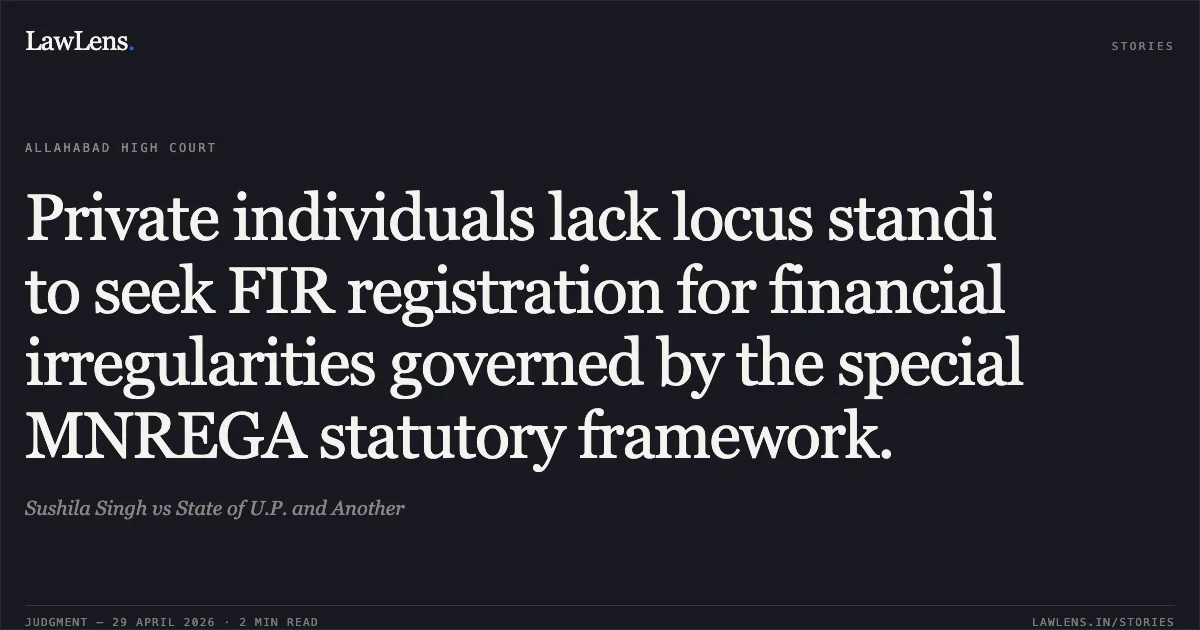
The Court held that the revisionist lacked locus standi as the power to initiate criminal proceedings under the MNREGA framework is vested in the competent authority defined by the Act
The Court dismissed the revision petition, affirming the Magistrate’s order as justified and free from jurisdictional error [para 31-32]. It clarified that any ongoing administrative proceedings under the MNREGA Act should continue independently
Source reference: para 32Acts & Sections Cited
7 provisions across 2 statutes referred to in this judgment. Each provision opens on LawLens.
Bharatiya Nagarik Suraksha Sanhita, 20232
Code of Criminal Procedure, 19735
Original Court PDF
Sushila SinghvsState of U.P. and Another
Click to open original judgment
Original judgment, available to read, download and summarize on LawLens.in


![Subsequent exoneration does not retrospectively invalidate a finalized promotion select list.. UNNIKRISHNAN M vs M/o Environment And Forests. CAT - ['Ernakulam']. LawLens](/stories/thumbnails/subsequent-exoneration-does-not-retrospectively-invalidate-a-finalized-promotion-select-li-ce80a0e84f2f4887857271e8b4341c42.webp)