Facts
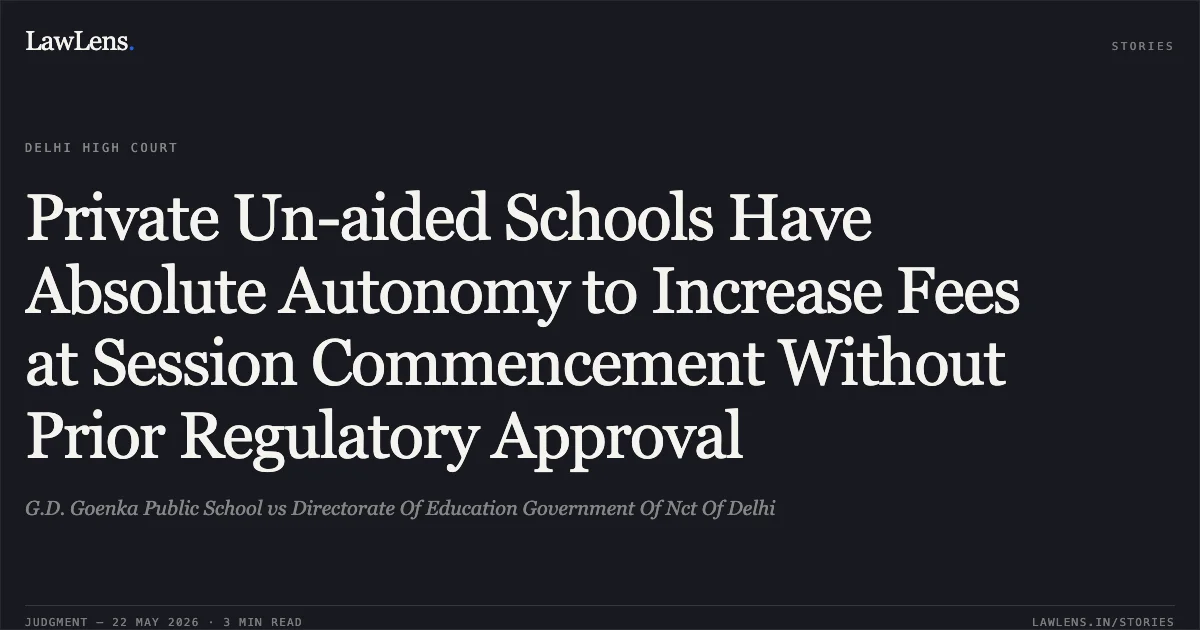
Petitioner schools, which are private, un-aided, and recognized by the Directorate of Education (DoE), challenged various orders rejecting their fee-hike proposals for academic sessions ranging from 2016-17 to 2022-23
Source reference: p. 8, 41The DoE had mandated that all schools, particularly those on land allotted by the DDA with a 'land-clause' (requiring prior approval for fee hikes), must seek permission before increasing fees
Source reference: p. 28The DoE rejected these proposals based on audits conducted by empaneled Chartered Accountants and a Project Management Unit (PMU), claiming the schools possessed sufficient "available funds" and that fee hikes would amount to profiteering
Source reference: p. 30-31The schools contended that these rejections were arbitrary, violated principles of natural justice (no hearing or disclosure of CA reports), and impinged upon their fundamental right to financial autonomy
Source reference: p. 8-13Issues
1. Whether private, un-aided, recognized schools require prior approval from the DoE to increase fees at the commencement of an academic session under Section 17(3) of the DSE Act
Source reference: p. 5; Point 22. Whether schools governed by a ‘land-clause’ are subject to different regulatory powers of the DoE compared to those without such a clause
Source reference: p. 6; Point 43. Whether the DoE’s method of calculating "available funds" by including contingency reserves, depreciation funds, and retiral benefit funds is legally sustainable
Source reference: p. 7; Point 54. Whether the impugned orders violated principles of natural justice by failing to provide show-cause notices or personal hearings before the Director
Source reference: p. 5; Point 1Law Applied
Section 17(3) of the Delhi School Education (DSE) Act, 1973, which mandates filing a statement of fees before a session but requires "prior approval" only for mid-session increases
Source reference: p. 45The Constitution Bench precedent in T.M.A. Pai Foundation v. State of Karnataka, establishing the fundamental right to "maximum autonomy" in fixing fees
Source reference: p. 52Islamic Academy of Education v. State of Karnataka, permitting a "reasonable surplus" (6-15%) for institutional growth
Source reference: p. 55Modern School v. Union of India, which balanced institutional autonomy against the DoE's power to prevent "commercialisation" while requiring schools to follow Fund-Based Accounting/GAAP
Source reference: p. 59-62Rule 177 of the DSE Rules, 1973, regarding the utilization of fees and the ICAI Guidance Note (2005) on accrual basis accounting for schools
Source reference: p. 48, 94-96Reasoning
The court reasoned that the DoE’s insistence on "prior approval" for session-commencement fee hikes is ultra vires Section 17(3), as the statute only requires a "statement of fees" except for mid-session changes
Source reference: para 77.1, 100Regarding the 'land-clause', the court held that contractual lease conditions cannot override statutory rights under the DSE Act; the DoE’s role is to report breaches to land agencies, not to arrogate extra-statutory regulatory powers
Source reference: para 91-95The DoE’s financial analysis was found fundamentally flawed: it treated restricted, earmarked, and statutory funds (like Depreciation, Gratuity, and Contingency Reserves) as "available funds" for revenue expenditure, which violates Rule 176 and 177 of the DSE Rules and established Accounting Standards
Source reference: para 117-119, 126.4The court also condemned the DoE for violating natural justice, noting that the Director passed orders based on CA recommendations that were never shared with the schools, and without granting a personal hearing, thereby reducing the "statutory inspection" to an empty formality
Source reference: para 108-110Holding
The court quashed and set aside all impugned orders rejecting the fee-hike proposals. It held that: (i) no prior approval is needed for fee hikes at the start of a session; (ii) the DoE can only interfere upon a specific finding of "profiteering" or "commercialisation" following a full-dressed audit under Section 18(5); and (iii) schools have the right to maintain a reasonable surplus and pay salaries higher than government scales
To balance equities and avoid a retrospective burden on parents, the court directed that the last proposed fee hikes shall apply only prospectively from the Academic Session April 2027, and no school shall recover retrospective arrears. All pending fee-hike proposals with the DoE were ordered closed
Source reference: para 146, 150Acts & Sections Cited
9 provisions across 2 statutes referred to in this judgment. Each provision opens on LawLens.
Delhi School Education Act, 19736
Right of Children to Free and Compulsory Education Act, 20093
Original Court PDF
G.D. Goenka Public SchoolvsDirectorate Of Education Government Of Nct Of Delhi
Click to open original judgment
Original judgment, available to read, download and summarize on LawLens.in


![Authorities must decide pensionary and retiral-benefit claims through a reasoned order within eight weeks.. Habibullah khan vs HOME DEPARTMENT. CAT - ['Srinagar']. LawLens](/stories/thumbnails/authorities-must-decide-pensionary-and-retiral-benefit-claims-through-a-reasoned-order-wit-d0cbe8a8119c48fbabe7df9f2d353488.webp)