Facts
The Petitioner schools, comprising 137 private un-aided recognized institutions in Delhi, challenged various orders and circulars issued by the Directorate of Education (DoE) that rejected their fee-hike proposals for academic sessions ranging from 2016-17 to 2022-23
Source reference: p.8, 41The DoE had mandated that schools situate on land allotted by government agencies (the "land-clause") obtain prior approval before increasing fees
Source reference: p.28These proposals were scrutinized by DoE-appointed Chartered Accountants (CAs) and a Project Management Unit (PMU), often leading to rejections on the grounds that schools possessed "available funds" in the form of reserves, or were indulging in "profiteering"
Source reference: p.30-32The schools alleged these rejections violated their fundamental right under Article 19(1)(g), breached statutory provisions of the DSE Act, and ignored settled accounting principles
Source reference: p.8-9Issues
1. Whether private un-aided schools require prior approval from the DoE to increase fees at the commencement of an academic session
Source reference: p.5 / para. 52. Whether the DoE has the power to regulate fees beyond the prevention of "profiteering" and "commercialization"
Source reference: p.6 / para. 53. Whether the DoE can mandate schools to use "earmarked funds" (like Development or Depreciation funds) to meet revenue expenditures like salaries
Source reference: p.7 / para. 54. Whether the regulatory powers of the DoE differ for schools governed by a "land-clause" versus those on private land
Source reference: p.6 / para. 55. Whether the impugned orders violated principles of natural justice by denying hearings or withholding CA reports
Source reference: p.5 / para. 5Law Applied
Section 17(3) of the Delhi School Education (DSE) Act, 1973, which requires managers to file a statement of fees before a session but mandates prior approval only for mid-session hikes
Source reference: p.45, 73Rule 177 of the DSE Rules, 1973, governing the utilization of fees and permissible savings
Source reference: p.48Constitution Bench principles in T.M.A. Pai Foundation v. State of Karnataka, establishing maximum autonomy for un-aided schools in fee fixation
Source reference: p.50-54Islamic Academy of Education v. State of Karnataka, permitting a "reasonable surplus" (6-15%) for growth
Source reference: p.55Modern School v. Union of India, which balanced institutional autonomy with the DoE's duty to prevent "commercialization" using Generally Accepted Accounting Principles (GAAP)
Source reference: p.56-62Reasoning
The Court reasoned that Section 17(3) is a "balancing provision" where the filing of a fee statement serves as intimation, not an application for permission
Source reference: p.73The Court noted that the DoE’s "prior approval" requirement for the start of a session was ultra vires the DSE Act
Source reference: p.74The Court criticized the DoE for miscalculating "available funds" by including earmarked reserves (Depreciation, Gratuity, and Development Funds) which, under Rule 176 and GAAP, cannot be diverted to revenue expenses
Source reference: p.101-102Regarding the "land-clause," the Court held that a contractual lease condition cannot override the statutory framework of the DSE Act; thus, even "land-clause schools" only need prior approval for mid-session increases
Source reference: p.83-84The Court found the DoE’s process "vitiated" as it relied on CA reports never shared with the schools and passed orders without granting a personal hearing before the actual decision-maker (the Director), violating the audi alteram partem rule
Source reference: p.91-92Holding
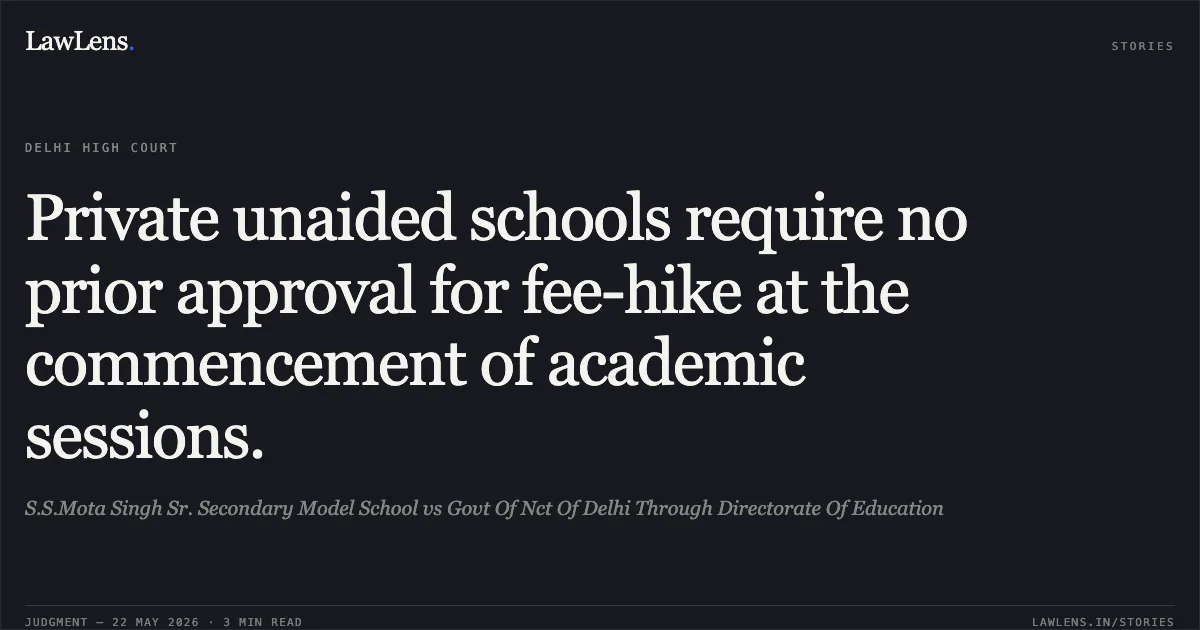
The Court quashed the impugned orders, holding that private un-aided schools have the autonomy to fix fees at the start of a session without prior DoE approval
The DoE’s role is limited to post-facto audits under Section 18(5) to catch actual profiteering
Source reference: p.75, 117(a) no school can be forced to use earmarked funds for salaries; (b) schools can pay higher salaries than government scales; and (c) Depreciation/Reserve funds are not "available funds"
Source reference: p.107, 112, 109The Court directed that the last proposed fee hikes would apply only prospectivesly from April 2027, prohibiting schools from recovering retrospective arrears from parents for the years lost in litigation; all pending fee-hike proposals were ordered closed
Source reference: p.120, 119Acts & Sections Cited
9 provisions across 2 statutes referred to in this judgment. Each provision opens on LawLens.
Delhi School Education Act, 19736
Right of Children to Free and Compulsory Education Act, 20093
Original Court PDF
S.S.Mota Singh Sr. Secondary Model SchoolvsGovt Of Nct Of Delhi Through Directorate Of Education
Click to open original judgment
Original judgment, available to read, download and summarize on LawLens.in


