01Facts
The Petitioner schools, being private unaided recognized institutions, challenged several orders and circulars issued by the Directorate of Education (DoE) that rejected their fee-hike proposals for academic sessions ranging from 2016-17 to 2022-23.
p. 8, para 49The DoE had mandated that schools situate on land allotted by government agencies (governed by a 'land-clause') must seek prior approval before increasing fees.
p. 28, para 45.1Following financial audits conducted by DoE-appointed Chartered Accountants and a Project Management Unit (PMU), the DoE rejected the hikes, claiming the schools possessed sufficient surplus funds and were indulging in commercialization.
pp. 29-30The schools contended these actions violated their fundamental right under Article 19(1)(g) and overstepped the DoE's statutory regulatory powers.
pp. 8-902Issues
i.1. Whether private unaided schools require prior approval from the DoE to increase fees at the commencement of an academic session.
p. 5, Issue 2.1ii.2. Whether the DoE violated principles of natural justice by rejecting proposals without providing audit reports or a personal hearing before the Director.
pp. 5, Issue 1.1-1.3iii.3. Whether the DoE’s regulatory powers differ between schools with a ‘land-clause’ and those without.
p. 6, Issue 4iv.4. Whether the DoE can mandate a system of accounting (e.g., treatment of reserve funds as available cash) that contradicts the Income Tax Act and ICAI Guidance Notes.
p. 6, Issue 3 & 503Law Applied
Section 17(3) of the Delhi School Education (DSE) Act, 1973, which mandates filing a statement of fees before a session but requires "prior approval" only for mid-session hikes.
p. 45, para 60Constitution Bench rulings in T.M.A. Pai Foundation v. State of Karnataka, establishing the right to set a reasonable fee structure.
p. 50Islamic Academy of Education v. State of Karnataka, permitting a reasonable surplus of 6-15%.
pp. 54-55Modern School v. Union of India, which balanced institutional autonomy with the DoE’s power to prevent "profiteering" and "commercialization" using Generally Accepted Accounting Principles (GAAP).
p. 56, 59Rule 177 of the DSE Rules regarding the utilization of fees and Rule 180 regarding the DoE's power to audit financial returns.
pp. 48-49Provisions in the judgment · 9 · Linked ones open on LawLens
Delhi School Education Act, 1973 Section 2Section 4Section 5Section 10Section 17Section 18
Right of Children to Free and Compulsory Education Act, 2009 Section 2Section 13Section 18
04Reasoning
Section 17(3) is a "balancing" provision; it grants schools fiscal autonomy at the start of a session while reserving DoE intervention for mid-session changes or proven profiteering.
p. 73, para 77.1The Court found the DoE’s insistence on "prior approval" for all hikes in 'land-clause' schools to be a misinterpretation of Modern School and Justice for All, clarifying that a contractual land-clause cannot override statutory autonomy or grant the DoE powers beyond the DSE Act.
pp. 83-84, para 93-95Regarding accounting, the Court held the DoE’s method of adding restricted funds (e.g., Depreciation Reserve, Gratuity Fund) to "available funds" was illegal and contrary to ICAI Guidance Notes.
pp. 101, para 117-118Since Rule 176 and 177(3) mandate that earmarked funds be used only for specific purposes, the DoE cannot legally compel schools to deplete these reserves for operational salaries.
p. 107, para 126.4The Court determined that rejecting proposals based on secret audit reports without a hearing before the deciding authority (the Director) was "destructive of the concept of judicial hearing".
p. 91, para 10805Holding
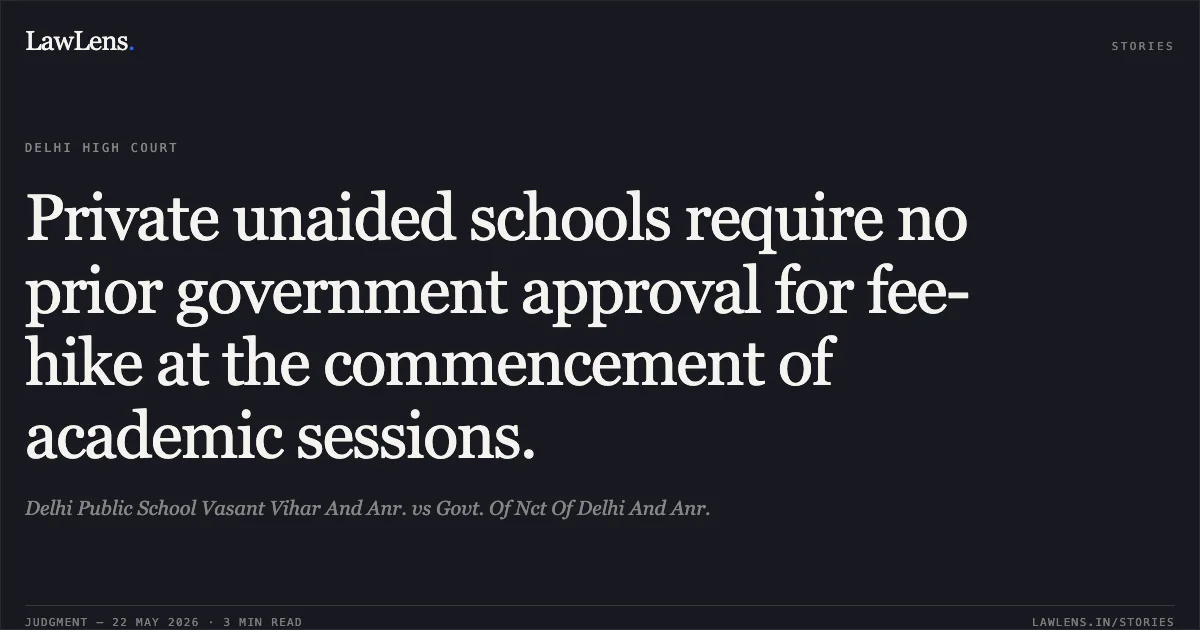
The Court quashed and set aside all impugned DoE orders rejecting the fee-hike proposals.
p. 119, para 145No prior approval is needed for commencement-of-session hikes; only a statement under Section 17(3) is required.
p. 117, para 144.1The DoE can only intervene upon a definitive finding of profiteering via a post-facto audit under Section 18(5).
p. 117, para 144.3'Land-clause' schools enjoy the same statutory autonomy as others.
p. 118, para 144.5Schools must follow the 'accrual system' of accounting per ICAI notes.
p. 117, para 144.4The Court directed that the last proposed fee increases shall apply prospectively from the April 2027 session, with no recovery of retrospective arrears.
p. 120, para 150Original Court PDF
Delhi Public School Vasant Vihar And Anr.vsGovt. Of Nct Of Delhi And Anr.
Click to open original judgment
Original judgment, available to read, download and summarize on LawLens.in