Facts
The appellant/complainant alleged he advanced three loan installments to Respondent No. 1 (totaling ₹50,000) for which the respondent issued three cheques dated November 6, 2011, November 21, 2011, and December 2, 2011
Source reference: para. 2The cheques were dishonored on February 27, 2012, due to insufficient funds, and despite a legal notice dated March 3, 2012, the respondent failed to repay the amount
Source reference: para. 2The Judicial Magistrate First Class (JMFC), Durg, convicted the respondent under Section 138 of the Negotiable Instruments (NI) Act, sentencing him to six months of rigorous imprisonment and ₹55,000 in compensation
Source reference: para. 3On appeal, the Additional Sessions Judge, Durg, reversed this finding and acquitted the respondent on February 1, 2016
Source reference: para. 3The complainant subsequently challenged this acquittal before the High Court of Chhattisgarh
Source reference: para. 1Issues
1. Whether the appellate court was justified in acquitting the respondent of the charge under Section 138 of the NI Act by reversing the trial court's conviction
Source reference: para. 102. Whether the complainant successfully established the existence of a legally enforceable debt through credible evidence
Source reference: para. 12Law Applied
The court applied Section 138 of the Negotiable Instruments Act, 1881, regarding the dishonor of cheques for insufficiency of funds
Source reference: para. 1It invoked the statutory presumptions under Sections 118 and 139 of the NI Act, which assume a cheque is issued for consideration and in discharge of a debt unless the contrary is proved
Source reference: para. 12Regarding the scope of appeals against acquittal, the court relied on Section 378 of the Cr.P.C.
Source reference: para. 1the principles established in Jafarudheen v. State of Kerala (2022) and Mallappa v. State of Karnataka (2024), which dictate that an appellate court should not interfere with an acquittal if the trial court’s view is a "plausible" or "possible" one, unless there is patent perversity or illegality
Source reference: para. 8-9Reasoning
The High Court scrutinized the complainant’s testimony (C.W.1), noting significant inconsistencies and a lack of credibility.
Source reference: para. 11The complainant could specifically recall an advancement of ₹10,000 from 2008 but failed to remember the dates for the three loans central to this case
Source reference: para. 11Crucially, the complainant admitted to filling out the cheque details himself and provided no explanation for the visible difference in ink between the accused’s signatures and the body of the cheques
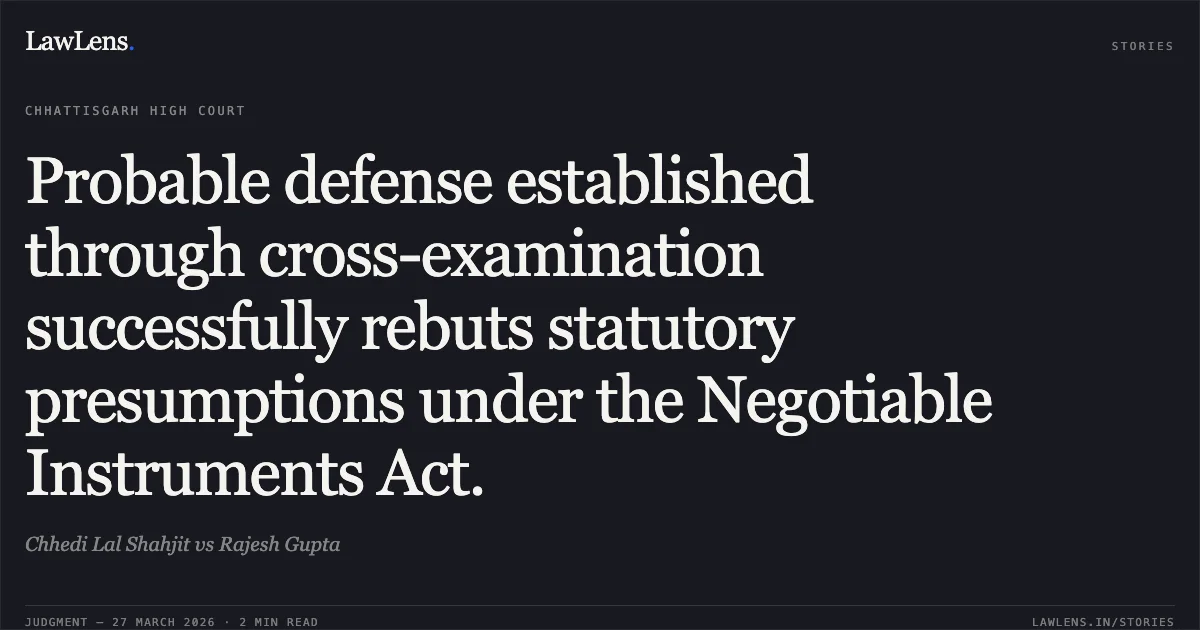
Source reference: para. 11-12The court reasoned that while the accused’s signature triggered the statutory presumptions under Sections 118 and 139, the respondent successfully rebutted these presumptions by raising a "probable defense" on the standard of "preponderance of probabilities" during cross-examination
Source reference: para. 12The court found that the complainant’s failure to adduce cogent evidence regarding the circumstances of the installments created a reasonable doubt regarding the existence of a legally enforceable debt
Source reference: para. 12-13Holding
The High Court held that the appellate court's decision to acquit was based on a thorough analysis of the evidence and represented a plausible view of the facts
Finding no patent illegality or perversity in the judgment of acquittal, the court declined to interfere
Source reference: para. 14The appeal was dismissed, and the judgment of the Additional Sessions Judge acquitting Respondent No. 1 was affirmed
Source reference: para. 15Original Court PDF
Chhedi Lal ShahjitvsRajesh Gupta
Click to open original judgment
Original judgment, available to read, download and summarize on LawLens.in