Facts
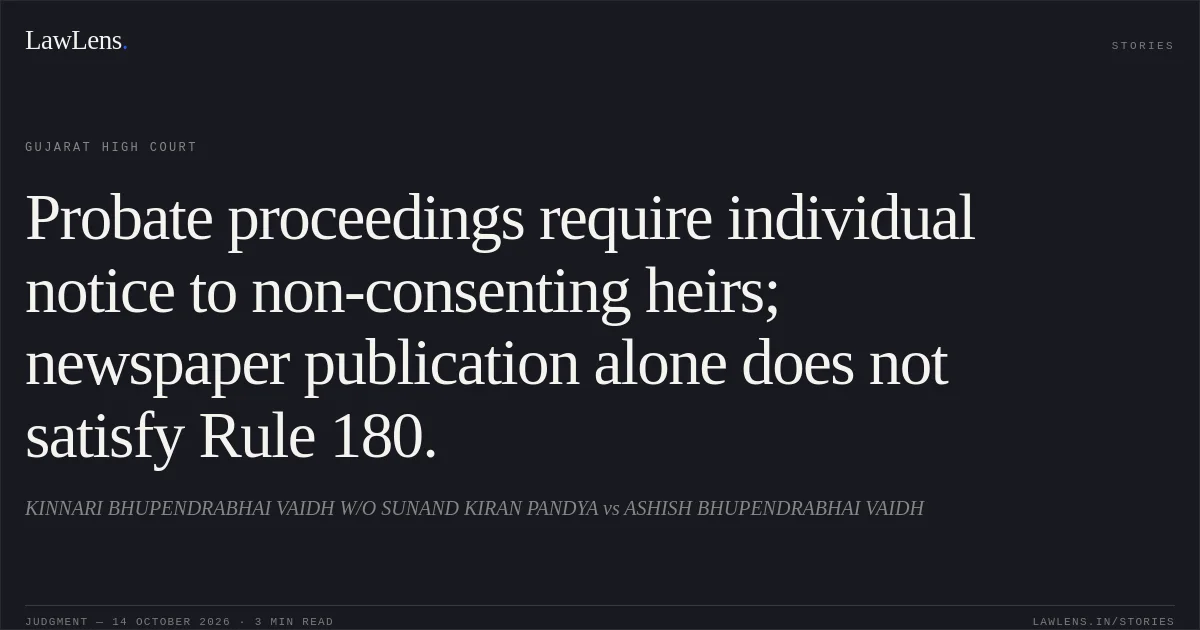
The appellants were the deceased Jyotiben Bhupendrabhai Vaidh’s daughters.
Source reference: no citationThe respondent obtained probate of an alleged Will dated 11 September 2020 without joining the appellants in the probate proceedings.
Source reference: paras. 2.1–2.6, p. 2The probate court granted probate on 26 May 2022; the appellants later sought revocation under Section 263 of the Indian Succession Act, 1925. The trial court dismissed that application as time-barred and held that citation had been published in a newspaper.
Source reference: paras. 2.1–2.6, p. 2The High Court noted that the appellants had not been joined as parties, although the probate petition identified them as the deceased’s Class I legal representatives, and that citation had been published in Divya Bhaskar.
Source reference: paras. 10–12, pp. 5–6The appellants filed the revocation application in August 2024.
Source reference: para. 19, p. 13Issues
Whether the grant of probate was open to revocation for failure to give notice to the deceased’s heirs and next of kin as required by Section 283 of the Succession Act and Rule 180 of the Ahmedabad City Civil Court Rules, 1961.
Source reference: paras. 12–15, pp. 6–10; para. 20, p. 14Whether the appellants’ application under Section 263 was barred by limitation when filed after the grant of probate.
Source reference: para. 19, p. 13Law Applied
Section 263 of the Indian Succession Act permits revocation or annulment of a grant for “just cause”; just cause includes proceedings defective in substance, fraud or concealment of material facts, and a grant made without citing persons who ought to have been cited.
Source reference: para. 17, pp. 10–11Section 283 empowers the probate court to issue citations, and that discretion must be exercised judicially and with proper care, particularly where a Will alters the devolution of property.
Source reference: paras. 13–15, pp. 7–10Rule 180 of the Ahmedabad City Civil Court Rules requires notice of a probate application to all heirs and next of kin mentioned in the petition, except those whose consent is filed.
Source reference: para. 13.1, p. 7The Court also relied on Basanti Devi v. Raviprakash Ramprasad Jaiswal concerning non-compliance with citation requirements and Manibhai Amaidas Patel concerning omission to cite parties who ought to have been cited.
Source reference: paras. 16–17, pp. 10–12Section 263 prescribes no limitation period; Article 137 of the Limitation Act, 1963 therefore provides a three-year period, which the Court treated as running from the order granting probate.
Source reference: para. 19, p. 13Reasoning
The appellants were identified in the probate petition as the deceased’s Class I legal representatives but were not joined or individually served. The Court held that newspaper publication did not, in the circumstances, satisfy Rule 180’s requirement to notify heirs and next of kin; the omission raised a ground for revocation under Section 263, notwithstanding the respondent’s contention that the appellants had not raised Rule 180 before the trial court.
Source reference: paras. 11–12, 18, pp. 6, 12; para. 20, p. 14The Court also rejected the trial court’s limitation calculation, which had treated notice under Section 135-D of the Gujarat Land Revenue Code as the relevant starting point. It held that the cause for seeking revocation arose upon the grant of probate on 26 May 2022 and that the application filed in August 2024 was within the three-year period under Article 137.
Source reference: para. 19, p. 13The Court did not determine the merits of the revocation application.
Source reference: para. 22, p. 15Holding
The High Court allowed the appeal, quashed the trial court’s order dated 24 August 2026, and remanded the Section 263 application for fresh decision within six months of receipt of the order.
It directed the parties to cooperate and clarified that it had expressed no view on the merits.
Source reference: paras. 21–23, pp. 14–15The connected stay application was disposed of as not surviving.
Source reference: paras. 21–23, pp. 14–15Acts & Sections Cited
3 provisions across 2 statutes referred to in this judgment. Each provision opens on LawLens.
Indian Succession Act, 19252
Limitation Act, 19631
Original Court PDF
KINNARI BHUPENDRABHAI VAIDH W/O SUNAND KIRAN PANDYAvsASHISH BHUPENDRABHAI VAIDH
Click to open original judgment
Original judgment, available to read, download and summarize on LawLens.in