Facts
Bal Vikas Vidyalaya was a privately managed, unaided school registered under the Societies Registration Act, 1860 and affiliated with the CBSE. Respondent No. 2 was appointed as a Mathematics Teacher on 31 March 1982 and took voluntary retirement on 22 February 2012. He claimed arrears of salary and post-retirement benefits, including provident fund, group insurance, gratuity and earned leave dues.
Source reference: para. 5After the school failed to settle his claims, respondent No. 2 filed CWJC No. 8108 of 2014. By order dated 14 August 2019, he was granted liberty to approach the District Appellate Authority. His subsequent appeal was dismissed as not maintainable on 30 October 2019. The State Appellate Authority, however, allowed his appeal on 29 July 2021 and remanded the matter for fresh consideration under the Bihar State Teaching Institutions, Teacher and Employees (Dispute Redressal and Appeal) Rules, 2020, read with the applicable 2015 Rules.
Source reference: paras. 3, 6–7Upon remand, the District Appellate Authority allowed respondent No. 2’s claim on 10 July 2025 and directed payment of the admissible difference in salary and retirement benefits. The school-management petitioners challenged both the orders before the High Court, contending that the appellate authorities lacked jurisdiction because the cause of action arose in 2012, before the relevant Rules came into force.
Source reference: paras. 2–4, 18–23Issues
1. Whether the writ petition was maintainable when the petitioners had an alternative statutory remedy of appeal before the State Appellate Authority under Rule 14 of the 2020 Rules?
Source reference: para. 82. Whether the petitioners, having participated in the proceedings before the District Appellate Authority after the remand orders, could subsequently challenge the jurisdiction of that Authority after the decision went against them?
Source reference: paras. 14–16, 27, 343. Whether the 2015 and 2020 Rules, which created or regulated the appellate forum for service disputes in non-government, non-aided schools, could apply to a claim arising from voluntary retirement in 2012?
Source reference: paras. 17–23, 29–334. Whether the orders of the State and District Appellate Authorities were without jurisdiction and therefore liable to be quashed?
Source reference: paras. 18–23, 32–35Law Applied
The Court applied Article 226 of the Constitution and the principle that a writ petition is ordinarily not entertained where an efficacious statutory alternative remedy exists, particularly where Rule 14 provides an appeal to the State Appellate Authority.
Source reference: para. 8It relied on Satyadhyan Ghosal v. Deorajin Debi, AIR 1960 SC 941, for the finality of judicial decisions and the principle of res judicata; State of Punjab v. Gurudev Singh, (1991) 4 SCC 1, for the rule that an order remains legally effective unless properly challenged and set aside; and Hope Plantations Ltd. v. Taluk Land Board, (1999) 5 SCC 590, for cause-of-action estoppel and issue estoppel.
Source reference: paras. 10–13The Court also applied the principle against approbation and reprobation, relying on Union of India v. N. Murugesan, (2020) 2 SCC 25 and Mumtaz Yarud Dowla Wakf v. Badam Balakrishna Hotel Pvt. Ltd., 2023 SCC OnLine SC 1378.
Source reference: paras. 15–16On retrospectivity, the Court relied on Neena Aneja v. Jai Prakash Associates Ltd., (2022) 2 SCC 161, New India Insurance Co. Ltd. v. Shanti Misra, (1975) 2 SCC 840, and Ramesh Kumar Soni v. State of Madhya Pradesh, (2013) 14 SCC 696, holding that procedural amendments and changes of forum ordinarily operate retrospectively, while substantive rights are governed by the law applicable to the relevant entitlement.
Source reference: paras. 29–32The Court also referred to St. Mary’s Education Society v. Rajendra Prasad Bhargava, (2023) 4 SCC 498, and Siyaram Education Society v. Chhaya, 2026 (5) BLJ 142 (SC), regarding the limited availability of writ jurisdiction in service disputes involving private unaided educational institutions.
Source reference: para. 25Reasoning
The Court held that the petitioners had repeatedly participated in the proceedings before the District Appellate Authority after the High Court’s earlier order and the State Appellate Authority’s remand order, without challenging those orders at the appropriate stage.
Source reference: paras. 26–27Their subsequent challenge to jurisdiction, raised only after the District Appellate Authority decided the matter against them, was inconsistent with the principles of finality, estoppel and approbation and reprobation.
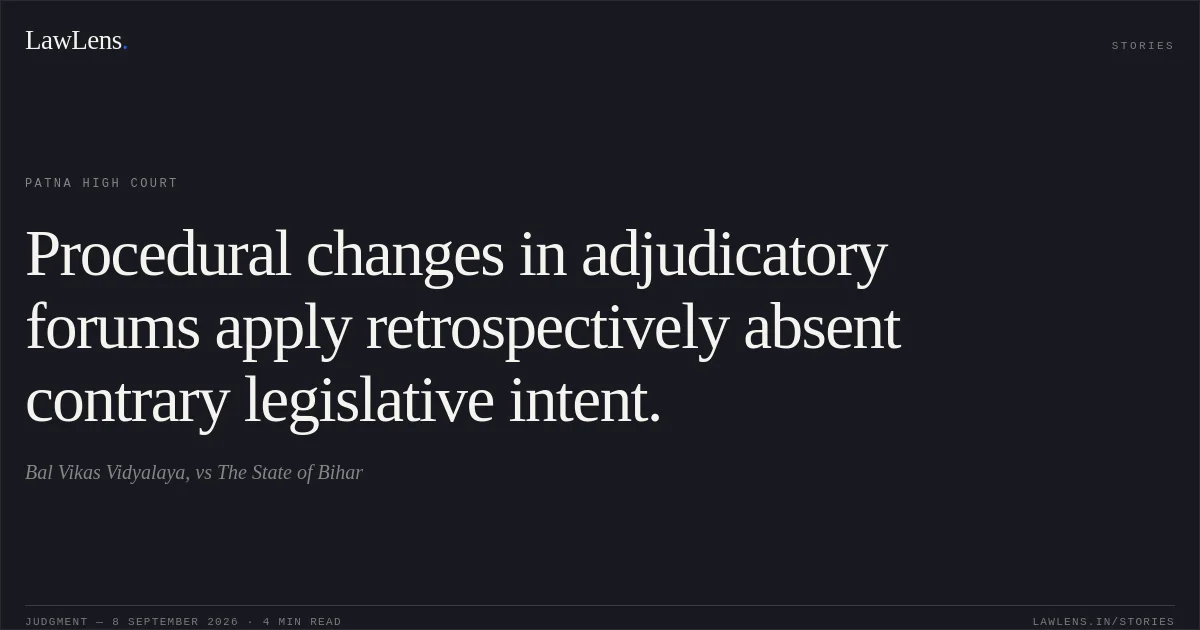
Source reference: paras. 27, 34The Court rejected the argument that applying the 2015 Rules to a 2012 dispute was impermissibly retrospective. It distinguished between the substantive entitlement to retirement benefits and the procedural forum for adjudicating that entitlement: while the former would be determined under the applicable substantive law, the latter was procedural and could apply to pending or existing disputes unless expressly excluded.
Source reference: paras. 29–33The Court further rejected the “Caesar to Caesar’s wife” argument, observing that the State Appellate Authority had earlier dealt only with maintainability and remanded the matter; the petitioners could raise their remaining objections in the statutory appeal.
Source reference: para. 28Since the District Appellate Authority was not found to be inherently without jurisdiction, the petitioners could not invoke the exception permitting jurisdictional objections at any stage.
Source reference: para. 34Holding
The High Court dismissed the writ petition as devoid of merit and declined to quash either the State Appellate Authority’s remand order dated 29 July 2021 or the District Appellate Authority’s decision dated 10 July 2025.
It held that the 2015 Rules could govern the procedural forum for adjudicating respondent No. 2’s claim notwithstanding the fact that his retirement occurred in 2012, and that the petitioners were precluded from belatedly disputing the Authority’s jurisdiction after participating in the proceedings.
Source reference: paras. 32–34The petitioners were, however, granted liberty to pursue any remedy available to them in law, including the statutory appellate remedy.
Source reference: para. 36Acts & Sections Cited
1 provisions across 1 statute referred to in this judgment. Each provision opens on LawLens.
Code of Civil Procedure, 19081
Original Court PDF
Bal Vikas Vidyalaya,vsThe State of Bihar
Click to open original judgment
Original judgment, available to read, download and summarize on LawLens.in