Facts
The parties entered into a Fit-Out Agreement dated 28 November 2023 under which Orbit In-Terio was to supply and install fit-outs and fixtures at American Epay Services’ commercial premises against monthly fit-out lease charges, while retaining ownership of the installations.
Source reference: p. 1Following disputes concerning the works, modifications and additional works, the respondent terminated the agreement on 15 February 2024 and subsequently claimed approximately ₹15 crore towards reimbursement and damages.
Source reference: p. 2The respondent invoked arbitration, and a Sole Arbitrator was appointed by the High Court.
Source reference: p. 2Orbit In-Terio filed two applications under Section 17 of the Arbitration and Conciliation Act, 1996, and a counterclaim of approximately ₹16.78 crore.
Source reference: p. 2By order dated 25 September 2025, the Tribunal directed Orbit In-Terio to deposit its share of the arbitral fees before its Section 17 applications and counterclaim would be heard.
Source reference: p. 3Although it deposited ₹14 lakh against an assessed amount of approximately ₹39.03 lakh, it failed to deposit the entire amount.
Source reference: p. 3On 27 March 2026, the Tribunal closed Orbit In-Terio’s right to pursue its Section 17 applications and counterclaim due to non-payment of the requisite arbitral fee.
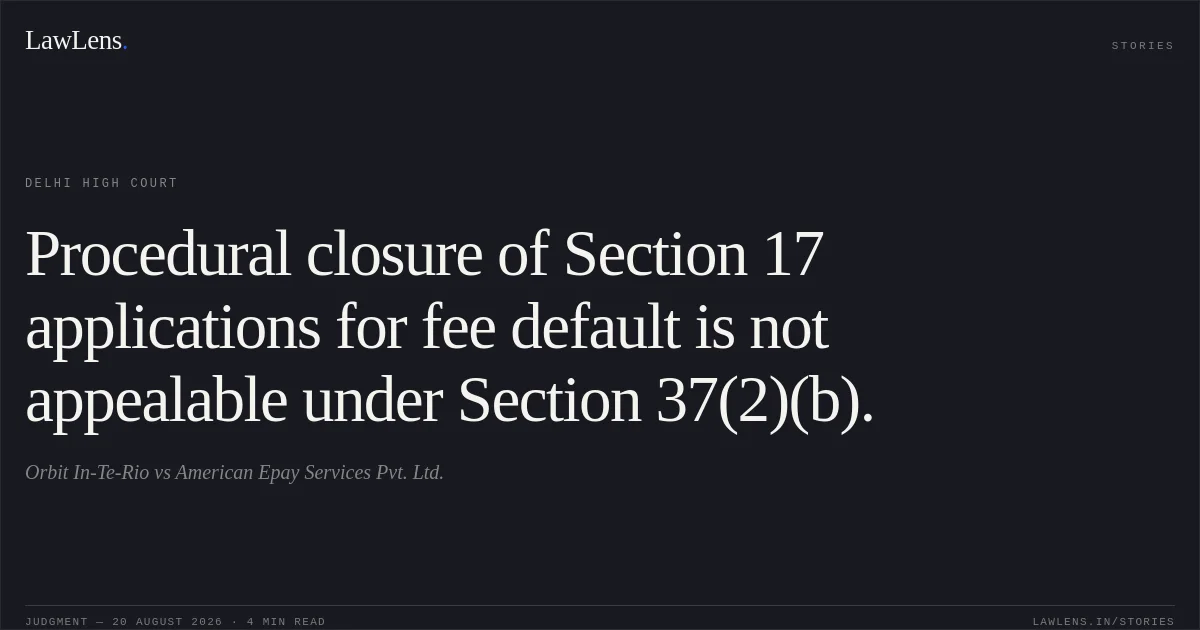
Source reference: p. 3Orbit In-Terio challenged that order under Section 37(2)(b), contending that the closure effectively amounted to refusal of interim measures under Section 17 and that no effective remedy of recall or review was available before the Tribunal.
Source reference: pp. 3–5Issues
Whether an arbitral tribunal’s order closing a party’s Section 17 applications for non-payment of arbitral fees constitutes an order “refusing to grant an interim measure” under Section 37(2)(b) of the Act and is therefore appealable?
Source reference: paras. 21–32, 42–46Whether the appropriate remedy against such a procedural closure order was to seek recall or restoration before the arbitral tribunal rather than invoke the appellate jurisdiction of the High Court under Section 37?
Source reference: paras. 33–39Whether the Tribunal’s direction requiring deposit of arbitral fees and the resulting closure of the counterclaim and Section 17 applications were procedural orders, notwithstanding their adverse effect on the appellant’s rights?
Source reference: paras. 40–48Law Applied
Section 37(2)(b) of the Arbitration and Conciliation Act, 1996 permits an appeal only against an order of an arbitral tribunal “granting or refusing to grant an interim measure under Section 17”; it does not create a general appellate remedy against every procedural order passed during arbitration.
Source reference: para. 42A procedural order which regulates the conduct of proceedings, even if it affects a valuable right, is not appealable unless it finally determines a substantive claim, defence or entitlement; this principle was drawn from H.S. Nag v. Asian Hotel (North).
Source reference: paras. 29–32Under Harshbir Singh Pannu v. Jaswinder Singh, an arbitral tribunal possesses limited inherent procedural power to recall an order terminating or procedurally closing proceedings in order to cure a patent or procedural error, without undertaking a review on merits.
Source reference: paras. 34–39Oil and Natural Gas Corporation Ltd. v. Afcons Gunanusa JV establishes that deposits towards arbitral fees under Section 38 are provisional and intended to secure anticipated arbitral expenses; an order relating to such deposits is procedural and does not constitute a binding adjudication of costs.
Source reference: paras. 40–41The appellant’s reliance on Sections 38 and 39 and the applicable DIAC Rules raised issues to be considered first by the Tribunal in a recall application.
Source reference: para. 47Reasoning
The Court examined the substance of the Tribunal’s order rather than its practical effect.
Source reference: no citationThe Tribunal had not considered the merits of Orbit In-Terio’s Section 17 prayers, applied the test for interim relief, or granted or refused any specific interim measure.
Source reference: paras. 22–28It had merely closed the right to prosecute the applications and counterclaim because of failure to comply with a fee-deposit direction.
Source reference: no citationApplying H.S. Nag, the Court held that an order may adversely affect a valuable procedural right without becoming a substantive adjudication.
Source reference: paras. 29–32The fee direction itself was procedural because arbitral deposits are provisional and intended to secure future expenses, as explained in Afcons Gunanusa.
Source reference: paras. 40–41Consequently, the resulting closure was also procedural and did not fall within the statutory language of Section 37(2)(b).
Source reference: paras. 42–46Following Harshbir Singh Pannu, the Court held that the appellant’s first remedy was to seek recall or restoration before the Tribunal, including raising its objections under Sections 38 and 39 and the DIAC Rules there.
Source reference: paras. 34–39, 47Holding
The High Court held that the Tribunal had neither granted nor refused an interim measure under Section 17; it had passed only a procedural, fee-related order closing the appellant’s right to pursue its Section 17 applications and counterclaim.
Accordingly, the appeal under Section 37(2)(b) was held to be not maintainable and was dismissed.
Source reference: para. 49The Court clarified that the appellant remained entitled to participate in the arbitration and that the Tribunal had not become functus officio generally.
Source reference: paras. 50–51Liberty was granted to Orbit In-Terio to file an appropriate application seeking recall of the impugned order or other relief in accordance with law.
Source reference: para. 52Acts & Sections Cited
10 provisions across 1 statute referred to in this judgment. Each provision opens on LawLens.
Arbitration and Conciliation Act, 1996
Original Court PDF
Orbit In-Te-RiovsAmerican Epay Services Pvt. Ltd.
Click to open original judgment
Original judgment, available to read, download and summarize on LawLens.in