Facts
The petitioner was appointed as a Lower Division Clerk in 1990 on a substitute/temporary basis against the post of an employee deputed elsewhere, and was subsequently reappointed in 1991 against the post of another employee, subject to termination upon that employee’s reinstatement.
Source reference: paras. 2, 6, 28–29The State Government had permitted the Department to make substitute appointments against existing posts.
Source reference: paras. 16, 28–29The petitioner continued in service, received regular pay and service benefits, was included in departmental gradation lists, and was permitted to appear in the departmental competitive examination for Inspector of Weights & Measures.
Source reference: paras. 2, 5, 12, 15After qualifying, he was promoted on 27.12.2003 and underwent departmental training.
Source reference: paras. 2, 5, 12, 15An earlier termination order dated 31.05.2000 was challenged, but the proceedings were dismissed as infructuous in 2005 after the petitioner disclosed that he had continued in service and had been promoted.
Source reference: paras. 34–36In 2007, the respondents issued a show-cause notice and thereafter passed the impugned order dated 24.07.2007 terminating the petitioner on the ground that his initial appointment had been made without following the prescribed recruitment procedure.
Source reference: paras. 6–8, 40Issues
Whether the petitioner’s initial appointment, having been made against an existing sanctioned post but allegedly without following the prescribed recruitment procedure, was illegal or merely irregular.
Source reference: paras. 11, 19, 28–30, 39Whether the respondents were justified in terminating the petitioner in 2007 after approximately 17 years of service, particularly when the Department had recognised his service, granted benefits, permitted his departmental examination, and promoted him.
Source reference: paras. 11–15, 31–33, 37–41Whether the impugned termination was unsustainable for violating the principles of natural justice, having been passed only after a show-cause notice and reply, without a charge-sheet or regular departmental enquiry.
Source reference: para. 40Law Applied
Under Secretary, State of Karnataka v. Uma Devi, an appointment made in total disregard of the constitutional scheme, essential qualifications, recruitment rules, or against a non-existent post is illegal, whereas an appointment against a sanctioned vacancy suffering only from procedural defects may be irregular and capable of regularisation in appropriate circumstances.
Source reference: paras. 23–25State of M.P. v. Lalit Kumar Verma similarly holds that substantial compliance with the constitutional and recruitment scheme, coupled with a procedural deviation, constitutes irregular rather than illegal appointment.
Source reference: para. 23The Madhya Pradesh Government Circulars dated 16.05.2007 and 08.02.2008 classify appointments against sanctioned posts but made without complete recruitment procedure as irregular, while treating appointments against non-existent or unauthorised posts as illegal.
Source reference: paras. 17–19, 26–30Vinod Kumar v. Union of India, Jaggo v. Union of India, and Shripal v. Nagar Nigam, Ghaziabad establish that long, continuous, non-fraudulent service and the employer’s subsequent recognition of such service are relevant considerations, and that Uma Devi cannot be applied mechanically to justify arbitrary termination after prolonged employment.
Source reference: paras. 20–22, 31Termination having serious civil consequences must also comply with the principles of natural justice.
Source reference: para. 40Reasoning
The Court found that the petitioner’s appointment was made against existing posts and pursuant to Government permission; the respondents failed to establish that he had been appointed against a non-sanctioned or non-existent post.
Source reference: paras. 28–30, 39Therefore, the alleged failure to follow the prescribed recruitment procedure constituted, at most, a procedural irregularity and not an illegality.
Source reference: paras. 28–30, 39The petitioner had served for approximately 17 years when the impugned order was passed and, by the time of judgment, approximately 36 years.
Source reference: paras. 14, 32–33, 36There was no allegation of fraud, misrepresentation, suppression, manipulation, or clandestine entry.
Source reference: paras. 14, 32–33, 36The Department had itself continuously treated him as an employee, granted him service benefits, included him in gradation lists, permitted him to take the departmental examination, promoted him, and sent him for training.
Source reference: paras. 12, 15, 32–33The Court held that the respondents could not rely on their own alleged administrative mistake in permitting the examination and promotion to terminate the petitioner after several decades of service.
Source reference: para. 33The earlier proceedings concerning the 2000 termination did not decide the legality of the petitioner’s subsequent promotion or service, since they had been dismissed as infructuous in view of subsequent events.
Source reference: paras. 34–37Finally, termination based solely on a show-cause notice and reply, without a charge-sheet or regular enquiry, was held to violate natural justice.
Source reference: para. 40Holding
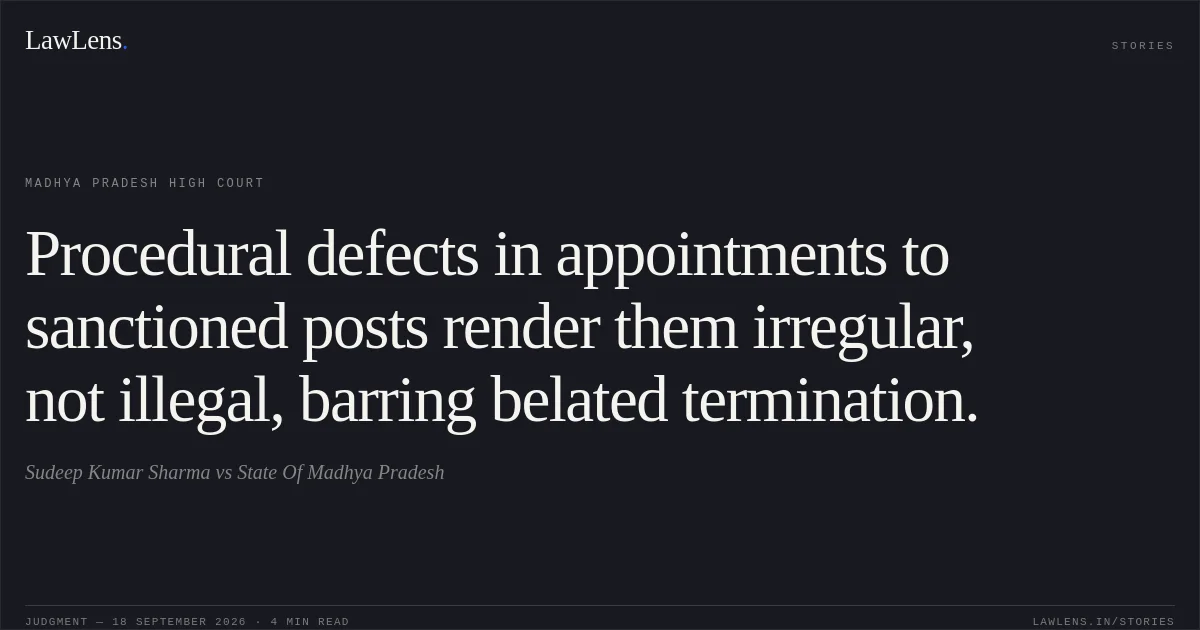
The Court held that the petitioner’s appointment was irregular, not illegal, and that termination after prolonged service on the basis of a procedural defect in the initial appointment was arbitrary, harsh, and unsustainable.
The writ petition was allowed, and the termination order dated 24.07.2007 was quashed.
Source reference: para. 43The respondents were directed to extend to the petitioner all consequential benefits granted to similarly situated persons promoted as Inspectors of Weights & Measures pursuant to the order dated 27.12.2003, within three months from receipt of the certified copy of the judgment.
Source reference: para. 43Pending applications were disposed of.
Source reference: para. 44Original Court PDF
Sudeep Kumar SharmavsState Of Madhya Pradesh
Click to open original judgment
Original judgment, available to read, download and summarize on LawLens.in