Facts
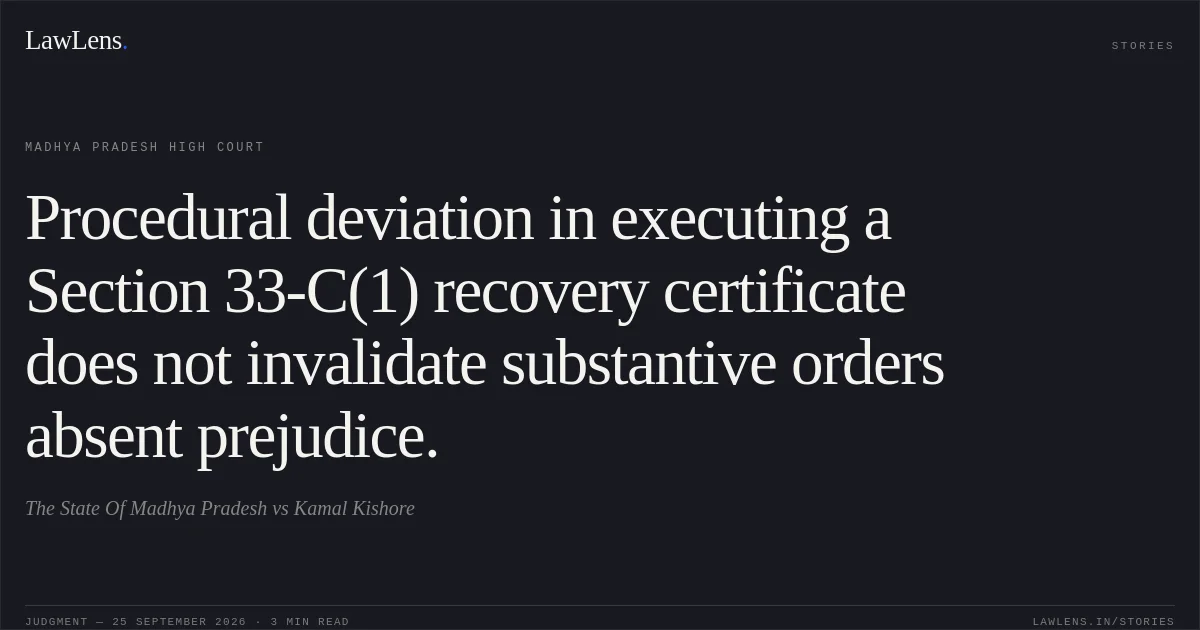
The State preferred a writ appeal under Section 2(1) of the Madhya Pradesh Uchcha Nyayalaya (Khand Nyay Peeth Ko Appeal) Adhiniyam, 2005, challenging the order dated 15.05.2025 by which the learned Writ Court declined to interfere with proceedings arising from orders of the Labour Court under Section 33-C(2) of the Industrial Disputes Act, 1947.
Source reference: pp. 1–2The State also sought quashing of orders dated 04.04.2019, 29.07.2022, 04.09.2024 and 11.04.2025.
Source reference: pp. 1–2The respondent had claimed monetary benefits amounting to ₹4,64,750 on the basis of an alleged classification under Order No. 656 dated 23.02.2005.
Source reference: pp. 1–2The State contended that the respondent’s name did not appear in the original classification list and that the subsequent service-book entry, and consequently the entitlement itself, was disputed.
Source reference: pp. 1–2It was further contended that the Labour Court improperly requested the District Judge, Mehgaon, to execute the recovery certificate instead of forwarding it to the Collector as contemplated by Section 33-C(1).
Source reference: pp. 1–2The respondent maintained that his entitlement had already been recognized or acted upon and relied on Director General (Works), C.P.W.D. v. Ashok Kumar, (1999) 9 SCC 167.
Source reference: p. 2Issues
1. Whether the Labour Court exceeded its jurisdiction under Section 33-C(2) of the Industrial Disputes Act by adjudicating a disputed question concerning the respondent’s underlying entitlement to monetary benefits?
Source reference: pp. 1–32. Whether the Labour Court’s direction to the District Judge, Mehgaon, to execute the recovery certificate, instead of adopting the Collector-based recovery mechanism under Section 33-C(1), invalidated the substantive orders in favour of the respondent?
Source reference: pp. 2–43. Whether the learned Writ Court’s order dated 15.05.2025, and the consequential orders challenged in the appeal, warranted interference?
Source reference: p. 4Law Applied
Section 33-C(2) of the Industrial Disputes Act permits the Labour Court to compute money or benefits due to a workman where the underlying entitlement has already been recognized or determined; it is not ordinarily a provision for adjudicating an entirely new or disputed entitlement.
Source reference: pp. 2–3Section 33-C(1) contemplates issuance of a certificate by the appropriate Government to the Collector, who may recover the amount as arrears of land revenue.
Source reference: pp. 2–3The Court relied on Director General (Works), C.P.W.D. v. Ashok Kumar, (1999) 9 SCC 167, for the distinction between proceedings involving adjudication of the right itself and proceedings limited to computation of an already recognized right.
Source reference: pp. 2–3It further applied the principle that a procedural irregularity in the mode of recovery does not necessarily invalidate substantive orders unless it goes to jurisdiction or causes demonstrable prejudice.
Source reference: pp. 3–4Reasoning
The Court held that the State’s assertion that the respondent’s name was absent from the 23.02.2005 classification order raised a disputed factual controversy concerning the original classification record and the circumstances in which the service-book entry was made.
Source reference: p. 3In the absence of unimpeachable material demonstrating fraud or patent illegality, that factual dispute was insufficient to justify interference in writ appeal.
Source reference: p. 3The Court also accepted that Section 33-C(1) contemplated recovery through the Collector and that the Labour Court’s direction involving the District Judge was not strictly consistent with the statutory mechanism.
Source reference: pp. 3–4However, the defect concerned only the mode of recovery and did not demonstrate that the substantive orders recognising the respondent’s monetary claim were without jurisdiction or legally non-existent.
Source reference: pp. 3–4Since the appellants failed to establish prejudice or failure of justice, the procedural deviation did not warrant setting aside the orders.
Source reference: pp. 3–4Holding
The Court answered the issues against the State.
It held that the disputed factual challenge to the respondent’s classification and service-book entry did not justify interference with the Labour Court’s proceedings, and that the incorrect mode of executing the recovery certificate did not invalidate the substantive orders in the absence of demonstrated prejudice.
Source reference: p. 4The writ appeal was accordingly dismissed, and the order dated 15.05.2025 in Writ Petition No. 15631/2025, along with the orders dated 04.04.2019, 29.07.2022, 04.09.2024 and 11.04.2025, was left undisturbed.
Source reference: p. 4Acts & Sections Cited
4 provisions across 2 statutes referred to in this judgment. Linked provisions open on LawLens.
M.P. Uchcha Nyayalaya (Khand Nyayapeeth Ko Appeal) Adhiniyam, 20051
Industrial Disputes Act, 19473
Original Court PDF
The State Of Madhya PradeshvsKamal Kishore
Click to open original judgment
Original judgment, available to read, download and summarize on LawLens.in