Facts
The Respondent, a conductor with the Petitioner (DTC) since 1985, was apprehended by checking staff on 16.10.2003 for possessing counterfeit/duplicate ticket blocks of ₹5 and ₹10 denominations
Source reference: para. 2–4Following an FIR and departmental inquiry, he was removed from service on 12.12.2006
Source reference: para. 5–9By an interlocutory order dated 28.10.2009, the Labour Court held the domestic inquiry was vitiated because no Labour Welfare Officer (LWO) or Presenting Officer (PO) was appointed
Source reference: para. 11, 19Subsequently, after hearing evidence on merits, the Labour Court passed an Award on 02.12.2010, holding that the management failed to prove misconduct as it relied on a solitary witness and failed to produce original documents (which were in police custody)
Source reference: para. 12, 41The Petitioner challenged both the interlocutory order and the final Award under Articles 226 and 227 of the Constitution
Source reference: para. 13Issues
1. Whether the Labour Court was justified in holding the domestic enquiry vitiated due to the absence of a Labour Welfare Officer and a Presenting Officer?
Source reference: para. 16(I)2. Whether the Labour Court erred in concluding that the management failed to prove misconduct on merits after leading evidence before the Court?
Source reference: para. 16(II)3. Whether the findings of the Labour Court warrant interference under the supervisory jurisdiction of the High Court?
Source reference: para. 16(III)Law Applied
The Court applied the principle that departmental circulars regarding the presence of a Labour Welfare Officer are directory "rules of prudence" and not mandatory statutory requirements (Ramesh Chand v. DTC)
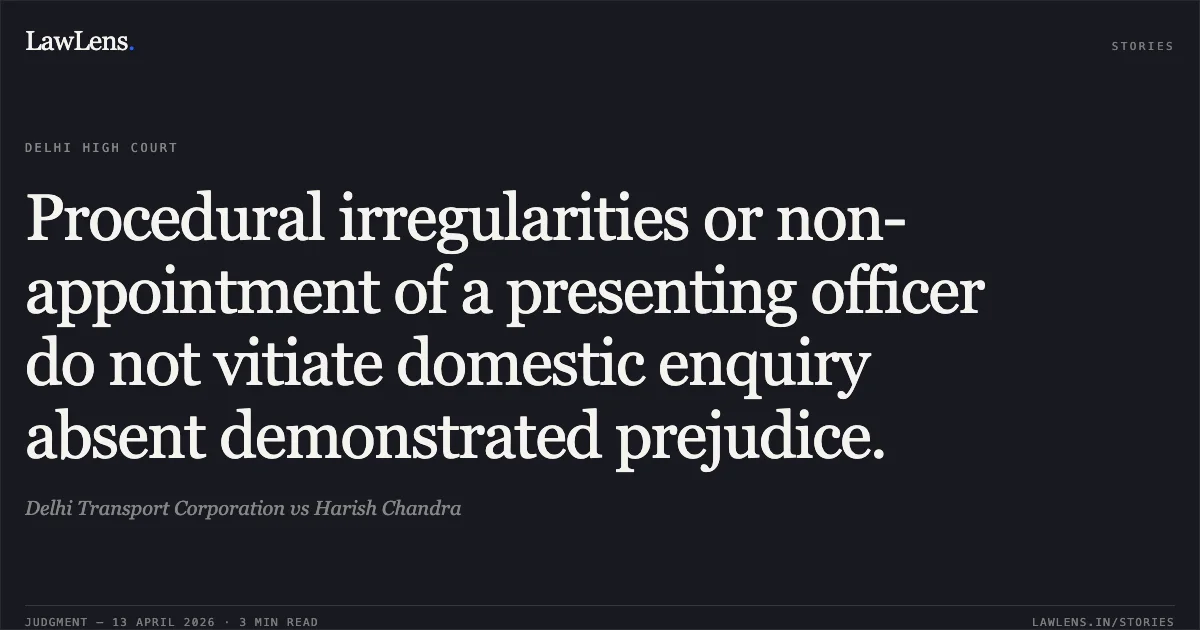
Source reference: para. 26The Court relied on the doctrine that the absence of a Presenting Officer does not vitiate an inquiry unless prejudice is demonstrated (Union of India v. Ram Lakhan Sharma; DTC v. Hanumant Kumar)
Source reference: para. 29–30Regarding evidence, the Court applied the "preponderance of probabilities" standard, noting that the strict Indian Evidence Act, 1872, does not apply to industrial adjudication (Bhavnagar Municipal Corp. v. JadejaGovubhaChhanubha; KSRTC v. Lakshmidevamma)
Source reference: para. 45–49The Court further applied the rule that a solitary witness's credible testimony is sufficient proof (Banaras Electric Light & Power Co. Ltd. v. Labour Court II)
Source reference: para. 52The Court further applied the "loss of confidence" doctrine in cases of financial irregularities (Janatha Bazar v. Secretary, SahakariNoukurara Sangha)
Source reference: para. 65Reasoning
The High Court found the Labour Court’s decision to vitiate the inquiry legally unsustainable, as procedural irregularities only invalidate an inquiry if they cause "real prejudice," which the Respondent failed to show
Source reference: para. 23, 32The Respondent had participated in the inquiry and cross-examined witnesses, signifying substantial compliance with natural justice
Source reference: para. 27Regarding the merits, the Court held the Labour Court adopted an "unduly technical approach" by rejecting the management's case for non-production of original documents, despite the management explaining they were in police custody—an explanation not disputed by the Respondent
Source reference: para. 44, 50The Court observed that in industrial disputes, "some evidence" with a reasonable nexus to the charge is sufficient
Source reference: para. 54The testimony of the checking staff (MW-1) was consistent and unshaken, and the Labour Court’s doubt regarding the presence of a second conductor was dismissed as mere conjecture
Source reference: para. 53, 60Consequently, the High Court determined the misconduct was proved on a preponderance of probabilities
Source reference: para. 63Holding
The Court allowed the writ petition and set aside the Labour Court’s order dated 28.10.2009 and the Award dated 02.12.2010
The Court held that the domestic inquiry was valid and the misconduct was established on merits
Source reference: para. 71–72Given the financial nature of the misconduct (forged tickets), the Court ruled that the "loss of confidence" made reinstatement unwarranted
Source reference: para. 66, 74The Court directed that any payments made to the Respondent under Section 17-B of the Industrial Disputes Act, 1947, are non-recoverable and shall be treated as final, but the Respondent is entitled to no further service or retiral benefits
Source reference: para. 75Acts & Sections Cited
3 provisions across 1 statute referred to in this judgment. Each provision opens on LawLens.
Indian Penal Code, 18603
Original Court PDF
Delhi Transport CorporationvsHarish Chandra
Click to open original judgment
Original judgment, available to read, download and summarize on LawLens.in