Facts
The applicant, a candidate for the post of Excise Inspector in the Combined Graduate Level Examination (CGLE) 2011, challenged the respondents' decision to treat him as a General (UR) category candidate instead of OBC.
Source reference: para 2The applicant belongs to the "Yadav" community and submitted an OBC certificate dated 08.11.2006 alongside a Non-Creamy Layer (NCL) certificate dated 08.04.2011.
Source reference: para 2The respondents rejected his OBC status because the 2006 certificate was older than three years from the closing date (15.04.2011) and allegedly not in the prescribed format.
Source reference: para 3.1, 5.2Consequently, the applicant was allocated the Kerala Cadre under the UR category instead of his preferred Gujarat Cadre, which was granted to lower-ranked OBC candidates.
Source reference: para 2.2, 3.2Issues
1. Whether the rejection of the applicant’s OBC status on the technical ground of the certificate's age (being older than three years) was legally sustainable.
Source reference: para 5.132. Whether the respondents could retrospectively apply a revised certificate format (prescribed in 2014) to a 2011 recruitment process.
Source reference: para 5.113. Whether the applicant is entitled to cadre reallocation and consequential benefits under the OBC category.
Source reference: para 6.3Law Applied
DoPT Office Memorandum No. 36012/22/93-Estt. (SCT) dated 08.09.1993, which established the initial framework for OBC certification and the exclusion of the "creamy layer".
Source reference: para 5.3, 5.4Tej Pal Singh v. GNCTD and Sunita v. GNCTD, which hold that eligibility cannot be denied on technical grounds when caste status is undisputed.
Source reference: para 2.1The doctrine from The General Manager, Southern Railway v. Rangachari, emphasizing that a technical or pedantic approach should be avoided in construing fundamental rights related to employment.
Source reference: para 5.12Kumari Madhuri Patil v. Addl. Commissioner regarding the verification of caste certificates.
Source reference: para 5.6Dilbagh Rai Jarry v. Union of India regarding the State's duty to be a "virtuous litigant" rather than pursuing hyper-technical pleas.
Source reference: para 5.14Reasoning
The Tribunal found that the applicant had obtained his Non-Creamy Layer certificate on 08.04.2011, well within the cut-off date of 15.04.2011.
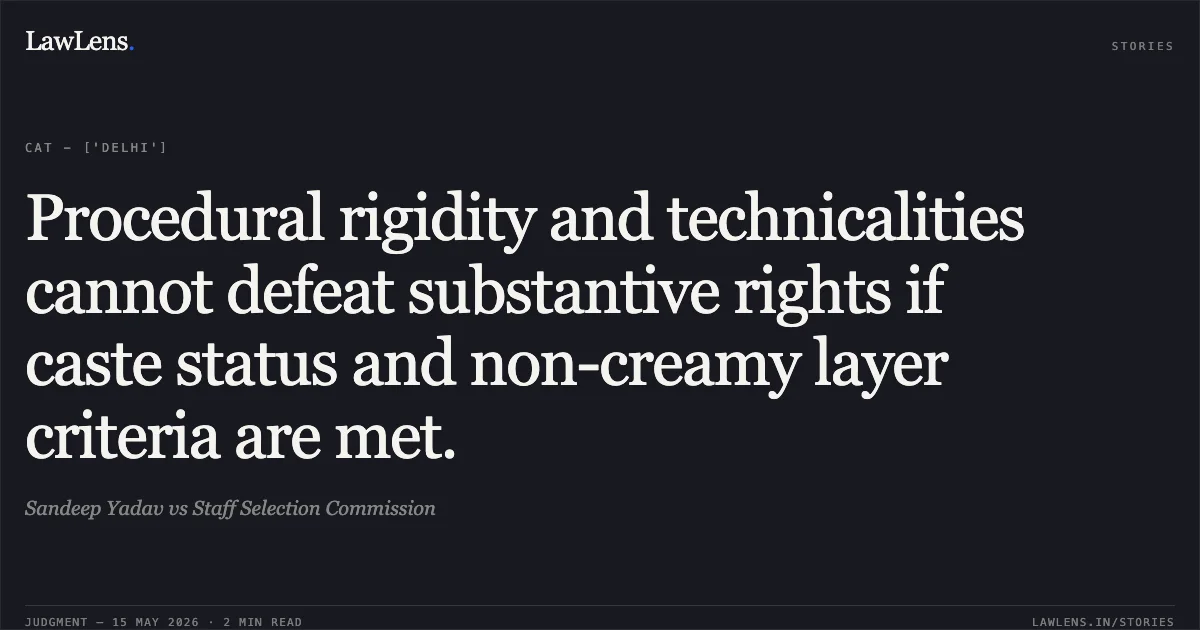
Source reference: para 5.13It reasoned that an OBC certificate typically remains valid unless the candidate's status changes, and the requirement for a certificate to be issued within a strict three-year window was "hyper-technical" and defeated the mandate of the 1993 DoPT OM.
Source reference: para 5.13Regarding the "prescribed format" objection, the Tribunal noted that the revised format was only introduced via OM dated 30.05.2014, and thus could not be applied retroactively to a 2011 selection.
Source reference: para 5.10, 5.11The court emphasized that the primary concern should be the veracity of the certificate, which the State failed to disprove.
Source reference: para 5.13Citing Sehdev v. GNCTD, the Tribunal held that procedural rigidity must not defeat substantive justice, especially when administrative inadequacies contribute to the dispute.
Source reference: para 5.15Holding
The Tribunal allowed the O.A., quashing the respondents' action of treating the applicant as a UR candidate.
It held that the two certificates (2006 and 2011) must be read harmoniously to establish OBC eligibility.
Source reference: para 5.13The respondents were directed to verify the certificates within two months and, upon successful verification, issue an offer of appointment/allocation for the Gujarat Cadre as originally sought. The applicant is entitled to all consequential benefits from the date his immediate junior was appointed, granted on a notional basis.
Source reference: para 6.2, 6.3Acts & Sections Cited
1 provisions across 1 statute referred to in this judgment. Each provision opens on LawLens.
Representation of the People Act, 19501
Original Court PDF
Sandeep YadavvsStaff Selection Commission
Click to open original judgment
Original judgment, available to read, download and summarize on LawLens.in


![Subsequent exoneration does not retrospectively invalidate a finalized promotion select list.. UNNIKRISHNAN M vs M/o Environment And Forests. CAT - ['Ernakulam']. LawLens](/stories/thumbnails/subsequent-exoneration-does-not-retrospectively-invalidate-a-finalized-promotion-select-li-ce80a0e84f2f4887857271e8b4341c42.webp)