Facts
The petitioner/decree-holder obtained an ex parte decree dated 30 January 2024 in a commercial suit against Respondent No. 2 for possession of a godown, mesne profits at ₹50,000 per month from 10 July 2021, and costs.
Source reference: p.2During execution, Respondent No. 1 filed objections under Order XXI Rules 97 and 101 of the Code of Civil Procedure, 1908 (“CPC”), claiming independent ownership and possession of the suit property.
Source reference: pp.2–3The petitioner’s challenge to the framing of issues was withdrawn before the Division Bench, which directed the Executing Court to decide the objections within three months and permitted the petitioner to raise the issue of maintainability.
Source reference: p.4By order dated 5 August 2026, the Executing Court rejected the petitioner’s application to introduce the documents, rejected the petitioner’s own evidence affidavit, and accepted the affidavit of one other witness.
Source reference: p.5By order dated 17 August 2026, it took the affidavit of another witness, Mukesh Kumar, off the record and closed the petitioner’s right to file evidence of its remaining witnesses.
Source reference: p.6Issues
1. Whether the Executing Court erred in rejecting the petitioner’s application under Order VIII Rule 1A(3) read with Section 151 CPC to place title and other supporting documents on record at a belated stage?
Source reference: p.9 / paras 25–272. Whether the Executing Court was justified in rejecting or redacting the petitioner’s evidence affidavit under Order XIX Rules 4 and 5 CPC when the affidavit elaborated upon the petitioner’s pleaded case of ownership?
Source reference: pp.9–10 / paras 28–303. Whether the Executing Court erred in taking the evidence affidavit of Mukesh Kumar off the record and closing the petitioner’s right to lead further evidence?
Source reference: p.9 / paras 25, 31–32Law Applied
The Court applied Order VIII Rule 1A(3) CPC, which permits a party to produce documents not filed with its pleadings where sufficient cause is shown, and Section 151 CPC concerning the court’s inherent powers to secure the ends of justice.
Source reference: no citationIt relied on Sugandhi v. P. Rajkumar, (2020) 10 SCC 706, for the principle that procedural and technical rules should not obstruct substantial justice, particularly where permitting documents causes no serious prejudice to the opposite party.
Source reference: p.11It distinguished the restrictive principle in Sudhir Kumar @ S. Baliyan v. Vinay Kumar G.B., (2021) 13 SCC 71, concerning belated production of documents already within a party’s possession, by considering the documents here foundational to the petitioner’s pleaded ownership.
Source reference: pp.7–8The Court further relied on Brij Prakash Gupta v. Ashwini Kumar, 2020 SCC OnLine Del 1759, holding that an evidence affidavit may factually expand or support the pleadings but cannot contradict them or introduce an entirely new case.
Source reference: pp.9–10Order VI Rule 2 CPC was also applied for the proposition that pleadings are required to contain material facts, not the evidence by which those facts are to be proved.
Source reference: p.10Reasoning
The Court held that both parties claimed ownership of the suit property and that effective adjudication therefore required consideration of the title documents relied upon by both sides.
Source reference: p.9, para 26Since Respondent No. 1 had been permitted to place fards/khatonis on record on the ground of inadvertence, applying a stricter procedural standard against the petitioner would cause serious prejudice and create an imbalance in the adjudication.
Source reference: p.9, para 26The petitioner had pleaded ownership in the suit and in its reply to the objections; therefore, the title documents and related materials were evidence supporting an existing plea, rather than a new case.
Source reference: pp.9–10, paras 27–30Similarly, the petitioner’s evidence affidavit merely elaborated upon the pleaded assertion of ownership and did not introduce a new controversy or take Respondent No. 1 by surprise.
Source reference: p.10, para 28The Court further found that taking Mukesh Kumar’s affidavit off the record and closing the petitioner’s remaining evidence effectively deprived the petitioner of an opportunity to substantiate its case against the objections.
Source reference: p.11, paras 31–32Applying the principle that procedure is the handmaid of justice, the Court held that the procedural defaults could be addressed through costs rather than by shutting out relevant evidence.
Source reference: p.11, paras 31–32Holding
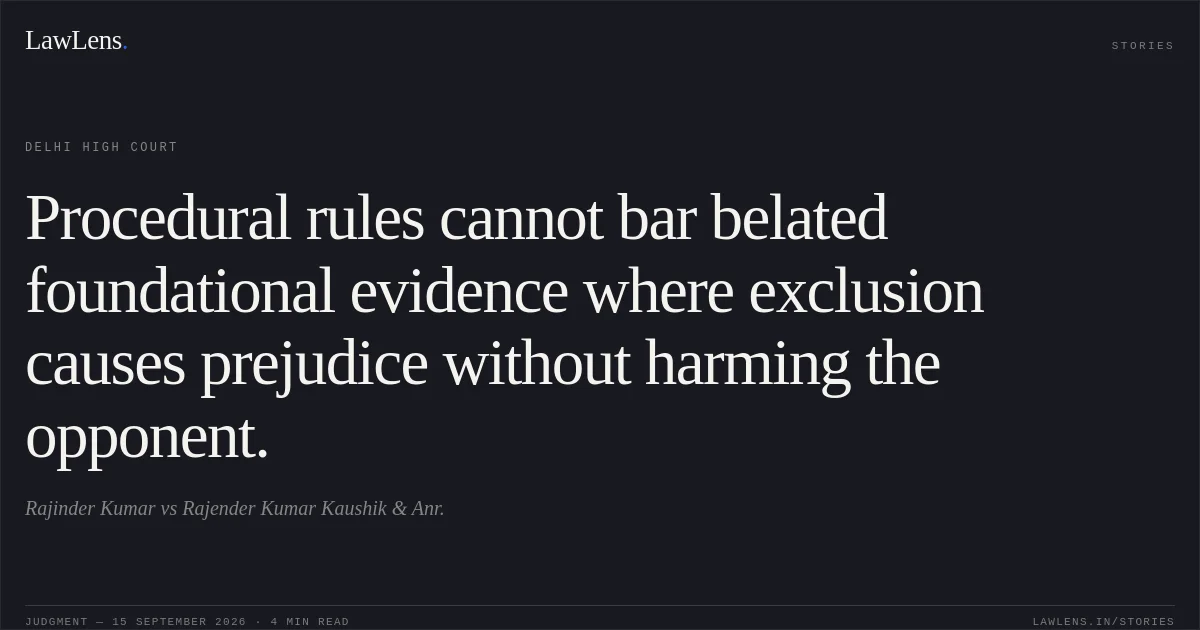
The High Court allowed the petition and set aside the impugned orders dated 5 August 2026 and 17 August 2026.
The petitioner’s application under Order VIII Rule 1A(3) read with Section 151 CPC was allowed; its evidence affidavit was restored, and the affidavits of its remaining witnesses, including Mukesh Kumar, along with the supporting documents, were taken on record.
Source reference: p.12, para 35The relief was made subject to payment of ₹25,000 as costs to the Delhi High Court Bar Association within one week.
Source reference: p.12, para 34The Executing Court was directed to proceed with the execution proceedings expeditiously in accordance with the earlier directions of the Division Bench.
Source reference: p.12, para 36Acts & Sections Cited
1 provisions across 1 statute referred to in this judgment. Each provision opens on LawLens.
Code of Civil Procedure, 19081
Original Court PDF
Rajinder KumarvsRajender Kumar Kaushik & Anr.
Click to open original judgment
Original judgment, available to read, download and summarize on LawLens.in


