Facts
The Respondent (wife) filed a divorce petition under Section 13(1)(ia) of the Hindu Marriage Act, 1955
Source reference: p. 2Summons were served on the Appellant (husband) on 12.09.2025, and he appeared through counsel on 17.10.2025
Source reference: p. 2Due to the transfer of the presiding officer and subsequent vacancies, the matter was adjourned to 27.02.2026
Source reference: p. 2On that date, the Appellant attempted to file a written statement with a 166-day delay
Source reference: p. 2-3The Family Court passed an impugned order refusing to accept the written statement because it was beyond the period prescribed under Order VIII Rule 1 of the CPC and contained verification defects under Order VI Rule 15 of the CPC, subsequently striking off the Appellant's defense and awarding ad-interim maintenance
Source reference: p. 2-3The Appellant challenged only the portion of the order closing his right to file the written statement
Source reference: p. 2Issues
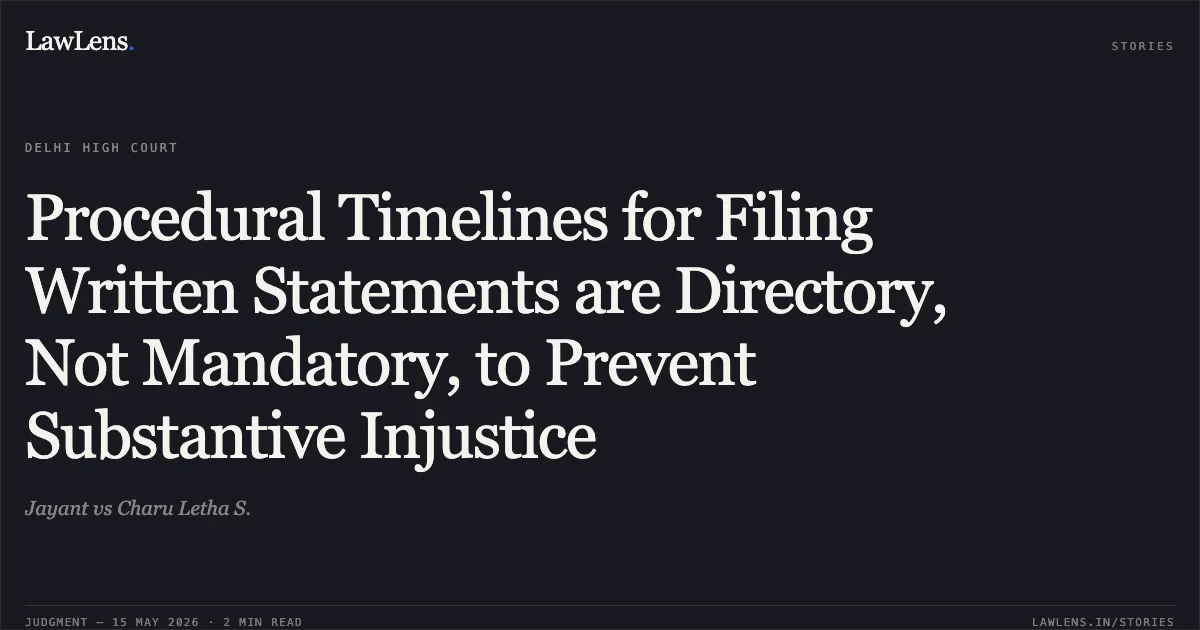
1. Whether the time limit for filing a written statement under Order VIII Rule 1 of the CPC is mandatory or directory in nature
Source reference: p. 4 / para. 13-142. Whether a defect in the verification of pleadings under Order VI Rule 15 of the CPC is a fatal error or a curable procedural irregularity
Source reference: p. 3 / para. 9Law Applied
The court applied Order VIII Rule 1 of the CPC regarding the timeline for filing written statements and Order VI Rule 15 regarding the verification of pleadings
Source reference: p. 2-3It relied on the Supreme Court precedent in Kailash v. Nanhku, which established that Order VIII Rule 1 is a part of procedural law and is directory, not mandatory, and that courts retain the power to extend time in exceptional circumstances to prevent grave injustice
Source reference: p. 4It further applied Uday Shankar Triyar v. Ram Kalewar Prasad Singh & Anr., which held that procedural requirements are the "handmaid of justice" and should not be used to defeat substantive rights if the defects are curable
Source reference: p. 3-4Reasoning
The High Court observed that the delay in filing the written statement was not mala fide but arose from bona fide efforts by the parties to reach an out-of-court settlement
Source reference: p. 3The Court reasoned that the Family Court erred in rejecting the pleading solely on procedural grounds, such as improper verification, as such defects are curable and should not scuttle a hearing on merits
Source reference: p. 3Applying the Kailash doctrine, the Court noted that while the 90-day limit should ordinarily be observed, the court possesses the discretion to depart from this rule in exceptional cases to ensure justice
Source reference: p. 4Here, the court found the explanation for the 166-day delay sufficient and emphasized that matrimonial disputes for dissolution of marriage ought to be decided on their merits rather than technicalities
Source reference: p. 5Holding
The Court allowed the appeal and set aside the portion of the Family Court's order that closed the Appellant’s right to file a written statement
The Court held that Order VIII Rule 1 is directory and the delay was properly explained
Source reference: p. 5The Appellant was granted two weeks to file the written statement, subject to the payment of costs amounting to Rs. 50,000/- to the Respondent
Source reference: p. 5The Family Court was directed to proceed with and decide the petition expeditiously
Source reference: p. 5Acts & Sections Cited
1 provisions across 1 statute referred to in this judgment. Each provision opens on LawLens.
Hindu Marriage Act, 19551
Original Court PDF
JayantvsCharu Letha S.
Click to open original judgment
Original judgment, available to read, download and summarize on LawLens.in