01Facts
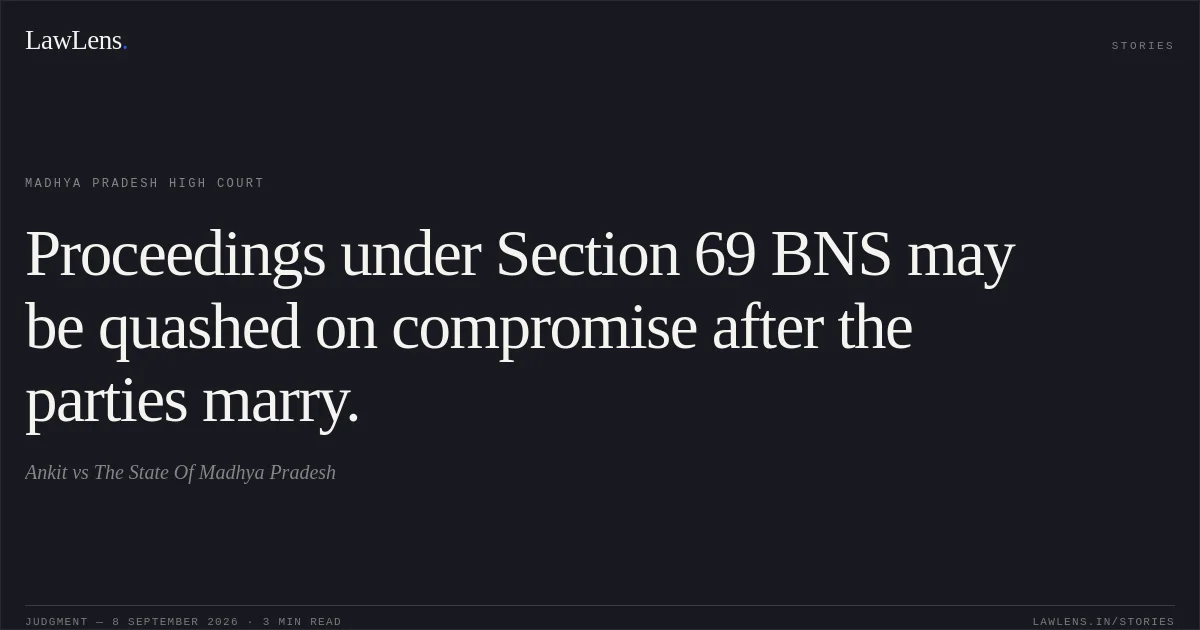
The prosecutrix/respondent no. 2 was residing in Indore and came into contact with the petitioner through Instagram. The petitioner proposed marriage and suggested that they live together to understand each other better. They thereafter resided together, and the petitioner allegedly established physical relations with the prosecutrix from November 2025 to March 2026. He allegedly left the shared residence on 30 March 2026 and blocked her contact.
¶ 2The prosecutrix subsequently lodged FIR Crime No. 767/2026 on 18 May 2026 at Police Station Lasudiya, Indore, for an offence under Section 69 of the Bharatiya Nyaya Sanhita, 2023 (“BNS”).
¶ 2The petitioner filed a petition under Section 528 of the Bharatiya Nagarik Suraksha Sanhita, 2023 (“BNSS”), seeking quashing of the FIR, charge-sheet, and consequential proceedings.
¶ 1During the proceedings, the parties reported that they had settled their dispute and had married each other. Their compromise was verified before the Principal Registrar on 1 July 2026 and was taken on record.
¶ 3, 502Issues
i.Whether the High Court could exercise its inherent jurisdiction under Section 528 of the BNSS to quash the FIR and subsequent criminal proceedings for an offence under Section 69 of the BNS on the basis of a compromise between the parties and their subsequent marriage?
¶ 1, 3, 5–7ii.Whether continuation of the criminal proceedings, in light of the verified settlement and marriage between the parties, would serve any useful purpose or would defeat the ends of justice?
¶ 6–703Law Applied
The Court applied Section 528 of the BNSS, which preserves the High Court’s inherent power to prevent abuse of the process of law and secure the ends of justice.
¶ 1It distinguished statutory compounding under Section 359 of the BNSS from quashing in exercise of inherent jurisdiction, relying principally on Gian Singh v. State of Punjab, (2012) 10 SCC 303.
¶ 6Under Gian Singh, quashing on the basis of settlement is distinct from compounding under Section 320 of the CrPC/Section 359 of the BNSS; the High Court may quash proceedings involving non-compoundable offences where the dispute is predominantly personal or matrimonial, the settlement is genuine, and continuation of the prosecution would be futile or would defeat the ends of justice.
¶ 6However, settlement ordinarily cannot justify quashing serious offences such as murder, rape, dacoity, or offences involving mental depravity, moral turpitude, or public servants acting in that capacity.
¶ 6Provisions in the judgment · 4 · Linked ones open on LawLens
Bharatiya Nagarik Suraksha Sanhita, 2023 Section 528Section 359
Bharatiya Nyaya Sanhita, 2023 Section 69
Code of Criminal Procedure, 1973 Section 320
04Reasoning
The Court accepted that the parties’ compromise had been verified before the Principal Registrar and that they had married each other.
¶ 5Applying the principle in Gian Singh, the Court treated the dispute as one arising from a personal relationship and concluded that, in view of the parties’ marriage and settlement, continuation of the prosecution would serve no useful purpose.
¶ 6The Court therefore considered that allowing the criminal proceedings to continue would not advance the interests of justice, whereas quashing them would secure the ends of justice.
¶ 6–705Holding
The Court answered the issues in favour of the petitioner.
¶ 7It allowed the petition and quashed FIR Crime No. 767/2026 dated 18 May 2026, registered at Police Station Lasudiya, Indore, for the offence under Section 69 of the BNS, along with all subsequent proceedings arising from that crime number and pending against the petitioner.
¶ 7The petition was accordingly disposed of on the terms of the compromise.
¶ 8Original Court PDF
AnkitvsThe State Of Madhya Pradesh
Click to open original judgment
Original judgment, available to read, download and summarize on LawLens.in