Facts
The Petitioner, a firm engaged in developing a Special Economic Zone, failed to file its return of income (ITR) for Assessment Year (AY) 2023-24 by the statutory deadline of 31.07.2023
Source reference: para 3.1Under incorrect professional advice from its accountant, the Petitioner believed its accounts required a mandatory audit under Section 44AB of the Income Tax Act, 1961 ("the Act")
Source reference: para 3.1Upon later realizing that an amended proviso to Section 44AB exempted it from such audit (due to the turnover limit being below Rs. 10 crores), the Petitioner filed its ITR on 26.10.2023, claiming a deduction of Rs. 52,92,631 under Section 80-IAB
Source reference: para 3.2, 4.2The return was processed under Section 143(1), disallowing the deduction due to the delay and raising a tax demand of Rs. 7,94,090
Source reference: para 3.2The Petitioner’s application for condonation of the 87-day delay under Section 119(2)(b) was rejected by the Respondent on 26.11.2025, on the grounds that the delay lacked reasonable justification and failed to demonstrate "genuine hardship"
Source reference: para 3.3, 6Issues
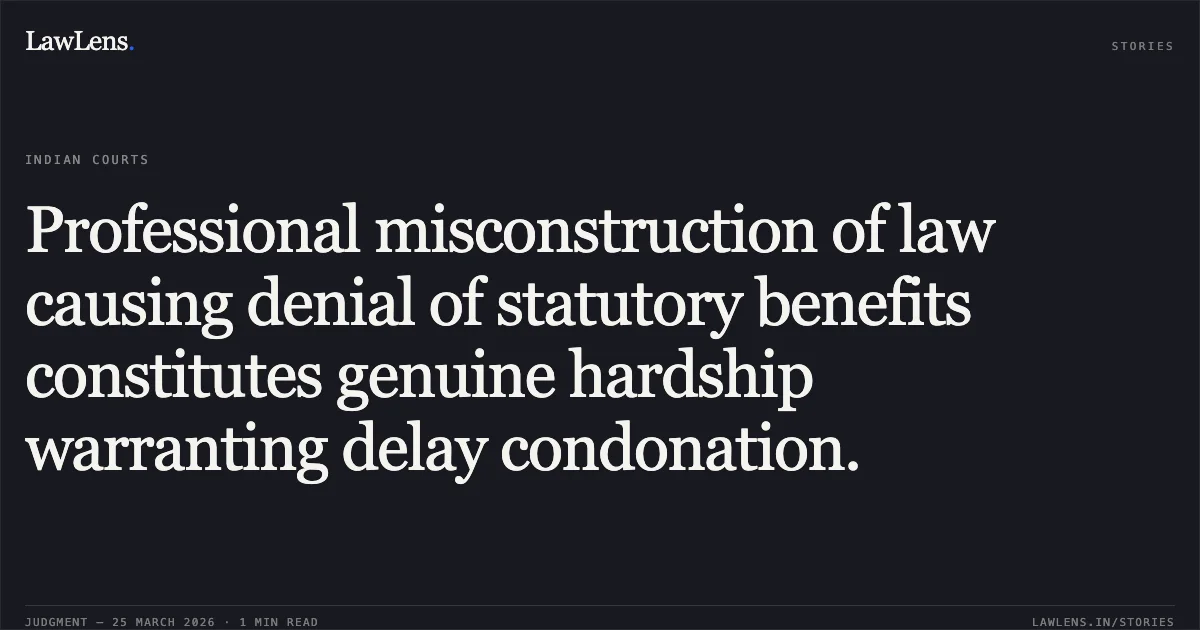
Whether the Respondent’s refusal to condone a delay caused by a professional misinterpretation of audit requirements constitutes an improper exercise of power under Section 119(2)(b)
Source reference: para 4.1, 6.1Whether the resulting denial of a substantial statutory deduction under Section 80-IAB qualifies as "genuine hardship" for the purpose of condoning delay
Source reference: para 6.1Law Applied
The court applied Section 119(2)(b) of the Act, which authorizes the CBDT (and delegated authorities) to admit belated applications or returns to avoid "genuine hardship" to the assessee
Source reference: para 6the term "genuine hardship" should be construed liberally to advance substantial justice
Source reference: para 4.1The court also considered Section 44AB regarding the thresholds for mandatory tax audits
Source reference: para 3.1, 4.2technical delays should not defeat meritorious claims in the absence of mala fide conduct [Jay Vijay Express Carriers v. Commissioner of Income Tax-III and Pala Marketing Co-operative Society Ltd. v. Union of India]
Source reference: para 4.1, 4.3Reasoning
The Court observed that the Respondent adopted an overly technical and narrow approach in defining "genuine hardship"
Source reference: para 6.1the Petitioner had no motive to gain from a belated filing and that the 87-day delay was a bona fide error resulting from the accountant's misconstruction of the amended audit limits under Section 44AB
Source reference: para 4.1, 6.1The Court found that the Respondent ignored the fact that rejecting the condonation would lead to the loss of a legitimate deduction of Rs. 52,92,631, which inherently constitutes a genuine hardship
Source reference: para 6.1the State should not benefit from "unjust enrichment" by denying statutory deductions due to procedural oversights or professional misinterpretation of complex provisions
Source reference: para 6.1a justice-oriented approach was required, as the Petitioner's claim was otherwise meritorious and the conduct was not negligent or mala fide
Source reference: para 4.1, 6.1Holding
the denial of a statutory claim due to a minor procedural delay caused by professional misadvice constitutes genuine hardship
The Court allowed the petition and quashed the Respondent’s order dated 26.11.2025
Source reference: para 7The High Court directed the Respondent to pass a de novo order condoning the delay in filing the return for AY 2023-24 and to complete the consequential exercise within twelve weeks
Source reference: para 7Rule was made absolute
Source reference: para 7Acts & Sections Cited
5 provisions across 1 statute referred to in this judgment. Linked provisions open on LawLens.
Income Tax Act, 19615
Original Court PDF
RAR PROPERTIESvsPRINCIPAL COMMISSIONER OF INCOME TAX
Click to open original judgment
Original judgment, available to read, download and summarize on LawLens.in