Facts
The Petitioner was appointed as a Data Entry Operator on a contractual basis on August 10, 2007, in the Office of the Block Education Officer, Marwahi.
Source reference: p. 1-2Having worked continuously for over 18 years, the Petitioner sought regularization of his services and submitted a representation to Respondent No. 1 on May 16, 2025, which remained pending.
Source reference: p. 2The State opposed the petition, contending that the Petitioner was not covered under the Circular dated March 5, 2008, regarding the regularization of daily wage or temporary employees.
Source reference: p. 2-3The Petitioner approached the High Court seeking a direction for the respondents to decide his representation and regularize his services with consequential benefits.
Source reference: p. 1-2Issues
1. Whether the State is justified in continuing the Petitioner’s services on a contractual basis for over a decade while denying consideration for regularization.
Source reference: p. 3-42. Whether the court should direct the respondent authorities to consider the Petitioner’s pending representation in light of recent Supreme Court mandates on "ad-hocism".
Source reference: p. 6Law Applied
The Court relied on the foundational principles of State of Karnataka v. Umadevi (3) regarding the regularization of employees who have completed ten years of service.
Source reference: p. 3It applied Narendra Kumar Tiwari v. State of Jharkhand, which addressed the claim of regularization for those completing a decade of service.
Source reference: p. 3It applied Jaggo v. Union of India, emphasizing that the government should lead by providing stable employment.
Source reference: p. 3The Court cited Bhola Nath v. State of Jharkhand, which held that the State cannot deny regularization by labels of "contractual engagement" for sanctioned posts held over a decade.
Source reference: p. 4Finally, it applied Dharam Singh v. State of UP, which deprecated "ad-hocism" and held that prolonged insecure employment offends the promise of equal protection under Articles 14, 16, and 21 of the Constitution of India.
Source reference: p. 4-5Reasoning
The Court observed that the Petitioner has been working continuously for more than 18 years as a daily wage/contractual employee.
Source reference: p. 3It rejected the State’s reliance on Premsagar Chouhan v. State of Chhattisgarh, noting that the facts therein involved the discontinuation of services, whereas the current Petitioner remains in service.
Source reference: p. 6Applying the principles from Dharam Singh, the Court reasoned that the long-term extraction of regular labor under temporary labels corrodes public confidence and constitutes a "conscious method of denial" of dignity.
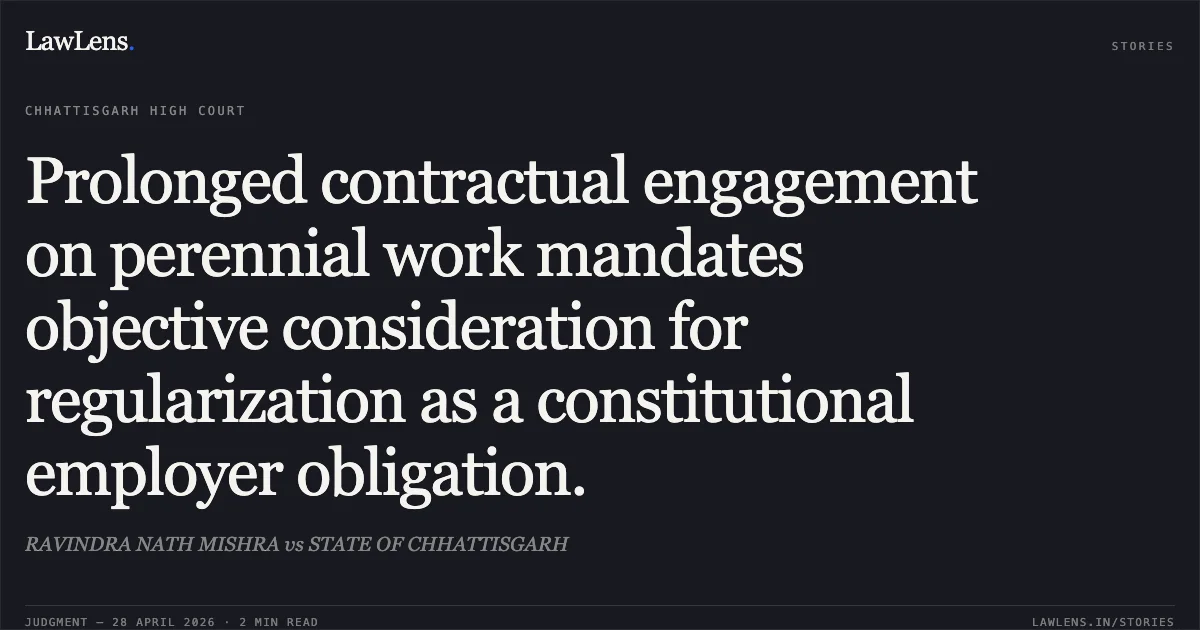
Source reference: p. 4-6The Court noted that the State, as a "constitutional employer," has a duty to organize perennial work on a sanctioned footing rather than balancing budgets on the backs of basic-function workers.
Source reference: p. 4-5Consequently, the Court found that the Petitioner’s length of service necessitated an objective and sympathetic reconsideration of his claim for regularization.
Source reference: p. 6Holding
The High Court disposed of the writ petition by permitting the Petitioner to submit a comprehensive fresh representation to the respondent authority.
The Court directed the concerned authority to consider and decide the Petitioner’s claim for regularization in an objective and sympathetic manner within a period of four months taking into account the legal standards established by the Supreme Court.
Source reference: p. 6-7Original Court PDF
RAVINDRA NATH MISHRAvsSTATE OF CHHATTISGARH
Click to open original judgment
Original judgment, available to read, download and summarize on LawLens.in


![Subsequent exoneration does not retrospectively invalidate a finalized promotion select list.. UNNIKRISHNAN M vs M/o Environment And Forests. CAT - ['Ernakulam']. LawLens](/stories/thumbnails/subsequent-exoneration-does-not-retrospectively-invalidate-a-finalized-promotion-select-li-ce80a0e84f2f4887857271e8b4341c42.webp)