01Facts
The applicant sought regular bail under Section 483 of the Bharatiya Nagarik Suraksha Sanhita, 2023 (“BNSS”) in a case arising from an attack in which Karan Parihar died.
pp. 3–4, 7The prosecution alleged that the applicant was among those who surrounded the principal assailants to prevent the deceased’s family from intervening; there was no allegation that the applicant stabbed the deceased.
pp. 3–4, 7The applicant had been in custody since 7 April 2023.
pp. 4–5, 7Charges had been framed, but only two of 83 prosecution witnesses had been examined.
pp. 4–5, 7The applicant claimed to have been a minor at the time of the offence, but the Trial Court had retained his recorded date of birth on the basis of verified school records.
pp. 5–6The State opposed bail, while noting that the applicant was seen standing at the scene and that a similarly placed co-accused had been granted bail.
p. 602Issues
i.1. Whether the applicant should be released on regular bail, having regard to his alleged role, period of custody, progress of trial, antecedents, and the circumstances of co-accused.
pp. 5–7ii.2. Whether the applicant’s asserted youth and claimed minority at the time of the offence weighed in favour of bail.
pp. 5–703Law Applied
Section 483 of the BNSS provides the basis for the High Court’s consideration of an application for regular bail.
p. 2The applicant faced charges under Sections 302, 308, 34, 147, 148, 149 and 201 of the Indian Penal Code, 1860; those provisions defined the offences charged but the judgment did not separately analyse their elements.
p. 2, 7The Court cited no precedent and did not set out a broader bail test; it assessed the application cumulatively by reference to the applicant’s alleged role, custody, trial progress, age, antecedents, and the bail granted to a similarly placed co-accused.
pp. 7–8Provisions in the judgment · 9 · Linked ones open on LawLens
Bharatiya Nagarik Suraksha Sanhita, 2023 Section 483
Indian Penal Code, 1860 Section 302Section 308Section 34Section 147Section 148Section 149Section 201
Code of Criminal Procedure, 1973 Section 160
04Reasoning
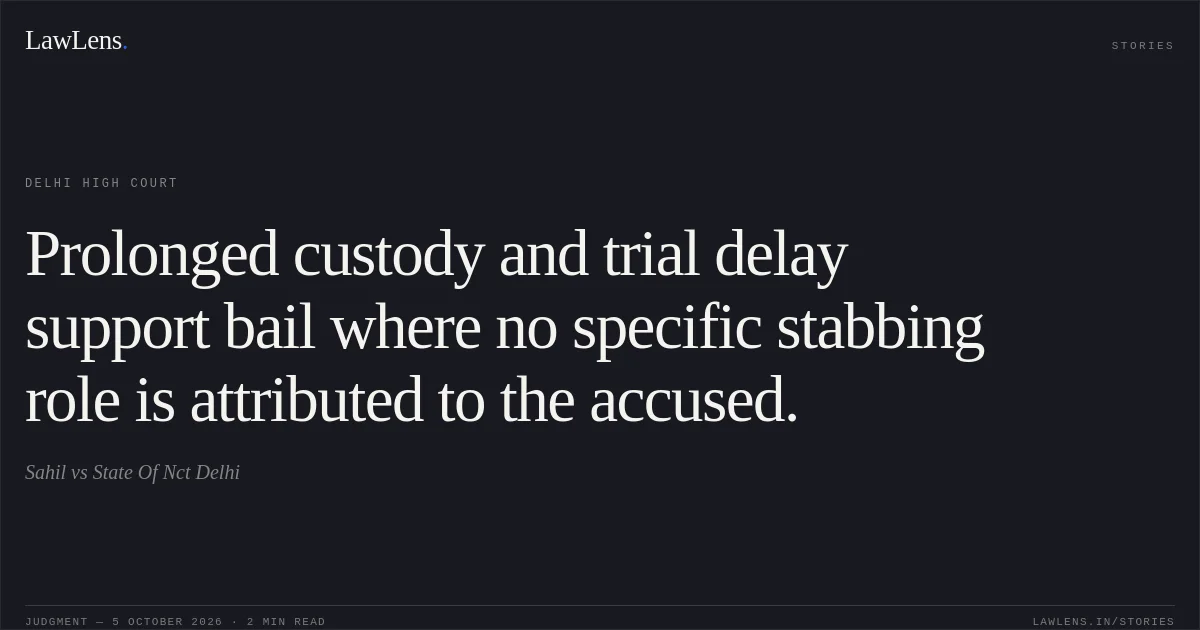
The Court found that the applicant had remained in custody for approximately three years and six months, while only two of 83 witnesses had been examined, making early completion of trial unlikely.
p. 5, 7It also noted that the applicant was not alleged to have stabbed the deceased and was instead shown at the scene with others around the principal accused.
p. 7The Court further considered the applicant’s young age, absence of criminal antecedents, and the grant of bail to a similarly placed co-accused.
p. 7Taking these circumstances together, it found a case for release on bail.
p. 705Holding
The High Court allowed the application and directed the applicant’s release on regular bail upon furnishing a personal bond of ₹50,000 with one surety for the like amount, subject to specified conditions, including attendance at each hearing, providing and updating his address and mobile number, reporting to the jurisdictional police station every Monday at 9:00 a.m., and refraining from threatening witnesses, tampering with evidence, or committing any offence.
pp. 7–8The Court clarified that its observations were confined to the bail application and would not affect the trial.
p. 8Original Court PDF
SahilvsState Of Nct Delhi
Click to open original judgment
Original judgment, available to read, download and summarize on LawLens.in