Facts
The petitioner’s father, a government schoolteacher, died in harness on 21 September 2014, leaving the petitioner and her mother as his legal heirs.
Source reference: para. 3–10The petitioner, who was married, applied for compassionate appointment on 5 September 2015.
Source reference: para. 3–10Her claim was rejected under the Karnataka Civil Services (Appointment on Compassionate Grounds) Rules, 1996, because she was a married daughter.
Source reference: para. 3–10After the Rules were amended in 2021 to include married daughters, the authorities again rejected her claim in 2022; the Karnataka State Administrative Tribunal dismissed her application, holding that the amendment did not apply to a 2014 death.
Source reference: para. 3–10The petitioner challenged the Tribunal’s order and the rejection before the High Court.
Source reference: para. 3–10The writ petition was filed on 22 July 2026.
Source reference: para. 3–10Issues
1. Whether the petitioner was entitled to compassionate appointment under the 2021 amendment to the 1996 Rules, despite her father’s death occurring in 2014.
Source reference: para. 6–9, 15–162. Whether the Tribunal’s dismissal should be set aside where the petitioner had not established continuing financial distress and more than a decade had elapsed since the employee’s death.
Source reference: para. 17–21Law Applied
Compassionate appointment is an exception to the ordinary requirements of Articles 14 and 16 of the Constitution, not a source of recruitment or a matter of right; it is intended to help a deceased employee’s family overcome the immediate financial crisis caused by the employee’s death, and entitlement depends on the governing scheme.
Source reference: para. 17The Court relied on Mumtaz Yunus Mulani v. State of Maharashtra, (2008) 11 SCC 384, for the principle that compassionate appointment is a benevolent measure directed at relieving sudden financial hardship.
Source reference: para. 18It also relied on the Karnataka High Court’s decision in Smt. Laxmi v. The Registrar General, High Court of Karnataka, W.A. No. 100548/2024, decided 13 March 2026, which emphasised the immediacy of financial need and the relevance of a family’s ability to maintain itself over time.
Source reference: para. 20The Karnataka Civil Services (Appointment on Compassionate Grounds) Rules, 1996, as amended in 2021, formed the relevant statutory scheme concerning eligibility of married daughters.
Source reference: para. 6, 16Reasoning
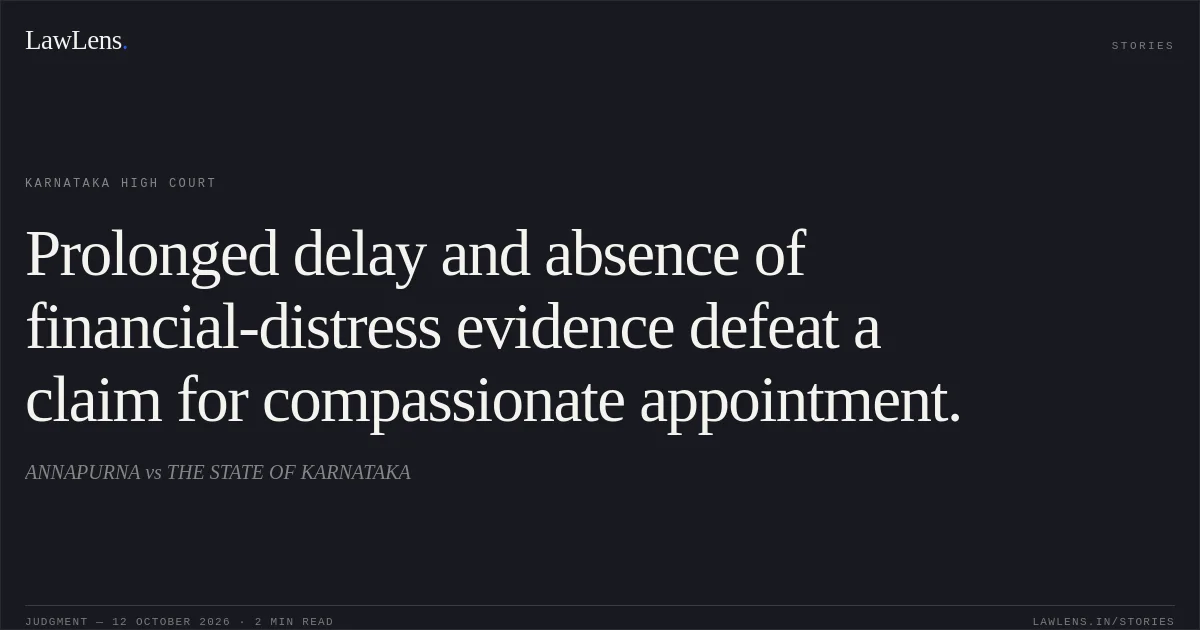
The Court noted that the petitioner’s claim had been rejected under the earlier Rules and that the 2021 amendment included married daughters, but it concluded that compassionate appointment remained dependent on proof of the scheme’s underlying purpose: immediate relief from financial crisis.
Source reference: para. 15–21The petitioner had produced no material showing that her family faced financial crisis or livelihood hardship after her father’s death.
Source reference: para. 15–21Further, more than a decade had elapsed, during which the family had survived.
Source reference: para. 15–21Applying Mumtaz Yunus Mulani and Smt. Laxmi, the Court held that the Tribunal was justified in dismissing the application.
Source reference: para. 15–21The Court did not separately determine whether the 2021 amendment applied retrospectively to the petitioner’s 2014 case.
Source reference: para. 15–21Holding
The High Court found no ground to interfere with the Tribunal’s order and dismissed the writ petition.
Pending interlocutory applications were disposed of as not surviving for consideration.
Source reference: para. 22–23Original Court PDF
ANNAPURNAvsTHE STATE OF KARNATAKA
Click to open original judgment
Original judgment, available to read, download and summarize on LawLens.in
![Competent authority must reconsider transfer-waiting-list priority through a reasoned order.. Prabhat Kumar Srivastwa vs NORTH CENTRAL RAILWAY. CAT - ['Allahabad']. LawLens](/stories/thumbnails/competent-authority-must-reconsider-transfer-waiting-list-priority-through-a-reasoned-orde-e23ccd4eaf154e82b09ea183b25e32fb.webp)
![Excess-pay recovery from retired Group C employees is impermissible absent fraud or misrepresentation.. SATYA NAND YADAV vs NORTH EASTERN RAILWAY. CAT - ['Allahabad']. LawLens](/stories/thumbnails/excess-pay-recovery-from-retired-group-c-employees-is-impermissible-absent-fraud-or-misrep-c357cbdd195c44d68331385eea2a3c9a.webp)