Facts
The plaintiff claimed that the first defendant agreed to sell him the suit property for ₹1,50,000 under an agreement dated 21 August 1995, received the full consideration, and delivered possession.
Source reference: p. 3–5, 11The first defendant accepted that the property had been sold to the plaintiff but maintained that the plaintiff had postponed execution of the formal sale deed. The second defendant claimed title under registered sale deeds dated 24 July 2002, executed through the first defendant’s power agent, and asserted possession
Source reference: p. 3–5, 11The plaintiff sought specific performance in O.S. No. 9 of 2006; the trial court dismissed the suit, and the first appellate court affirmed that dismissal. The plaintiff’s second appeal was also dismissed
Source reference: p. 2, 6–8, 13Issues
Whether the plaintiff proved readiness and willingness to perform the agreement so as to obtain specific performance, given the delay in seeking a sale deed and the subsequent sale to the second defendant
Source reference: p. 11–13Whether the concurrent findings of the courts below disclosed illegality or perversity, or otherwise raised a substantial question of law warranting interference under Section 100 of the Code of Civil Procedure
Source reference: p. 13Law Applied
The Court applied the principle that a plaintiff seeking specific performance must plead and prove readiness and willingness to perform the contract
Source reference: p. 13It also considered whether the plaintiff had sought performance within a reasonable time, notwithstanding the absence of a specified time for completion in the agreement
Source reference: p. 10, 12In the second appeal, the Court considered whether the concurrent findings of the courts below involved illegality or perversity and whether a substantial question of law arose under Section 100 CPC
Source reference: p. 13Reasoning
Although the first defendant accepted that the agreement had been executed, the plaintiff paid the entire consideration in 1995 yet did not seek a sale deed or bring suit until 2006.
Source reference: p. 11–13The property had meanwhile been conveyed to the second defendant in 2002, and the plaintiff took no steps after that conveyance.
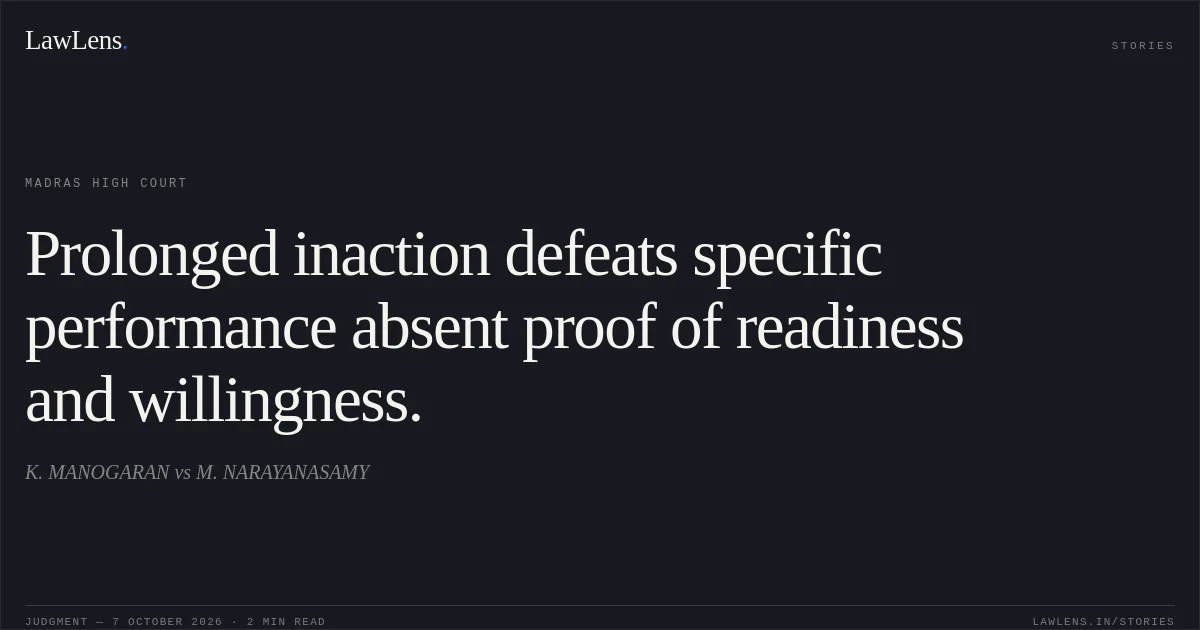
Source reference: p. 11–13The Court treated this prolonged inaction as evidence that the plaintiff had not established readiness and willingness and as raising doubt about the agreement’s genuineness.
Source reference: p. 11–13It found no illegality or perversity in the concurrent findings and held that no substantial question of law arose
Source reference: p. 11–13Holding
The Court held that the plaintiff had failed to prove readiness and willingness and was not entitled to specific performance.
Finding no substantial question of law or basis to disturb the concurrent decisions, it dismissed the second appeal and closed the connected miscellaneous petitions, with no order as to costs.
Source reference: p. 13Acts & Sections Cited
1 provisions across 1 statute referred to in this judgment. Each provision opens on LawLens.
Code of Civil Procedure, 19081
Original Court PDF
K. MANOGARANvsM. NARAYANASAMY
Click to open original judgment
Original judgment, available to read, download and summarize on LawLens.in